When DOGE struck in January 2025, USAID officers mobilized, providing peer support, challenging misinformation, and rescuing the agency’s knowledge infrastructure for the future.
BY SUSAN REICHLE
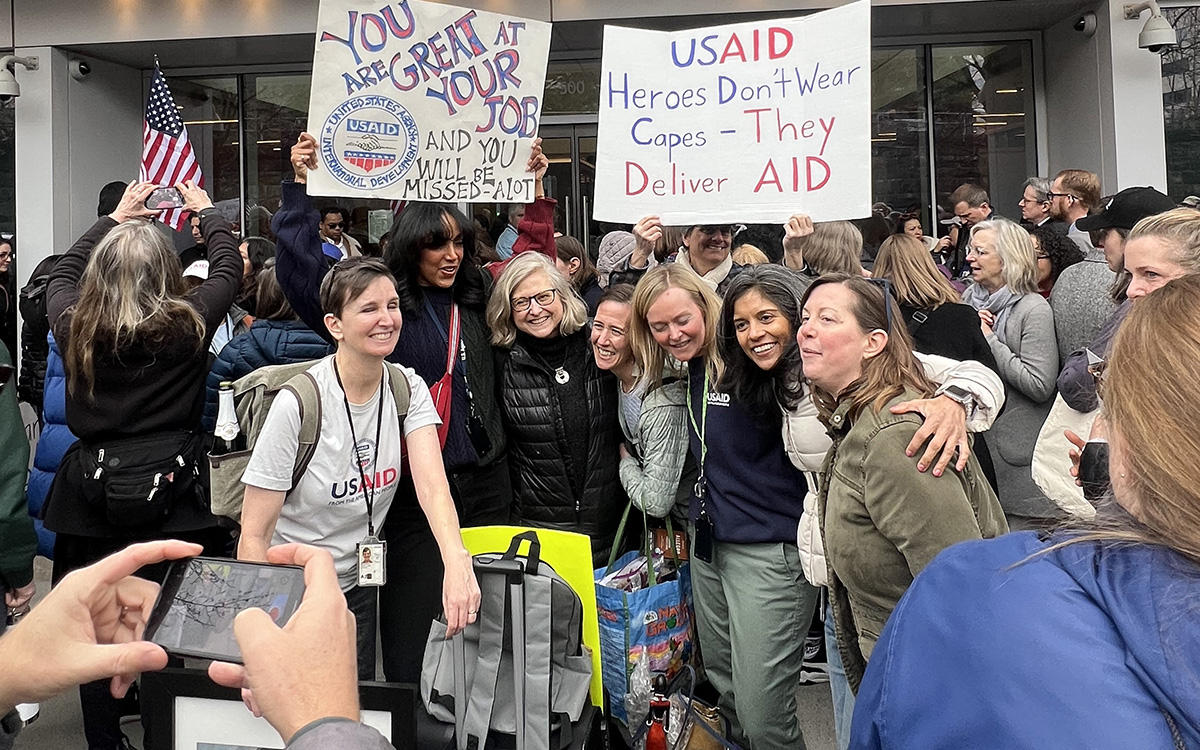
In February 2025, when terminated USAID professionals were given 15 minutes to pack up their offices and leave, former colleagues, members of the U.S. Foreign Service, advocates of foreign development and disaster assistance, and the foreign affairs community gathered outside the Ronald Reagan Building to honor their service.
AID Transition Alliance
When the Department of Government Efficiency (DOGE) attacked USAID, they perhaps thought the thousands of development and humanitarian professionals would wither away. But that’s not who we are. We were trained that when you see a disaster, you run toward it, not away. You help people in need, not just in the short term, but as they rebuild.
So when USAID missions went dark, our work did not. When the attacks on USAID began in January 2025 with dedicated public servants being locked out of their computers and stop-work orders halting all USAID assistance, the development community mobilized.
As a former USAID Foreign Service officer and acting assistant administrator of the bureau that oversaw USAID’s Office of Foreign Disaster Assistance (OFDA), I realized right away that we were trying to respond to a disaster without an “ops center,” like USAID once had and State still does, that serves as the nerve center critical to coordinating a response.
In the following days, four USAID Foreign Service officers—Ambassador Erin McKee, Alicia Dinerstein, Jeanne Briggs, and I—mobilized donations for Stand Up for AID and established the Aid Transition Alliance (AidTA). We named our small volunteer team “Point Four”—a nod to history for those who knew that President Harry Truman’s Point Four initiative was the precursor to USAID and that the Administrator’s conference room was named Point Four. USAID’s first innovation counselor, Maura O’Neill, was instrumental in helping mobilize funds from members of Forward Global for our work.
Requests from media poured in, and a team of former USAID communications experts gathered data, prepared us for interviews, and knocked down the relentless misinformation that tried to define USAID as a “criminal organization” full of “radical lunatics.”
A LinkedIn group of more than 2,000 former USAID staff members came together to rescue data, websites, and other public documents before they disappeared. Mental health professionals mobilized to provide pro bono webinars and counseling services to the thousands who had suddenly lost not only their jobs, but their calling. We organized rallies and joined with AFSA for “clap outs” to honor our colleagues who were given just 15 minutes to pack up their offices and carry a lifetime of memories into the streets.
A New Type of Service
During those early days in 2025, a new type of service was born: community service to support the USAID staff and partners who had dedicated their professional lives to improving and saving the lives of others.
As a USAID FSO who retired in 2017, I was free to jump in to help, but many of the emerging grassroots leaders who leapt into action to support colleagues had themselves just lost their jobs. Instead of retreating, they organized and created an array of “pop-up” groups to fight back and serve the development community across the globe. Many of these initiatives continue today, because just like in the disasters we responded to overseas, communities need support not just during the immediate crisis, but in rebuilding as well.
Ten Recommendations to Realign and Modernize U.S. Foreign Assistance
- Save Lives: Continue lifesaving aid in response to humanitarian disasters.
- Support U.S. Engagement Globally: Be deliberate about supporting U.S. companies and collaborating with other U.S. private capital flows.
- Invest in America’s Comparative Advantage: Use U.S. resources, leadership, values, innovation, and institutions to advance global prosperity, security, and stability.
- Protect Americans’ Health and Economy: Investing in other countries’ human, animal, and plant health systems and responding to outbreaks remain critical to national security.
- Invest in Champions: Investments in future generations of global leaders will establish enduring networks of influence and shared values.
- Insist on Commitment and Accountability with a Clear Endgame: As an investment in a partner’s future, assistance should be conditioned on shared commitment.
- Make Targeted, High-Impact Investments in Fewer Countries: Make more targeted, robust investments in fewer countries and issues.
- Establish Partnerships Reflecting U.S. Interests: Avoid self-imposed political and ideological constraints that prevent global cooperation and undermine U.S. security and prosperity.
- Focus on Desired Outcomes, Not Earmarks: Shift toward a results-driven framework that emphasizes long-term outcomes over rigid, input-based funding mandates.
- Eliminate Barriers to a Whole-of-Government Approach: Eliminate barriers to delivering assistance under a single American banner while utilizing the full weight, talent, and influence of the entire U.S. government.
—Former senior career USAID officials, excerpted from “An Open Letter on the Future of U.S. Foreign Assistance,” signed by 72 senior career development diplomats and humanitarians and released in November 2025.
We were fortunate to quickly secure the fiscal sponsorship of Forward Global, enabling us to raise funds to support AidTA’s efforts to provide counseling services, peer support, and data management. Donations by former USAID Administrators helped jump-start this initiative, along with funding from the Packard and Rockefeller foundations, which will end in 2026. Every three months our Point Four team assesses whether the alliance’s support is still needed, and each time we have found the need is still high. These results encourage us to continue our pro bono work as we raise funds for the broader AidTA efforts.
For example, more than 2,200 practitioners are connected and actively contributing to rescuing six decades of USAID’s data and information, vital operational knowledge that might otherwise be lost—including contributions from former staff, Foreign Service Nationals, implementing partners, researchers, and technical specialists from across the development world. So far, our USAID Knowledge Rescue initiative has recovered more than 270,000 digital files of nonclassified documents, and 100 structured interviews of recently departed USAID staff were completed and transcribed, surfacing insights and lessons for the future of foreign assistance. This work resulted in the July 1 launch of the Development Knowledge Commons, which provides public access to records taken down when USAID was dismantled.
USAID’s knowledge infrastructure wasn’t the only thing requiring immediate attention. Former USAID staff and partners needed urgent psychological support to weather the loss not only of their employment and livelihoods, but their life’s mission as international development professionals. On June 30, 2025, the last day for the majority of USAID staff, AidTA and USAID Administrators organized a global celebration of USAID service. The daylong USAID Appreciation Event, held at Georgetown University in Washington, D.C., featured messages from President Barack Obama and President George W. Bush, two panels of former Administrators, messages from several world leaders, a panel of practitioners on the impact of USAID assistance, and more. You can see the videos of this event here.
Tens of thousands of practitioners had been abruptly thrust into a job market where their primary employment options were decimated and, in many cases, had also lost the health insurance coverage that would ordinarily cover the costs of mental health support. AidTA established a partnership with the KonTerra Group, a former USAID Staff Care provider, which in the year since its founding had served more than 1,000 development professionals through weekly peer group counseling sessions, weekly webinars, and discussion groups on managing grief, anxiety, and transition, as well as individual counseling services.
In 2026 AidTA launched a new career wellness transition program following our partnership with Georgetown University’s Pivot with Purpose in 2025. With such a high number of people continuing to search for not just employment, but a meaningful career, the new initiative is a cohort-based program designed to support people in exactly this moment. Given the dearth of opportunities for former Foreign Service Nationals and national staff members of implementing partners impacted by USAID’s closure, AidTA also initiated a peer-to-peer support program. These groups meet weekly for six to eight weeks in a structured and facilitated process in the local language, helping build skills for career transition.
There Is a Future for Foreign Assistance
Stand Up for AID conducted original research intended to identify changing perceptions of foreign assistance. The research revealed that Americans don’t hate foreign aid; they hate the term “foreign aid.” There is significant support for specific interventions, especially in global health, when communicated effectively. Americans want to provide countries with medicine, food, and medical supplies. For example, a May 2025 Pew Research Center study found that 83 percent of all Americans (and 77 percent of Republicans) say the U.S. should provide medicine and medical supplies to developing countries.
And, while 58 percent of Americans initially say the United States spends “too much” on foreign aid, according to a February 2025 Kaiser Family Foundation survey, after learning aid accounts for just 1 percent of the federal budget, that number drops to 34 percent—a 24-point swing driven by information, not ideology.
More recently, a Rockefeller Foundation report, “An American Perspective on Foreign Aid,” published June 30, 2026, found that a year after USAID’s dismantlement, a majority (54 percent) across the political spectrum remain favorable toward U.S. foreign aid, and eight in 10 (including 83 percent of Republican and Republican-leaning respondents) say the path forward is to reform and strengthen foreign aid, not eliminate it.
This study also shows that “support grows significantly when Americans understand what these programs do, what they cost, and the results they achieve.” Humanitarian and disaster relief and preventing disease outbreaks receive the most support, at 90 percent of respondents; support for global health, economic development, and peacekeeping follows; and support for democracy promotion is lowest, at 72 percent. Significantly, seven in 10 support setting foreign aid at 2 percent of the annual budget, which would double its pre-2025 level, and that willingness extends across party lines.
The data are unambiguous: Broad, bipartisan support exists for foreign assistance. The challenge is translating that support into political will—and communicating it with the clarity the American public deserves.
Think tanks, leaders in philanthropy, and many other groups have put out papers with recommendations over the past year on the future of foreign assistance. I have been part of many of these discussions and am often struck by how little participation there is by the actual practitioners who worked overseas. As a result, I think it’s important to highlight one set of recommendations (see sidebar opposite) drafted by 72 former USAID mission directors and other senior development leaders one year ago, on September 2, 2025, just after losing their jobs.
Regardless of whether you agree or disagree with the recommendations, it is inspiring to think the authors had just lived through the worst professional experience of their lives and still found the energy and courage to come together to share their thoughts on what needs to come next. But then again, we were trained to respond to disasters, and that’s exactly what we will continue to do—because too many lives are at stake to just stay home and do nothing.
Susan Reichle is a retired USAID Foreign Service officer and former president and CEO of the International Youth Foundation, co-founder of the Aid Transition Alliance (AidTA), chair of the board of the Coalition of Racial and Ethnic Equity in Development (CREED), and member of the American Academy of Diplomacy, National Security Leaders for America, and the Modernizing Foreign Assistance Network.
When sharing or linking to FSJ articles online, which we welcome and encourage, please be sure to cite the magazine (The Foreign Service Journal) and the month and year of publication. Please check the permissions page for further details.
Read More...
- “USAID at 60: An Enduring Purpose, a Complex Legacy” by John Norris, The Foreign Service Journal, November 2021
- “USAID’s Policy Framework” by George Ingram and Susan Reichle, Brookings Institution, June 2023
- “Planting and Growing Seeds of Prosperity and Justice Worldwide” by Samantha Power, The Foreign Service Journal, May 2024
- “How USAID’s Dismissed Workers Built a Foreign Aid Fighting Force” by Elissa Miolene, Devex, June 2026