A survey conducted by a USAID alumna found the agency’s closure had a profound professional, financial, and emotional impact on its Foreign Service members.
BY JAIME MICHELLE OBERLANDER
With a stop work order issued on January 28, 2025, the Trump administration halted USAID overnight—effectively shuttering 64 years of U.S. investment in global health, economic development, and democratic governance in more than 100 countries. The closure of USAID had a profound professional, financial, and emotional impact on USAID Foreign Service members.
One year after reduction-in-force (RIF) letters went out, on March 27, 2026, I asked USAID Foreign Service officers (FSOs) to respond to a longitudinal survey to document the impact of USAID’s dismantling on aid sector employees and their families. I received responses from 574 former USAID FSOs. This survey is part of my graduate work at the University of Michigan School of Social Work.
In the American Psychological Association’s “The Toll of Job Loss,” Dr. Carl Van Horn describes prolonged unemployment as a “psychological trauma and a financial trauma, and the two are closely intertwined.” While true for USAID FSOs, this framing fails to capture the unique dimensions of Foreign Service life that made FSOs vulnerable to not only financial and psychological harm, but also extraordinary moral injury. These survey results show significant barriers to recovery for the majority of USAID FSOs and their families. The results also offer five important takeaways:
- Fewer than half of former USAID FSOs have secured full-time employment.
- Younger FSOs are significantly more likely to be employed than older colleagues.
- Dual-career families were hit especially hard, with 48 percent of FS households experiencing dual job loss.
- FSOs, spouses, and children have all struggled with stress-related health effects.
- USAID families feel a deep sense of moral injury and values violation.
Chart 1. Full-Time Employment Rate by Age Group
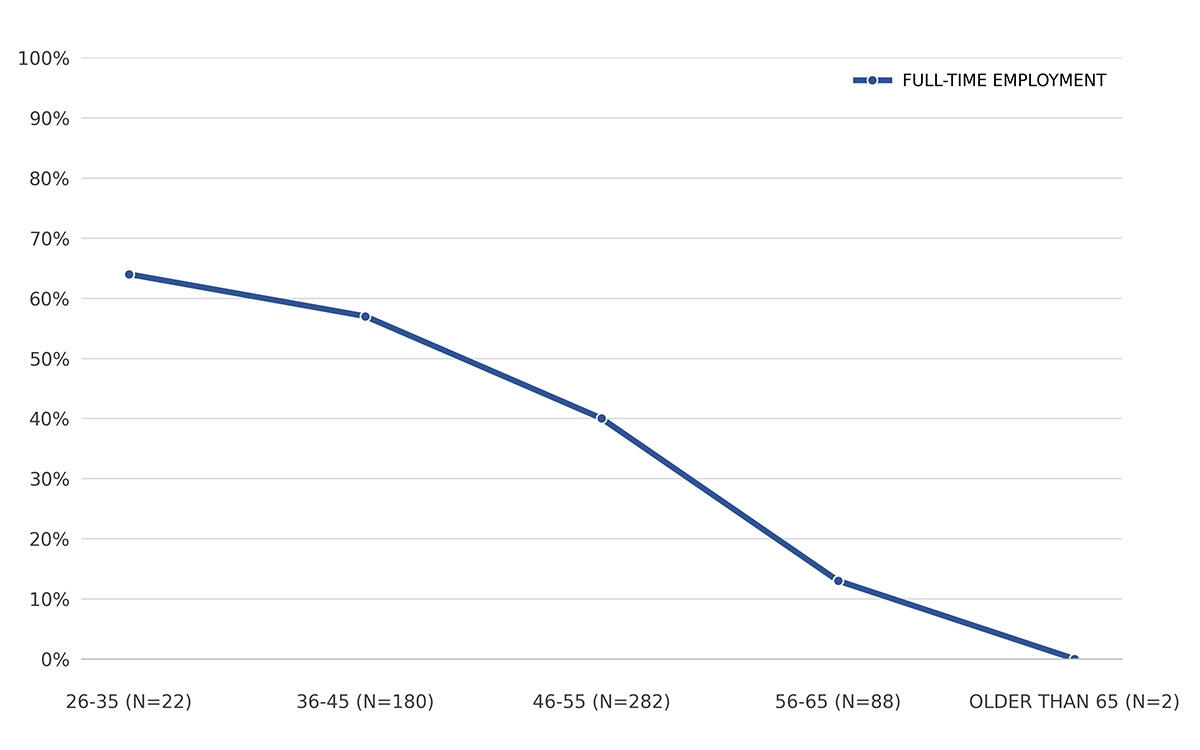
Chart by Jaime Oberlander; data from survey she conducted in March 2026 for her graduate program at the University of Michigan School of Social Work.
Challenges to Securing Employment
Fifteen months after the stop-work order, only 40 percent of responding USAID FSOs had secured full-time employment. Nearly as many—39 percent—had not found any employment. The remaining respondents had cobbled together paid consulting (10.8 percent), part-time work (9.1 percent), self-employment (4 percent), or were not actively searching (7.3 percent).
Underemployment is equally significant: 64 percent of those with full-time employment took a pay cut. Of those, 42 percent took a significant pay cut, making more than 25 percent less than their base U.S. government salary.
USAID FSOs built careers around specialized technical graduate degrees, mastery of U.S. foreign assistance regulations, and professional networks overseas. In 2025 the U.S. canceled more than 80 percent of its development and humanitarian programs, imploding the global aid sector.
Drastically reduced employment options both within and adjacent to the development sector for USAID FSOs has been compounded by an 11.5 percent reduction in the federal workforce, loss of 29,000 nonprofit jobs nationally, and significant cuts in higher education.
The likelihood of finding full-time employment decreases sharply with age: 64 percent of FSOs between 26 and 35 have found full-time employment, compared to only 14 percent of those between 56 and 65. When extracting those eligible for retirement, full-time employment for FSOs between 56 and 65 hovers around 25 percent—less than half the reemployment rate of younger colleagues. Numerous qualitative responses to the question “In your own words, what was the hardest part of the dismantling of USAID?” spoke to the direct experience or the perception of age discrimination and the challenges of starting over professionally in one’s 40s or 50s.
We lived through coups, disease outbreaks, and evacuations. We missed funerals, weddings, graduations, and births back home. We are not hurting because we are not strong or resilient people. We are hurting because of the scale of the damage done and the betrayal and cruelty it represents.
—Former USAID FSO
While many younger FSOs described the strain of repaying graduate student loans undertaken to qualify for work in a now-diminished sector, their position in the labor market is often different. Younger employees may have more time to redirect their careers, fewer seniority-based expectations, and greater access to entry- and mid-level roles across adjacent fields. They may also have fewer constraints related to mortgages, children’s schooling, or long-established geographic commitments.
The challenges for mid-career FSOs are also stark. Many mid-career respondents described being trapped between too young and too old—unable to access retirement benefits and unable to compete in a saturated job market.
For senior USAID FSOs, the challenge is structurally different. Many have spent decades developing specialized expertise, mastering U.S. government regulations, leading complex overseas programs, and building professional networks that are not easily replicated outside the sector. They are often seeking senior roles in a market where there are far fewer openings, where employers may not understand the transferability of USAID experience, and where compensation, location, and family obligations narrow realistic options. The issue is not simply individual adaptability, but a mismatch between a highly specialized senior workforce and a sharply reduced market for the work it was trained to do.
Significantly, race was a stronger predictor of reemployment than sex. While male FSOs have a slightly higher rate of full-time reemployment (41.1 percent) than female FSOs (39.6 percent), when the data is disaggregated by race, Black FSOs have the lowest rate of full-time reemployment: 28.6 percent. This is compared to 31.8 percent for Hispanic/Latinx FSOs, 41.8 percent for white FSOs, and 45.3 percent for Asian American FSOs. Black female FSOs have the lowest rate of all, at 26.5 percent. This mirrors broader labor market trends: According to the Bureau of Labor Statistics April 2026 jobs report, Black Americans face more than double the unemployment rate of white Americans (7.7 percent versus 3.7 percent).
Chart 2. Former USAID Employment Status by Race (N>16)
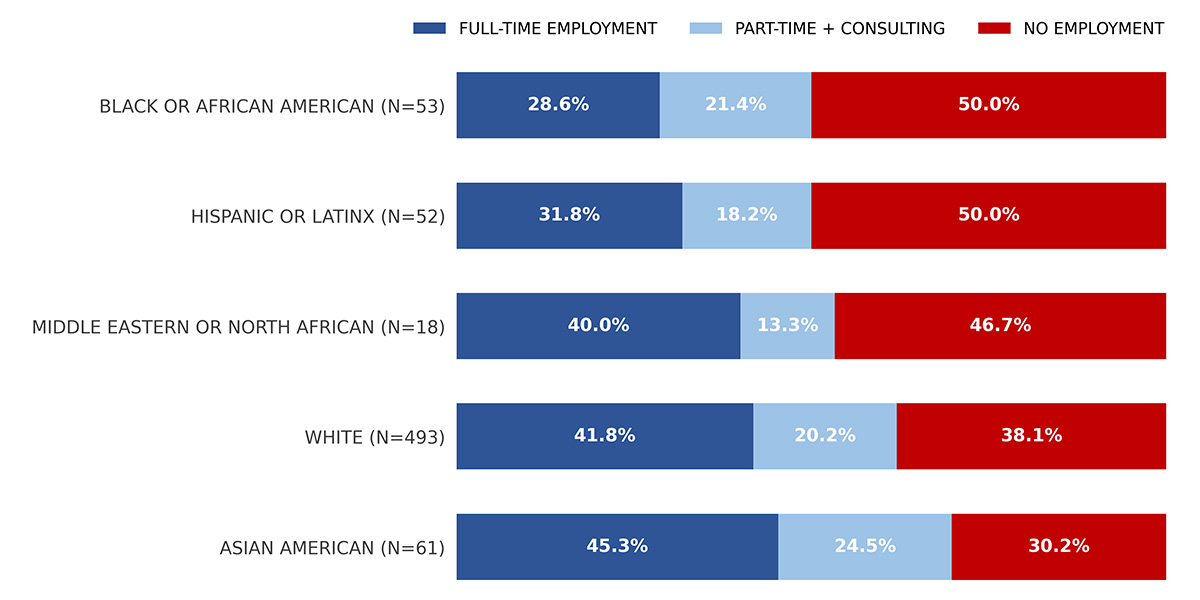
Chart by Jaime Oberlander; data from survey she conducted in March 2026 for her graduate program at the University of Michigan School of Social Work.
Household Financial and Psychological Shock
The Foreign Service has long struggled to accommodate dual-career households. With USAID’s closure, 48 percent of USAID FSOs experienced dual job loss, with their partner’s employment tied to diplomatic status, such as a tandem USAID couple, eligible family member position, or through a spouse’s position in the affected aid industry. By comparison, 20 percent of households in the full survey of aid-sector employees (N = 3,771) reported dual job loss. This suggests that USAID FSOs experienced a disproportionate household-level financial shock, not only the loss of one career.
The financial effects were significant and immediate. USAID FSOs reported relying on multiple coping strategies at once: 80 percent used more savings than planned, 73 percent made significant spending cuts, 67 percent stopped retirement contributions, 57 percent applied for unemployment insurance, and 36 percent delayed medical care. A substantial number of respondents reported more severe measures, including selling assets such as homes, taking on debt, or applying for government assistance programs such as SNAP or Medicaid.
Taken together, these responses point to a workforce facing not just temporary income disruption, but cascading financial stress across savings, health care, housing, retirement security, and family stability.
Even in normal circumstances, the Foreign Service places unusual demands on families, including repeated relocations, long separations, disrupted spousal employment, school transitions, and the strain of building and rebuilding support systems overseas. USAID’s dismantling added a different kind of pressure: sudden career loss, financial uncertainty, identity disruption, and a change in household status after years of service.
While the majority of FSOs reported their relationships remained intact, a meaningful minority described real strain: 27 percent reported their marriage or relationship became weaker due to stress and status change associated with USAID’s dismantling. In addition, 10.6 percent reported their relationship status changed in 2025 (e.g., separation, divorce), and nearly half attributed it directly to USAID’s closure.
These findings do not suggest that USAID’s closure was the sole cause of family disruption in every case. They do, however, indicate that it acted as a significant stressor for a workforce already operating under family conditions more complex than those faced by most professionals. For some households, it appears to have intensified existing pressures; for others, it may have created new ones around income, identity, relocation, and uncertainty about the future.
I was the provider for my family, and that was suddenly taken away in a cruel and vindictive way. … The destruction took away our credibility, broke our promises, tore down our partnerships, made us weaker in the world, hurt our fellow humans who we had committed to supporting. It’s impossible to put into words all that has been lost.
—Former USAID FSO
Physical health was also affected. Chronic, severe, and prolonged stress affects every system in the body, contributing to high blood pressure and cardiovascular disease, as well as anxiety and depression. In the survey, 85 percent of FSOs reported an increase in stress-related physical symptoms since the stop-work order was issued—including headaches, chest pain, digestive issues, and worsening of existing conditions.
Of USAID FSOs, 78 percent reported negative mental health impacts, with 22.7 percent receiving a formal mental health diagnosis in the 12 months since the RIF. The top diagnoses were depression (58 percent), anxiety (57 percent), and PTSD (32.4 percent). Of those without a formal diagnosis, 79.4 percent still experienced significant psychological distress: 83 percent reported depression, 81 percent sleep problems, 71 percent increased anger or irritability, and 64 percent anxiety or panic attacks.
More than a year after receiving RIF letters, nearly half (46 percent) of respondents reported still not feeling a sense of agency—defined as having control over major life decisions. Some 57 percent reported feeling less confident since losing their USAID position, and 89 percent reported difficulty functioning, including completing tasks needed to move forward, with 43 percent experiencing extreme difficulty.
Children were not spared. Ninety-five percent of FSO parents reported their children were struggling. Nearly half of FS children (49 percent) had to change schools—double the rate of U.S.-based families. Fifteen percent of parents reported their children were still struggling significantly one year later. Spouses and partners also experienced significant distress: 60 percent reported psychological distress symptoms, 33 percent reported stress-related physical symptoms, and 20 percent received a mental health diagnosis.
A Deep and Pervasive Wound
To capture the complexity of the experience, scaled questions (0–4) based on validated psychometric measures assessed identity disruption, grief, anger, and moral injury—the distressing psychological, behavioral, social, and sometimes spiritual aftermath of exposure to events that contradict deeply held moral beliefs and expectations. The findings are striking: 90 percent of respondents scored 3 or 4 (out of 4) on questions measuring betrayal by trusted institutions and violation of deeply held moral and professional values.
A sense of betrayal was the strongest qualitative theme, appearing in 18 percent of open-ended responses. Respondents described not only the loss of a career, but the public false accusations of fraud, the failure of Congress to intervene, and the pain of having extended family members who accepted the narratives maligning USAID.
Nearly as prominent was a lost sense of professional identity. USAID was not “just a job.” It was a vocation, a worldview, and a personal identity. Seventy-three percent of respondents felt strongly (scored 3 or 4) that their jobs were a central part of who they were and losing that job left them feeling unanchored. Job loss was experienced not only as unemployment, but as dislocation from a mission and a life built around public service overseas. Respondents also described grief over the human consequences—the knowledge that people who depended on lifesaving aid would suffer or die as programs stopped abruptly.
This data represents the first phase of a long-term longitudinal study that I hope will ultimately document stories of resilience. At this point, however, the findings point to a population still absorbing the shock of the rupture. These were purpose-driven professionals, individuals who saw their work not only as a way to earn a living, but as a vocational worldview and identity deeply rooted in public service, international investment, and an oath to defend the Constitution of the United States of America.

Jaime Michelle Oberlander served as a USAID Foreign Service officer in Pakistan, Kenya, Somalia, and Ethiopia from 2015 to 2025 and as a civil servant at the U.S. Department of State from 2009 to 2015. Following the closure of USAID, she is pursuing a career in mental health and is currently a graduate student at the University of Michigan School of Social Work.
Author’s note: The survey instrument was reviewed by the University of Michigan Institutional Review Board. This survey was circulated on LinkedIn and shared through alumni channels such as AFSA, Our USAID Community, and OneAID, from March 27 through April 26, 2026. While there are limitations to self-reported data, the high response rate (30 percent of the USAID Foreign Service workforce) suggests that USAID FSOs have a story to tell and want their experience documented.
When sharing or linking to FSJ articles online, which we welcome and encourage, please be sure to cite the magazine (The Foreign Service Journal) and the month and year of publication. Please check the permissions page for further details.
Read More...
- “Addressing Mental Health Needs at USAID” by Clinton D. White and Randy Chester, The Foreign Service Journal, July-August 2024
- Dismantling USAID: Consequences for Americans and Global Development, Institute for Development Impact, 2025
- “Survey Shows the Toll of USAID’s Closure on Former Employees and Their Families” by Sean Michael Newhouse, Government Executive, July 2026