Continuing education courses offer Foreign Service alumni the opportunity to learn, teach, and make new friends in retirement.
BY ELIZABETH “LIZ” SHELTON
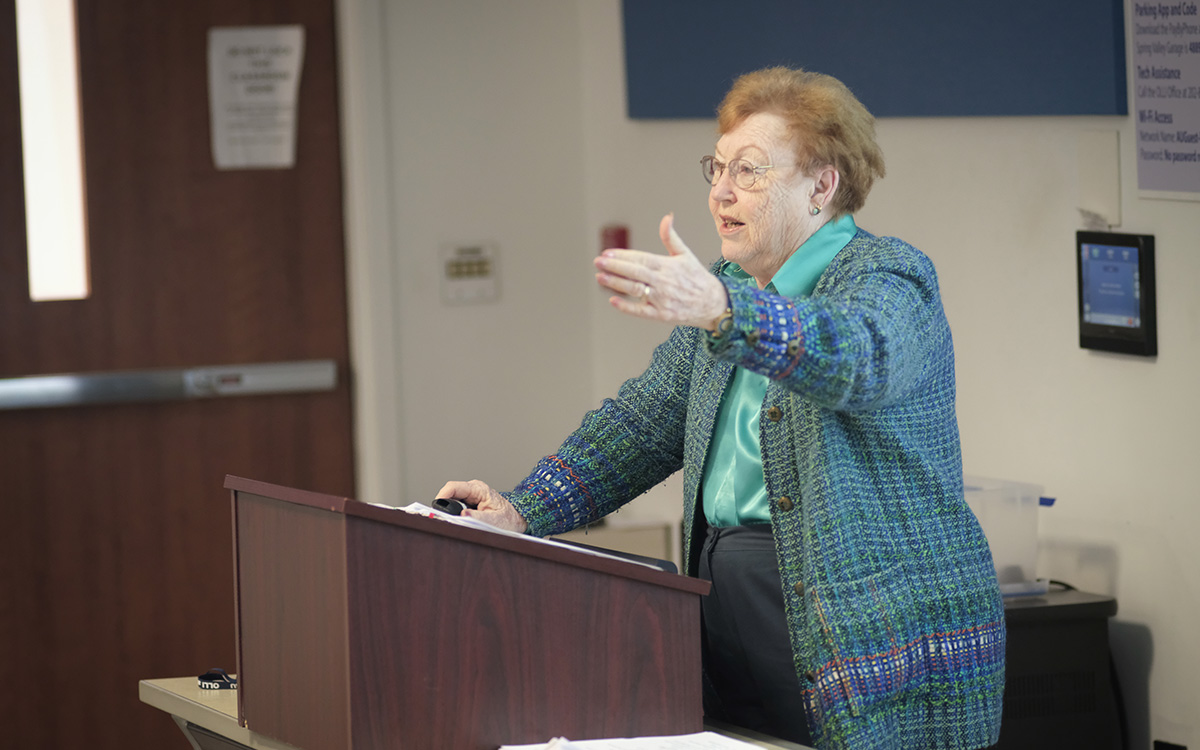
Liz Shelton gives a lecture at American University in 2019.
OLLI AT AMERICAN UNIVERSITY
Do you think all the experiences and knowledge acquired during years of living abroad and serving your country are for naught when you retire? Think again! Sure, you can play golf, swim with sharks, perfect an English rose garden, or walk the Appalachian Trail, if you want to.
But don’t ignore the fact that retired FSOs have had opportunities that most can only dream about. Why not share that knowledge and impart your insights in a lifelong learning community, exploring educational opportunities with new friends?
Can you imagine the excitement and deep satisfaction of building on the broad reservoir of knowledge you have acquired, adding new dimensions, reading about new vistas that always interested you but you never had time for while fully occupied in your Foreign Service career?
If you are like most of us, we kept promising ourselves that we would take time to read and explore ideas that interested us or take the time to augment our knowledge with a deeper plunge into new waters. But, of course, there was scant time for that as the demands of a career and public service always took priority.
Life after retirement offers wonderful opportunities to refresh your mind and learn all kinds of things. For the first time since college, you are the master of your own time and can pick and choose new avenues to broaden your knowledge, keep your mind sharp, discover new worlds of ideas, and make friends along the way.
An Idea Whose Time Has Come
Lifelong learning is sweeping the country, and new retirees can find a wide range of opportunities for continuing education. Universities, colleges, and institutions such as the Smithsonian Associates are adopting programs for those who want to keep their minds engaged as we prepare for a world of rapidly changing norms and technologies. One such example, the Osher Lifelong Learning Institute (OLLI), offers programs at 124 higher education institutions across the United States, with 125,000 students enrolled.
You can find three OLLI programs in the D.C. metropolitan area: at American University in Washington, D.C., George Mason University across the river in Virginia, and Johns Hopkins University in Montgomery and Howard counties in Maryland. In 2025 the American University program alone—where I am a member—had about 1,700 active members taking 300 noncredit courses a year. Unlike regular college courses, there are no papers to write and no tests to take—just a remarkable classroom learning experience with other retirees.
Imagine the sheer range of subjects you can study: from the music of Bach, Beethoven, or Mozart to the history of rock and roll; from Plato’s academic works to contemporary issues in medical ethics; from Thackeray’s Vanity Fair to the novels of Toni Morrison; from American colonial and federal furniture to contemporary Asian architecture; from how to develop a photographer’s eye to how to take better travel photos.
Lifelong learning is sweeping the country, and new retirees can find a wide range of opportunities for continuing education.
Imagine, too, the luxury of being guided by suggested readings offered by course leaders to stretch your mind, to introduce you to ideas and new areas you had never considered before. Your classmates may include a retired Air Force colonel, a federal judge, a published poet, a nuclear scientist, an oceanographer, or, like you, a specialist in foreign affairs, all with knowledge to share.
One other benefit of remaining intellectually active in a community of curious fellow students and teachers is that it can be good for both your physical and mental health. According to the journal Innovation in Aging, “engaging in any later-life learning was associated with significantly better cognitive function.” Their study found “the benefits of education in later life were equivalent to a nearly six-year delay in cognitive decline among older adults.”
For a community such as the Foreign Service that values sharp thinking, adaptability, and curiosity, these findings are worth considering. We all want to keep our marbles!
My Experience, for Example
Coming from a family that valued education as a lifelong adventure, I thought that after nearly 30 years as a Foreign Service officer, I might enjoy teaching as a second career—but first, I wanted to go back to school. At age 65, I was fortunate to find a program at Georgetown University that allowed me a great deal of freedom in constructing a doctoral program based on my interest in the Ottoman Empire, and I earned an interdisciplinary doctorate in liberal studies at age 70.
Shortly afterward, I learned about OLLI’s continuing education program at American University and joined as an instructor. I first taught a course on the history of the Ottoman Empire and its relations with Europe in “the Eastern Question.” Later I expanded that into a new course, “Five Empires, Five Centuries: The Eastern Question Redefined.”
Lecturing to 100 students at a time is daunting but exhilarating. As mature thinkers, my students bring so many different perspectives to the issues under discussion. Their interest and questions led me into new research and a broadening of topics. The give and take of mutually stimulating sessions has kept me young. Now, at age 86, I am still learning. As Atatürk, the founder of the republic of Türkiye, said: “Reading and learning never end.”
The Reward of Volunteering
I’m not alone at OLLI. My colleague, veteran diplomat John Bargeron, also found a new path through OLLI, where he has volunteered for years. Bargeron spent more than 35 years with State, specializing in the Middle East and transnational organized crime and serving in Jerusalem, Cairo, Tel Aviv, Managua, and as chief of the civilian observers with the Multinational Force and Observers (MFO).
“When I retired,” Bargeron told me, “a primary aim was to recharge my intellectual batteries. I had previously taught college history and I missed the chance to read, contemplate, and exchange ideas with peers and colleagues.”
He added: “OLLI colleagues are seasoned learners at the peak of their life experiences who want to know more. They bring enormous life, professional, and other experiences to the classroom, where cross-discussions are often more compelling than lectures.”
I learned about OLLI’s continuing education program at American University and joined as an instructor.
Bargeron says his biggest surprise at OLLI has been “the reward of volunteering.” Volunteers “do much, if not most, of the heavy lifting, from serving as all-important study group leaders (teachers) to manning the many committees such as curriculum, lecture, development, finance, social, membership, and strategic planning.”
Bargeron started small, assisting the study group leader in his classes. From there he was asked to serve on several special committees before joining OLLI’s board and eventually becoming the board’s chair, responsible for a 1,600-member organization.
“This was new territory for someone who had served in a highly structured federal environment for nearly 40 years,” he says. “But I took the plunge, and it has turned out to be one of the most rewarding periods of my life. I often point out that OLLI is more than classes and lectures—it is a community. I learned that the best way to the heart of that community is to give back by volunteering.”
High-Caliber Discussion
After 30 years in the Foreign Service, Xenia Wilkinson retired and earned a PhD in Latin American history at Georgetown University. Having served in Mexico, Honduras, Brazil, and at the U.S. Mission to the Organization of American States, Wilkinson was interested in studying the region through an academic lens.
“Post-retirement, I devoted several years to academic research as well as travels with my husband, Ted, also a retired FSO,” Wilkinson told me. “After Ted passed away in 2015, I knew that my plans and dreams had to change.” At the recommendation of another FSO colleague, Wilkinson turned to OLLI to help her through this difficult time.
She explored OLLI study groups on history and literature and took advantage of opportunities to learn about finance, estate planning, and technology. She enjoyed it so much that she became a study group leader herself, starting with the history of the Amazon and other Latin American subjects.
“I am always impressed with the caliber of our study group discussions,” Wilkinson says. “OLLI attracts retired professionals who participate actively in discussions in which we learn from each other’s perspectives. It’s a great place to learn, to teach, and to make new friends!”
A Whole New World
We know how critical mental health is to physical health, and as we get older and begin to slow down physically, we can keep our minds active and alert by learning new things, exchanging ideas with others, and participating in intellectually expanding discussions.
There is a whole new world forming around us—so much to learn and to know. Enjoy these golden retirement years by finding a lifelong learning program near you and building a fuller, richer life.
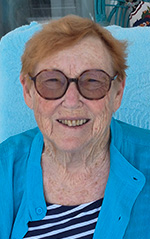
Elizabeth “Liz” W. Shelton retired from the State Department in 2005 after nearly 30 years as a Foreign Service officer. She served in Thailand, Malaysia, Nigeria, Türkiye (Istanbul and Adana), Azerbaijan, and Albania. She holds a BA in history from the University of Michigan, an MA in international development from American University, an MS in national security strategy from the National War College, and a doctorate in liberal studies from Georgetown University. She currently spends part of the year in Washington, D.C., and part in Kalkan, Türkiye. Retired FSOs John Bargeron and Xenia Wilkinson also contributed to this article.
When sharing or linking to FSJ articles online, which we welcome and encourage, please be sure to cite the magazine (The Foreign Service Journal) and the month and year of publication. Please check the permissions page for further details.
Read More...
- “Life After the Foreign Service,” The Foreign Service Journal, April 2020
- “Life After the Foreign Service: From U.S. Diplomat to Diplomatic Educator” by Richard W. Mueller, The Foreign Service Journal, September 2024
- “Lifelong Learning: Why the Future of Education Has No Age Limit” by Maja Zelihic, Forbes, March 2025