The closure of USAID is not the end of the story. Efforts by the USAID Alumni Association (UAA) are underway to preserve the agency’s intellectual and historical legacy.
BY CHRIS MILLIGAN
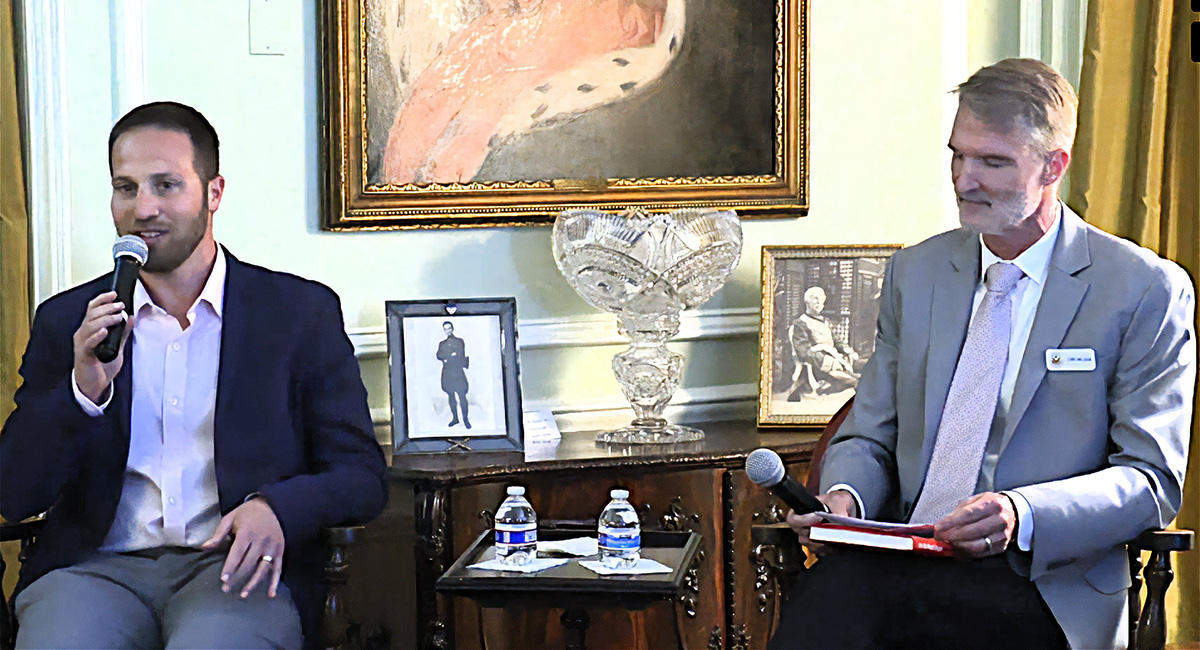
Chris Milligan (right) leads a talk with USAID’s Nicholas Enrich about his book, Into the Woodchipper, at an event co-sponsored by the USAID Alumni Alliance and DACOR at the DACOR Bacon House in Washington, D.C., on June 5, 2026.
DACOR
For more than six decades, the United States Agency for International Development—USAID—stood as a quiet yet essential pillar of American power. It was not the hard edge of military force or the visible weight of economic might, but something more enduring: the projection of U.S. democratic values, economic openness, and a spirit of cooperation.
It was, from the beginning, a strategic idea. When John F. Kennedy established USAID in 1961, he advanced a vision that helping other nations build stability and prosperity was not merely an act of goodwill. It was a form of leadership. Development, in this view, was not charity—it was statecraft. Not generosity alone, but a disciplined, forward-looking investment in a safer and more prosperous world.
For decades, that idea held strong bipartisan support. Through wars, recessions, and shifting political tides, USAID remained a cornerstone of U.S. global engagement—carried forward by generations of public servants who worked far from the spotlight, often in the most fragile corners of the world.
That continuity ended abruptly last year. Early in 2025, the United States began dismantling USAID: shutting down the Washington, D.C., headquarters building, firing local staff overseas, and sending its Foreign Service members home with little advance notice. The decision marked a profound rupture, not only in policy but in the institutional memory and professional capacity that had defined U.S. development leadership.
The consequences have been immediate and far-reaching. Overseas, programs that once stabilized communities, saved lives, and supported economic growth have been disrupted or halted. But the impact has also been deeply felt at home, particularly by the thousands of USAID staff and partners facing layoffs, financial strain, and an uncertain professional future.
For many, this was not just the loss of a job. It was the sudden end of work they regarded as central to U.S. leadership in the world.
A Consequential Network
In the absence of the institution, its community stepped forward. The USAID Alumni Association (UAA), originally formed in 2009 to maintain connections among former colleagues, evolved into something more consequential: a network for advocacy, support, and the preservation of a professional discipline that risks being irreversibly damaged or forgotten.
Over the past year, the UAA community has mobilized with urgency and purpose. We have expanded membership to include those most affected by the agency’s closure, including institutional support contractors who served at USAID. Regional branches—particularly in states such as California and Florida—have become more active, creating new opportunities for engagement and solidarity.
The UAA has also provided tangible support where it was most needed. Through its staff assistance fund, it has delivered emergency financial aid and job search training to hundreds of former colleagues. These efforts have helped stabilize individuals navigating sudden and often disorienting change.
At the same time, the UAA community has worked to honor the legacy of USAID’s workforce—recovering employee awards, reconnecting them with their recipients, and supporting events with sister organizations to recognize decades of public service.
Beyond mutual support, the UAA has taken on a broader mission: to explain, and defend, the role of development in American life. Through a growing speakers bureau and new outreach initiatives, former USAID professionals are engaging the U.S. public more directly, making the case that foreign assistance is not peripheral to national interests, but central to them.
This effort reflects a deeper concern: that the dismantling of USAID risks eroding not just programs but understanding.
Defending the Idea of Development
Development, after all, is not an abstract ideal. It is a technical, evidence-driven discipline—one that requires expertise in economics, governance, public health, agriculture, and more. It demands rigorous monitoring, long-term evaluation, and an ability to operate in complex political environments.
USAID embodied that expertise. It is no surprise then that the agency had the most highly educated workforce in the federal government. This concentration of specialized knowledge existed nowhere else at comparable scale. That capacity cannot be easily replaced.
Recognizing this, the UAA has also taken on the role of institutional steward. Working with other organizations like AidTA, efforts are underway to preserve USAID’s intellectual and historical legacy, including the recovery of hundreds of thousands of digital records and the documentation of professional experience through in-depth interviews with former staff. These materials represent not just the history of an agency, but a repository of lessons learned over decades of global engagement.
The goal is not simply archival. It is preparatory, because few who understand the field doubt that the United States will eventually need to rebuild its development capacity. The challenges that USAID addressed—fragility, poverty, instability, and the global ripple effects they produce—have not disappeared. If anything, they have intensified.
The dismantling of USAID may come to be seen as a defining moment in the trajectory of U.S. global leadership. But it is not the end of the story.
Looking to the Future
Across the country and around the world, a dispersed but determined community continues to carry forward the agency’s core mission: to advance stability, opportunity, and human dignity as integral components of U.S. foreign policy.
In doing so, they are preserving more than a legacy. They are keeping alive an idea—that America’s strength lies not only in what it can compel, but in what it can build, in power and in partnership.
And in that sense, the future of development in the United States may depend less on institutions than on the people who refuse to let that idea fade.

Chris Milligan serves as co-chair of the USAID Alumni Association. A Senior Foreign Service officer, he retired from USAID as Counselor of the agency in 2021 after more than 30 years advancing U.S. development and humanitarian goals, particularly in crisis and political transition settings. Over the course of his career, he led major initiatives that strengthened the effectiveness of U.S. foreign assistance and advanced U.S. foreign policy priorities.
When sharing or linking to FSJ articles online, which we welcome and encourage, please be sure to cite the magazine (The Foreign Service Journal) and the month and year of publication. Please check the permissions page for further details.
Read More...
- “USAID Transforms” by Chris Milligan, The Foreign Service Journal, December 2019
- “USAID Cuts Put U.S. on Sidelines of Myanmar Aid, Former Officials Say” by Tom Bateman, BBC, April 2025
- “Finding Strength in Community” by Randy Chester, The Foreign Service Journal, November-December 2025