Identifying future national leaders early is no simple task. Once-classified cables share U.S. diplomats’ early views on a much younger Vladimir Putin.
BY DAMIAN LEADER
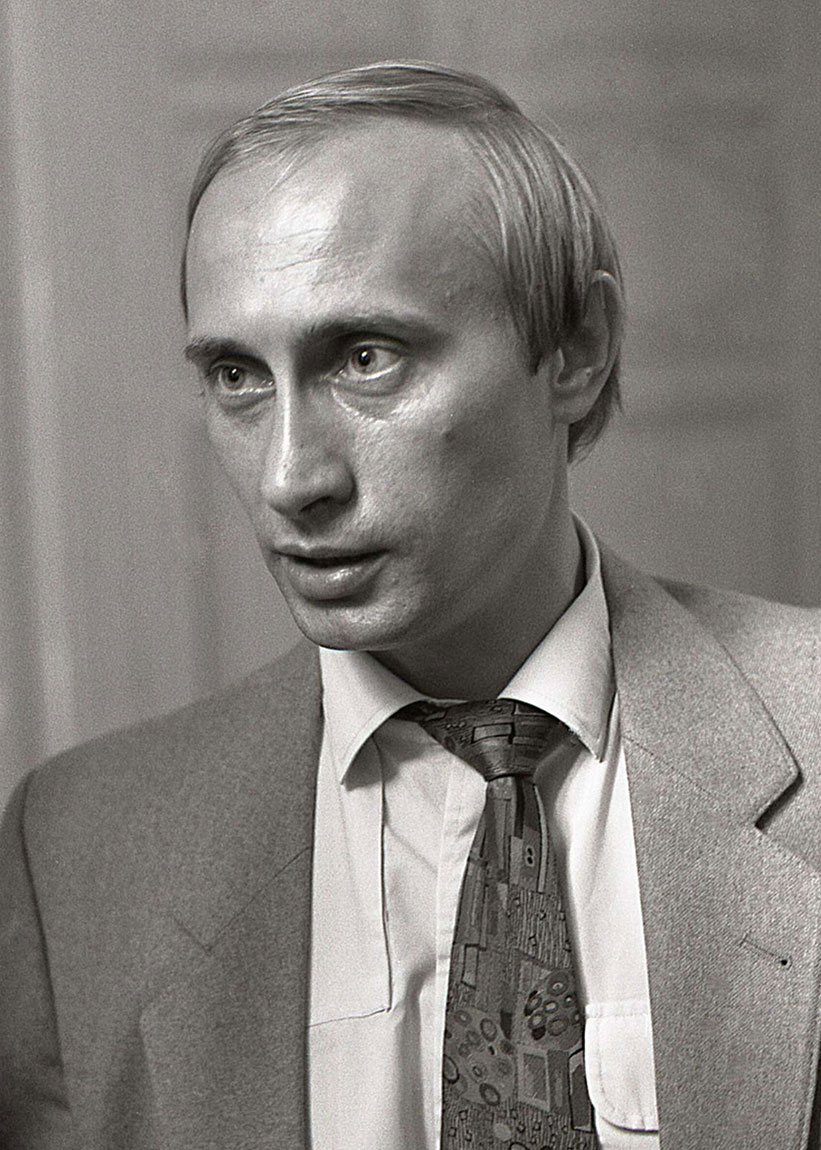
Vladimir Putin circa 1990 in Leningrad.
Sergey Kompaniichenko / Wikimedia Commons
When Vladimir Putin returned to St. Petersburg (then Leningrad) from East Germany in 1990, there was little about him that caused the U.S. consulate general (CG) in Leningrad to identify him as the historic figure he would become. But U.S. interactions with Putin described in the CG’s telegraphic reporting from 1991 to 1993 do give a sense of the man and his rising star.
Consulate officers described a man who, as chief of staff, quickly made himself indispensable to Mayor Anatoly Sobchak and was a key player in foreign investment and St. Petersburg real estate. Putin met visiting senior U.S. officials and traveled to the United States several times, but he was considered abrasive and corrupt.
Despite negative impressions of Putin among consulate staff, within Russia Sobchak’s star was fading while Putin’s only grew brighter. Putin first appears in a consulate report of Mayor Sobchak’s inaugural reception in June 1991. The reporting officer details a side conversation with a Sobchak aide, who said: “Another real winner in the recent election was Sobchak’s chief of staff Vladimir Putin. … Putin has been a Sobchak aide dealing largely with foreign delegations since early this year. Previously he worked as a foreign relations aide in the Leningrad State University rector’s office, where he undoubtably came to the attention of Professor Sobchak. He has traveled to the U.S. with Sobchak. He [Putin] says he speaks no English.”
Putin’s 1990 visit to the United States attracted little attention. The consulate issued him a visa as a member of Sobchak’s 15-person delegation that came at the invitation of St. Petersburg College in Florida. The delegation also visited Washington, D.C., where they met with President George H.W. Bush, Vice President Dan Quayle, and members of Congress, and Sobchak spoke at the Center for Strategic and International Studies on October 29, 1990. I have found no specific references to Putin’s participation in the Washington meetings, although as Sobchak’s foreign policy adviser, he was almost certainly present.
Like hiding his knowledge of English in the early 1990s, Putin did not seem to want anyone to know what he knew. He never mentioned his U.S. visits to the Western press until 2000, in an interview with David Frost, when he said only: “I have twice been to the United States on very short visits, on business,” without elaborating.
Putin first appears in a consulate report of Mayor Sobchak’s inaugural reception in June 1991.
In the months immediately following the 1991 Moscow coup attempt and the impending collapse of the USSR, a succession of senior U.S. officials visited the Soviet Union to show support for Soviet leader Mikhail Gorbachev and promote U.S. investment as privatization increased. Putin participated in all the visits to St. Petersburg.
When Secretary of State James Baker visited that September, and the consulate was tasked with providing biographies of guests at a dinner Sobchak was hosting, it repeated earlier reporting and added: “Putin appears to be in his late thirties [he was 38]. He speaks no English. We have no information on Mrs. Putin.”
In a telegram the next day the consulate filled in the birth date (1952), his degree date (1975), and that he was elected to the Leningrad City Council in April 1990, adding: “He is a legal specialist. Sobchak treats Putin as his key assistant on anything international, but Putin has grated on some foreigners here.”
The draft schedule showed Putin at the working dinner hosted by Secretary Baker for Sobchak. Not all of Baker’s party were included; those left out included future CIA Director Career Ambassador William Burns and future Chairman of the Joint Chiefs of Staff Gen. John Shalikashvili.
Privatization and Business Potential
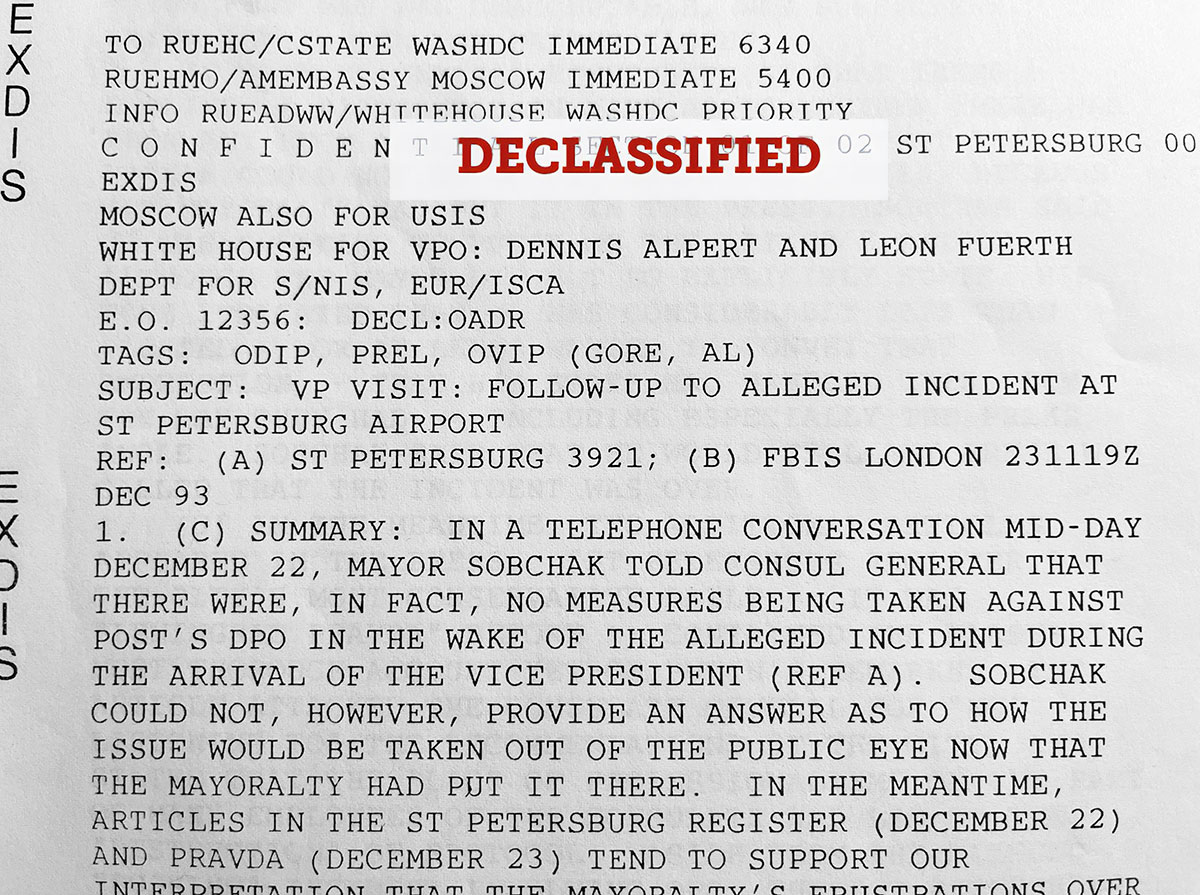
A snippet of a 1993 cable sent by the U.S. consulate in St. Petersburg to the State Department in Washington, D.C. This cable and others cited were declassified as part of a systematic review of all cables after 25 years by the State Department Bureau of Administration’s Office of Classification Policy and Declassification Review.
Damian Leader
Interest by U.S. businesses in potential investments in Russia grew during the twilight months of the Soviet Union. In late September 1991, Fred Zeder, president and CEO of the Overseas Private Investment Corporation (OPIC), planned a visit to St. Petersburg to discuss bilateral agreements. OPIC’s advance message said Zeder was “well aware of … Sobchak’s interest in commodity-based trade expansion concepts. … Post is requested to pave the way for meetings in St. Petersburg with the mayor and colleagues interested in private sector transactions (possibly including Vladimir Putin) to advance this process or U.S. investment in general.”
In late October, when Deputy Secretary of Defense Donald Atwood came to tour Russian defense plants, Putin was again on the tarmac to greet the delegation. Agriculture Secretary Edward Madigan also visited and met with city officials, including Putin.
In early December 1991, OPIC sent a three-person working delegation to follow up. In an informal note to the consulate, they asked for help setting up meetings with “Mayor Sobchak, privatization expert Vladimir Putin, and/or anyone else they recommend.” On December 8, 1991, Treasury Deputy Secretary John Robson came to discuss establishing a U.S. business school in the Soviet Union, but his meeting with Sobchak and Putin does not seem to have been a success. Sobchak spoke of the food crisis in the city and blamed problems on Ukrainian farmers and communist dead-enders. In the weeks prior, a Sobchak aide had given the consulate a readout of the chaos in the mayor’s office. The aide said Mayor Sobchak was circling the wagons and taking counsel only from Putin and the new deputy mayor, Georgy Khizha, describing them as the two strongest influences on the mayor.
The privatization of state-run enterprises and real estate controlled by the mayor’s office provided ample opportunity for corruption, and Sobchak and his staff took advantage of the possibilities. In those days of a relatively free press, none of this was a secret. In a television interview broadcast February 24, 1992, Putin said that he had not taken bribes in his current post but had found means to “supplement” his income when serving in previous positions. Putin editorialized that he could hardly be blamed for such behavior, given his meager government salary and the fact that he had two children to feed and clothe.
In a telegram sent four days later, the consulate reported: “A spate of articles have appeared in local newspapers detailing official allegations of corruption: both City Council deputies and high-ranking staffers in the mayor’s office have been accused of conflict of interest and are under investigation. Vladimir Vladimirovich Putin … and his deputy Oleg Markov are both under investigation for potential conflicts of interest in their involvement in a local tourism company.”
A Rising Star
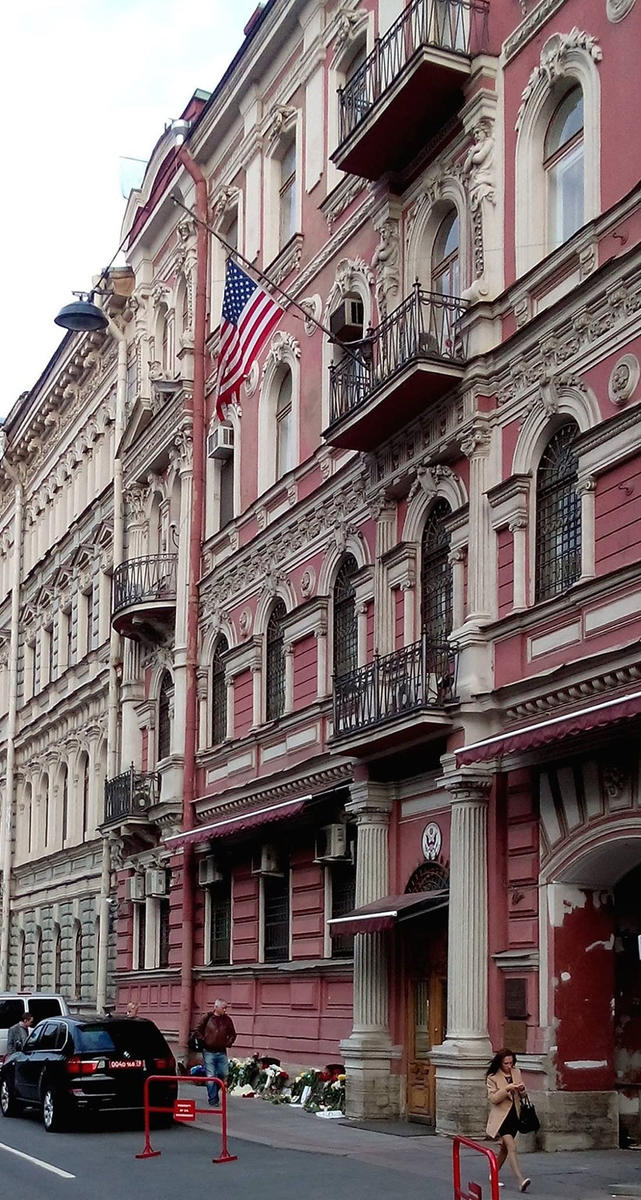
The facade of the former U.S. consulate in St. Petersburg, Russia.
U.S. Consulate St. Petersburg
The consulate followed up on March 3, 1992, with a 36-paragraph analysis of Sobchak’s performance and his Soviet leadership style, which it called opaque, secretive, and not very competent. Charges of corruption were laid, and Putin was included in the bill of particulars. The consulate did not find Putin easy to work with and a now-familiar picture of Putin emerged: “Another major player in the Sobchak administration is Vladimir Putin … through whom all foreign contacts must pass (we manage to avoid him). Although a young man, Putin comes from an ‘old guard’ background: an admitted former KGB agent. … Putin … has brought his own cronies into the administration, most of them former communists.”
The U.S. government had plans for a “Russian American Enterprise Fund” for the newly renamed Russian Federation, and when a team led by then–State Department official Liz Cheney visited in October 1992, Putin was the highest-ranking official they met. He recommended U.S. businesses remain in St. Petersburg to provide management and technical expertise to Russians. He argued that the enterprise fund should be headquartered in St. Petersburg rather than Moscow because it had more international business, closer links to Europe, and was less bureaucratic than Moscow. Putin endorsed Cheney’s suggestion that enterprise funds be used for “spin-off” enterprises from former defense industries and encouraged U.S. government involvement in them. The enterprise fund could, Putin said, finance defense conversion and help economic development in the region.
It would not be smooth sailing for U.S. investors in post-Soviet St. Petersburg, however. In March 1993, the consulate sought Putin’s help because organized crime was threatening the managers of a joint venture. The American staff had hired bodyguards. Putin promised to help, and the consulate reported they would be following up with him, adding that crime was becoming a leading issue for the American and Western business community.
Despite these concerns, official U.S. engagement with St. Petersburg only increased. In June 1993, the Coast Guard cutter Gallatin visited and hosted public tours for three days. The consul general signed a U.S. Trade and Development Agency (USTDA) grant to fund a feasibility study for automating customs procedures. The National Democratic Institute organized a conference on democracy and private enterprise, and Vladimir Putin gave the welcoming speech. The Federal Aviation Administration (FAA) and USTDA co-sponsored a conference attended by representatives from more than 60 U.S. aviation and finance companies.
In August 1993, future Secretary of Transportation Norman Mineta led a delegation to St. Petersburg that included six congressmen, Federal Highway Administrator Rodney Slater (another future secretary of Transportation), and an FAA representative. Putin, then acting mayor and described by the consulate as “in charge of foreign assistance programs in the city,” chaired a meeting for Russian counterparts. He “bemoaned the lack of U.S. business investment in St. Petersburg” and urged the U.S. to move from technical assistance to transportation infrastructure projects.
Like hiding his knowledge of English in the early 1990s, Putin did not seem to want anyone to know what he knew.
Putin said he was grateful for what the U.S. had done but called it “a modest beginning.” As any good deputy mayor would, he praised St. Petersburg’s tourism potential, its banking and communications role, and its unlimited possibilities as a “beachhead” (Putin’s word) for investors.
Putin described in some detail plans to modernize St. Petersburg’s port but also said Vyborg was his favored place for a new port. He explained that “some of the world’s richest deposits of natural gas are in the northwest region of Russia, and Vyborg is the most favorable port for processing and shipping this gas to world markets.”
The consulate observed: “Putin’s comments … reflect … the unrealistically high expectations, and resulting disappointments, that the many high-level USG and business delegations to this city have produced among city leaders.” (Putin’s dream was realized in 2011 when, as president, he oversaw the opening of the Nord Stream I pipeline from Vyborg to Germany.)
Coming into His Own
Relations with the mayor’s office, and with Putin in particular, reached a crisis point in December 1993 because of perceived U.S. protocol slights during a visit by Vice President Al Gore. After the visit, Mayor Sobchak’s protocol officer asked Consul General Jack Gosnell and his deputy to meet with Deputy Mayor Putin. They were told the meeting would involve “nothing terrible” but was an effort to find ways to avoid protocol problems in the future.
That was not Putin’s intention. The Americans were brought into a formal meeting room with local press present to report the meeting. Putin began by saying the Gore visit was very positive for U.S.-Russia relations and for St. Petersburg in particular. There were some security and protocol problems, he said, but those were “purely technical in nature.” He then added that there was one incident that did go beyond technicalities. It involved the deputy consul general allegedly pushing the Russian general who commanded the Leningrad military district out of the way during the airport arrival ceremony. The DCG would, Putin announced, not be invited to any city events in the future. The meeting, and the sanctions on the DCG, were widely covered by St. Petersburg media and made the front page of local newspapers.
Mayor Sobchak was out of town, and when the consul general tried to reach him, his private secretary knew nothing about the meeting. When told that it was Putin’s meeting, she responded, “Oh, that explains it.” After the mayor returned, he told the consul general that this incident was a misunderstanding and the DCG would not be sanctioned. The incident was discussed a few days later when Sobchak met with Ambassador Thomas Pickering in Moscow. Pickering “regretted” the incident but did not apologize, and both agreed to move forward.
By the end of 1993, Putin had established an identity independent of his patron Sobchak. His distaste for Americans was clear, as was his use of perceived insults to portray himself in the press as a defender of Russian honor. Putin’s business interests, his personal corruption, and his growing personal network were all clear.
What is particularly striking in retrospect is Putin’s early exposure, although he was only a deputy mayor, to a parade of senior U.S. government and corporate officials. By the mid-1990s, Vladimir Putin was already an experienced interlocutor with senior members of the Bush and Clinton administrations. And when Boris Yeltsin picked him to be his prime minister in 1999, Putin knew a lot more about Washington players than they knew about him. When President George W. Bush invited him to the White House in 2001, it was not Putin’s first time there—and would not be his last.
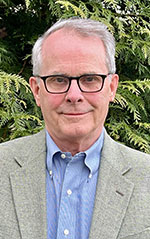
Damian Leader, PhD, is a retired career Foreign Service officer and former deputy director of Russian affairs at the State Department who later taught in New York University’s graduate program in international relations. The opinions and characterizations in this piece are those of the author and do not necessarily represent those of the U.S. government.
When sharing or linking to FSJ articles online, which we welcome and encourage, please be sure to cite the magazine (The Foreign Service Journal) and the month and year of publication. Please check the permissions page for further details.
Read More...
- “Changing Places: A Year in the British Foreign Office” by Damian Leader, The Foreign Service Journal, January 2002
- “Understanding Russian Foreign Policy Today” by Raymond Smith, The Foreign Service Journal, December 2016
- “Reflections on Russia, Ukraine and the U.S. in the Post-Soviet World” by John F. Tefft, The Foreign Service Journal, March 2020