A seasoned observer explains how this practical tool fosters transparency and promotes democratic development, and why it’s important.
BY DOUG WAKE
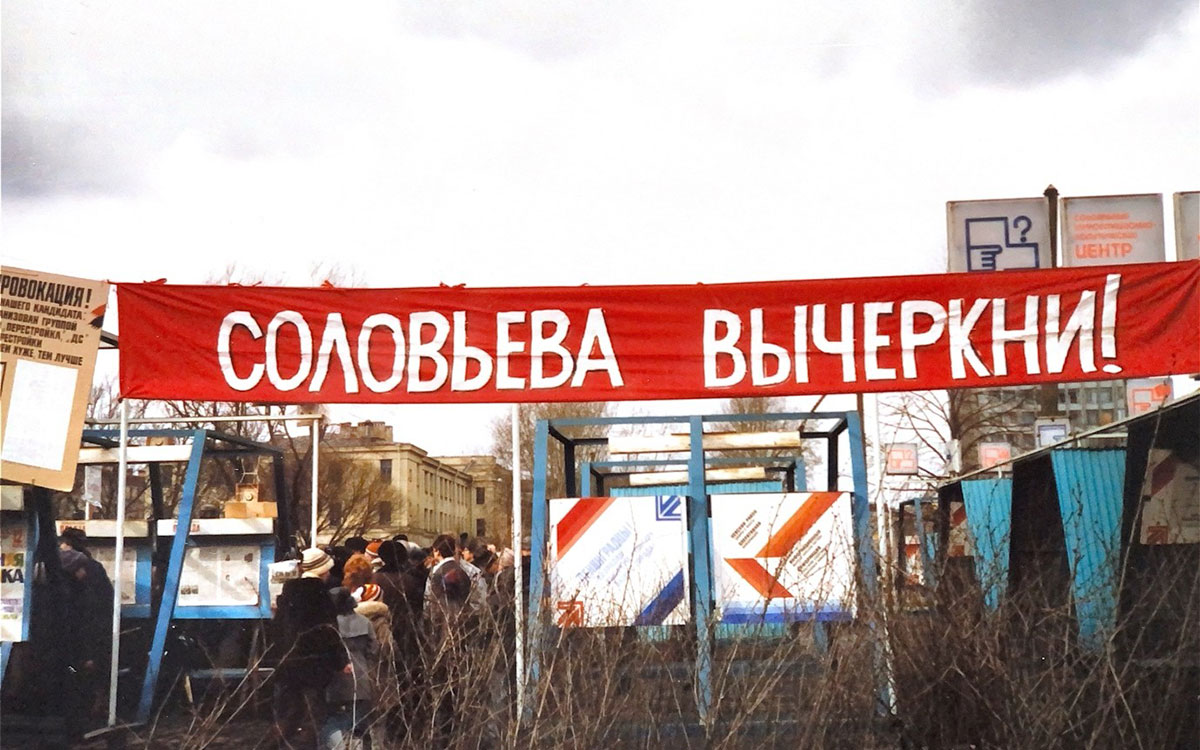
In March 1989, Leningrad activists urged voters to “Cross Out Solovyev!”—strike the name of the most powerful regional Communist Party boss, Yuri Filippovich Solovyev, from the ballot for a seat in the USSR Council of People’s Deputies.
COURTESY OF DOUG WAKE
Interested in Becoming an Election Observer?
First, international observation should only be seen as a complement to effective domestic observation. Those who care deeply about the integrity of elections may wish to volunteer at home, to work at a local polling station or as a nonpartisan observer in your community. (Such experience will also serve you well in any future international observation.)
Second, while opportunities are extremely limited, organizations such as ODIHR and the Carter Center conduct open recruitment campaigns on their websites for their core teams of election experts. Only those with significant experience are advised to apply.
Other credible organizations deploying substantial election missions, with diverse recruitment procedures and citizenship or language requirements, include the National Democratic Institute, the International Republican Institute, the Organization of American States, the European Union, the African Union, and the Asian Network for Free Elections.
Finally, most promising for private U.S. citizens with diplomatic or development backgrounds, the U.S. has continued (at least until late 2026) to “second” a substantial number of short- and long-term observers to almost all large OSCE ODIHR election observation missions. The work is voluntary, but expenses are paid and the process is managed through a State Department contractor. Information and an application are available at www.amentum.com/speo/.
When I was a Foreign Service officer heading to Leningrad in 1988, consulting experts on America’s key rival, no one mentioned elections. None were scheduled in the USSR, and none had been relevant there since 1917. Then, General Secretary Mikhail Gorbachev announced competitive elections to a new Soviet “Congress of People’s Deputies” in 1989 and to regional parliaments in 1990. We began to hear that activists would campaign to express long-repressed aspirations.
In Leningrad, an informal coalition would field candidates supporting reforms. In Estonia, Latvia, and Lithuania, popular movements would use Soviet elections to send delegates to Moscow in 1989 and restore independence in 1990.
We followed the campaigns closely, without knowing whether votes would be counted fairly or real results announced. By all appearances, in Leningrad and the Baltics, that was largely the case. Still, these were not fully democratic elections. There was only one legal party. Independent candidates faced obstacles. The most powerful Leningrad communist official, for instance, used his vast power to ensure he would be the sole candidate in one working-class district.
But on a Saturday outing shortly before the election, I came across a banner and grassroots campaign advising voters that Soviet legislation allowed them to cross out his name on the ballot. Amazingly, more than half the voters did just that, humiliating the party boss and prompting his early retirement.
During those last Soviet years, I occasionally asked officials for permission to enter polling stations. I had no accreditation to do so but was never turned down. Little did I ponder at the time that all these activities—talking to political organizers, watching campaigns on the street, visiting polling stations—were a form of “election observation.”
Democratic Elections as a Policy Priority
Though democracy promotion became a policy of Western governments following World War II, it wasn’t until the end of the Cold War that it became an explicit American diplomatic and development goal to support democratic institutions and specifically free elections, for their own sake but also to promote longer-term prospects for security, stability, and prosperity.
The United States provided substantial support through USAID and other channels to improve electoral processes abroad. American embassy staff often observed elections directly. Until very recently, the United States was for many decades the leading political and financial supporter of civil society actors carrying out election observation domestically and of international institutions doing so on a regional or global scale.
What we’ve seen since 2025 is that U.S. diplomatic support for democratic institutions and elections has been deemphasized (to put it mildly). Elections and political participation have disappeared from the State Department’s Annual Country Reports on Human Rights, nongovernmental partners have lost U.S. support, and administration officials have endorsed particular right-wing candidates in Europe publicly.
Meanwhile, from the 1990s, international election observation gradually evolved into a sophisticated endeavor, as I saw as both a U.S. diplomat and international civil servant observing more than two dozen elections in nearly 20 countries.
I worked mainly with the leading organization in this field: the Warsaw-based Office for Democratic Institutions and Human Rights (ODIHR) of the Vienna-based Organization for Security and Co-operation in Europe (OSCE). The work included observation of some memorable elections: in Ukraine after Russia’s “annexation” of Crimea in 2014, in Russia’s Far East and in Moldova in 2016, in Hungary when Viktor Orbán retained power in 2018, and in Poland when a pro-European coalition replaced the ruling party in 2023.
My main takeaway from this experience is that good international observation is a cost-effective and practical tool to foster transparency and promote democratic development that deserves financial and political support from friends of democracy worldwide, not least the government and people of the United States.
Though international observation is no substitute for honest and conscientious election administration, robust domestic observation, an independent judiciary, or the fundamental freedoms necessary for voters to make informed choices, international observers’ well-drafted reports and clear public statements can document and disseminate unbiased assessments, and their recommendations can point toward meaningful reforms to be enacted when the political climate is conducive.
What Are Modern Election Observers?
International observers have no mandate to intervene or alter election procedures or results. Their principal role is to assess and produce recommendations, thus contributing to transparency and helping domestic actors to make improvements for future elections.
Any “power” they have is largely the soft power to make their findings available to all who may find them useful. This includes media; partner organizations like the European Union (EU), which uses election reports to help evaluate progress toward membership; parliaments or governments considering election-related reforms; as well as civil society and ordinary voters.
Because elections involve much more than election day, serious international election observation involves a longer-term effort to analyze the entire process.
In addition, the mere presence of election observers can deter fraud or other abusive practices. Though this “deterrent effect” can be substantial, governments do not always behave better when international observers are on the scene.
Finally, an important myth to be busted is that international observers can give a definitive verdict on whether an election was “free and fair” or whether its results produce governance that is “legitimate.” Responsible international missions issue reports that allow readers to draw their own conclusions, but they generally avoid making binary judgments. While some elections are clearly much better than others, none are perfect.
On the practical question of what observers do, the modern observer simply tries to collect as much information as possible about a particular election, just as we did in 1989 Leningrad.
Specific activities in a typical election observation mission (EOM) depend on one’s role: a short-term observer (STO) will mainly visit polling stations on election day to assess how well the voting and counting processes comport with domestic laws and international standards. But because elections involve much more than election day, serious international election observation, whether by an embassy or an EOM, involves a longer-term effort to analyze the entire process. The OSCE ODIHR model, largely adopted by organizations like the EU and the Carter Center, often involves a core team of experts and long-term observers (LTOs) on the ground for six to eight weeks.
LTOs play various roles, from reporting and representing the mission to supporting and briefing the STOs who visit their regions. National staff, much like locally employed staff in U.S. embassies and consulates, provide critical support while bearing no responsibility for conclusions reached by the international team.
Core Team Basics
The core team operates something like an embassy “country team”: Its leadership engages with senior counterparts and manages the mission, while analysts dig deep into such issues as the political and human rights context, election administration, legal framework, media environment, gender equality, and campaign finance. Other experts handle the logistical and security challenges of deploying up to a thousand or more observers, frequently on short notice and in challenging environments.
In some respects, the substantive work of an EOM would be familiar to anyone with diplomatic and development experience (or concerned citizens, looking at elections in their own country). You start with research about the rules of the game. You learn about the main contestants and how they qualify to get on the ballot. You try to meet incumbents or challengers to learn about their programs and campaigns. You visit the national election administration and observe its proceedings. You make judgments about whether it appears impartial and professional.
Assessments by serious observer groups are always based on international standards accepted by the state concerned.
You ask various sources on the streets and in media and online about the campaign and how it is financed and regulated. You make a special effort to seek out and learn from valuable and well-informed host-country civil society partners, such as nonpartisan election monitors, human rights defenders, and organizations focusing on such issues as campaign finance, media freedom, gender equality, minority rights, and inclusion of persons with disabilities.
And you observe as much as possible for yourself, by monitoring media, attending public meetings and rallies, and looking and listening to assess the campaign’s visibility and tone.
For instance:
- Are all aspects of the elections regulated by a legal framework that is clear to all participants well in advance of election day and consistent with the constitution as well as international standards?
- Is the process competitive, or just a fig leaf for a regime to stay in power?
- Is there confidence in candidate registration, voter rolls, and ballot security?
- Is the playing field level, or tilted through abuse of government resources?
- Is there a clear separation between political parties and the state?
- Can all contestants campaign freely without risk of arrest or official harassment?
- Do contestants have adequate access to media—and money—so that voters get enough information to make an informed choice?
- Are disputes addressed fairly by election officials and independent courts?
- Can impartial organizations observe the process without undue restrictions?
On election day, you visit polling stations and election commissions. You observe how officials perform their functions, carefully noting whether the process conforms with standards on such issues as secrecy of the vote. You observe how votes are counted and tabulated, and whether results are publicly accessible. And then you write a detailed report to elucidate your findings.
Embassy vs. Multilateral Election Observation
There are many reasons for U.S. embassies (and counterparts from other democracies) to observe foreign elections. But there are also important differences between diplomatic observation and the work of professional international EOMs in the 21st century.
One difference is that diplomats work to advance all their country’s national interests, while international observers must focus solely on analyzing the electoral process. For more than 20 years, the most reputable international election observer groups have all signed on to a common Declaration of Principles for International Election Observation and a mandatory code of conduct that stress impartiality, objectivity, accuracy, integrity, professionalism, and noninterference in the electoral process.
OSCE observed U.S. elections from 2002 to 2024. For the 2026 midterms? Not invited.
Another difference between a good international EOM and even the best work by diplomats is that assessments by serious observer groups are always based on international standards accepted by the state concerned. And the main products of an international mission—typically a statement shortly after the election and a final report with detailed recommendations—flow from analyzing the extent to which an election was in line with those standards.
ODIHR’s methodology mandates that teams are multinational, with everyone bound by the same code of conduct. It also dictates that judgments be based on facts, not rumors or disinformation. Larger missions include systematic media monitoring. EOM methodologies must continually be updated to confront new challenges, including new voting and campaign technologies but also new tactics by autocrats to cover their tracks. For example, the most pressing election monitoring issues in 2026, not surprisingly, include foreign interference and disinformation, deepfakes, AI, and online harassment.
What About U.S. Elections?
I’m often asked, “When will international observers visit the United States?” In fact, the United States has not only been a historic supporter of international election observation but also regularly invited ODIHR, along with the OSCE Parliamentary Assembly (OSCE PA), to observe its elections. ODIHR and OSCE PA teams observed a dozen U.S. elections from 2002 through 2024, always commenting favorably on the U.S. electoral system and raising almost no questions about the integrity of the vote, while offering recommendations to address such persistent problems as gerrymandering, voter registration, campaign finance, and access for international observers (in some states).
Notably, immediately after observing the 2020 U.S. presidential election, an international mission from ODIHR and the OSCE PA stressed that it saw no evidence of wide-scale fraud. The ODIHR team noted in its final report that the January 6 riots “constituted an attempt to circumvent the democratic process.” The current administration expressed unhappiness about these findings, even suggesting that ODIHR should “rescind” this “inaccurate” report. ODIHR reports on the United States, as well as all OSCE states, are available at www.osce.org/odihr/elections.
In 2026 the Trump administration did not invite OSCE observation of midterm elections. ODIHR and the OSCE PA expressed regret, noting that this “is not in line with the commitments undertaken by all OSCE participating States” while they “look forward to the opportunity to observe future federal elections in accordance with ODIHR’s established methodology.”
This administration’s shameful failure to invite OSCE observers adds to a long list of signals that it does not consider itself bound by basic international commitments championed and honored by the U.S. under presidents of both parties for many decades. It also feeds the arguments of autocrats who frequently (and falsely) accuse credible international observer organizations of “double standards,” significantly undermining the work of U.S. citizens conscientiously promoting democracy overseas. Looking ahead, when OSCE experts can again observe U.S. elections, their findings and recommendations should be taken very seriously.

Doug Wake retired from the Senior Foreign Service in 2009 after a 28-year career focused largely on Europe and Eurasia, multilateral organizations, and human rights and democracy. He was first deputy director of the Organization for Security and Co-operation in Europe’s Office for Democratic Institutions and Human Rights (ODIHR) from 2009 to 2013 and has since led multiple ODIHR election observation missions. He and his wife, Connie Phlipot, also a retired Senior FSO, live in Vienna, Austria.
When sharing or linking to FSJ articles online, which we welcome and encourage, please be sure to cite the magazine (The Foreign Service Journal) and the month and year of publication. Please check the permissions page for further details.
Read More...
- “Interview with Douglas Wake, Deputy Head of the OSCE Mission to Serbia,” ReliefWeb, July 2006
- “How India Sees U.S. Elections” by Ruchir Joshi, The Foreign Service Journal, October 2016
- “Promoting Democracy in Tumultuous Times” by Bill Wanlund, The Foreign Service Journal, December 2022