A veteran FSO spotlights information monitoring and why it should be a 24/7 priority to defend democracy at home and abroad.
BY KARL STOLTZ
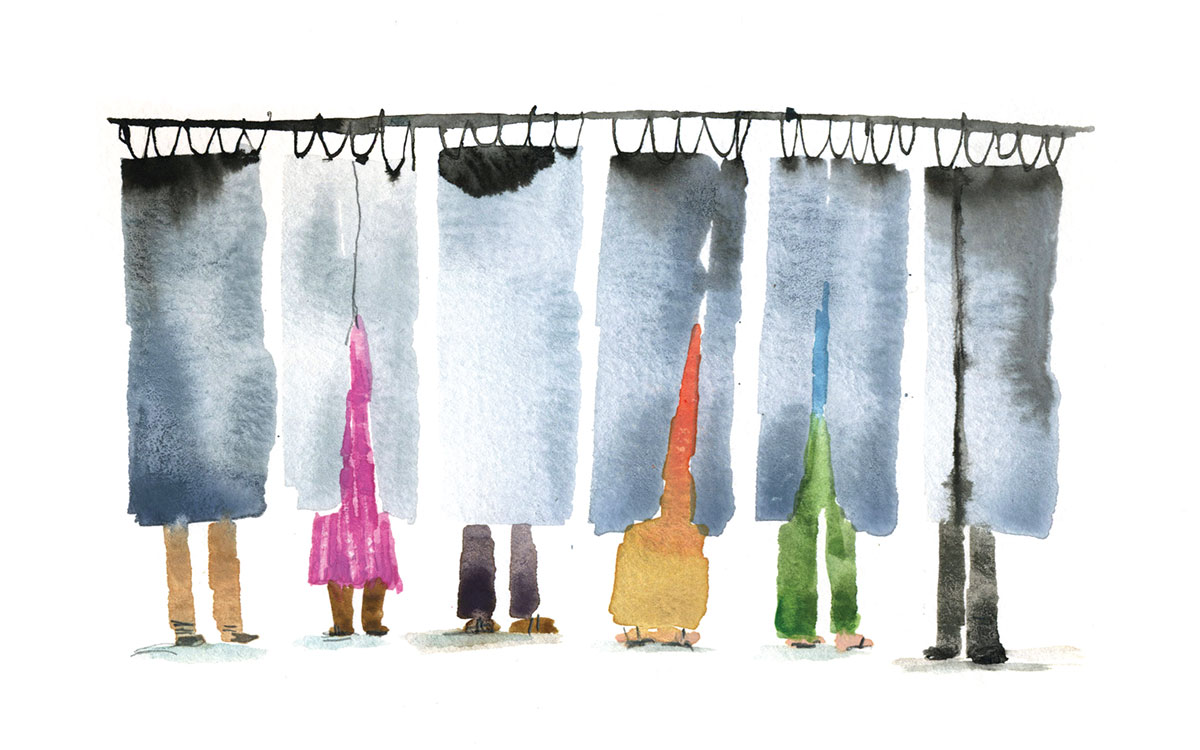
MARIA CARLUCCIO / THE I SPOT
Free and fair elections are the cornerstones of democracy. Without them, national security foundations crumble quickly. For decades, we have invested time and resources to safeguard electoral integrity around the world. Today one of the chief threats to free and fair elections is the online manipulation of information (and voters) by external actors seeking to undermine public trust in democratic institutions, exacerbate political divisions, and exploit the resulting chaos. Now foreign information manipulation and interference (FIMI) is a problem, moreover, that challenges the United States—despite our 250 years of experience with democracy—just as much as the rest of the world.
In 2011 the State Department office later called the Global Engagement Center (GEC) was created to help counter terrorism and other external threats exploiting the internet. As the growth of social media exploded over the next few years, so did the reach and impact of malign influences through FIMI. The GEC was expanded to address this problem in 2016 but was then shuttered in December 2024. By looking at how the GEC evolved and what it did, we can learn from its work for the future.
Online Terrorist Menace
In 2011 the Center for Strategic Counterterrorism Communications (CSCC, later the GEC) was created in recognition of the unprecedented online menace that nonstate actors like al-Qaida and ISIS/Daesh posed. Using the internet, terrorist groups were able to spread propaganda, raise funds, and recruit members across borders, and at the time we lacked the capacity to monitor, analyze, and counter them. Housed in the Office of the Under Secretary for Public Diplomacy and Public Affairs (R), CSCC was tasked with supporting government-wide public communications activities targeted against violent extremism and terrorist organizations. Initially, CSCC’s work focused on regions in the Near East and North Africa, where many terror groups were headquartered, but social media’s growth soon expanded the reach of malign influence and deliberate dissemination of false or misleading information.
To address this, in March 2016, President Barack Obama renamed and expanded the CSCC into the “Global Engagement Center” by Executive Order 13721. The GEC’s work soon revealed that other adversaries, not just terrorists, were exploiting online anonymity to target U.S. national security interests; potential interference in our democratic processes became a serious concern by the time of the 2016 U.S. elections.
With the National Defense Authorization Act of 2017, signed into law by President Obama on December 23, 2016, the GEC was to “direct, lead, synchronize, integrate, and coordinate efforts of the Federal Government to recognize, understand, expose, and counter foreign state and non-state propaganda and disinformation efforts aimed at undermining or influencing the policies, security, or stability of the United States and its allies and partner nations.” This mission was to be accomplished by tracking counterfactual narratives abroad, identifying trends in foreign propaganda and disinformation, and utilizing information from appropriate interagency entities to identify the countries, geographic areas, and populations most susceptible to propaganda and disinformation “where it is likely to cause the most harm.”
When the GEC began, few countries were aware of the disinformation threat from within, and even fewer were tracking it.
Because the GEC was based in R, Smith-Mundt Act restrictions on the distribution of public diplomacy media inside the United States were rigidly applied. Staff could trace the shadowy footprints of online propagandists and disinformers on other shores, but the minute the disinformation crossed U.S. borders or involved any Americans, the GEC’s investigations stopped.
At one time, the GEC enjoyed strong bipartisan support: It was co-sponsored by Senators Rob Portman (R-Ohio) and Chris Murphy (D-Conn.), and its first coordinator was a Trump appointee, Lea Gabrielle. As American politics grew more polarized, that bipartisan base of support began to change, but the organization and its funding still drew steady support from leaders of both parties until the end of 2024.
Troll Warfare
I joined the GEC in 2021, soon after I was PNGed from Moscow, along with other U.S. diplomats, as U.S.-Russian relations began their current nosedive. What I had learned in Russia and elsewhere in my career stimulated my interest in this new topic: the hybrid form of warfare fought against us in cyberspace via false personas, paid influencers, deepfakes, bots, troll factories, AI programs, and other manipulative tools. The internet allowed violent extremist organizations and authoritarian nations to meddle in the information space of other nations while hiding their fingerprints and practicing deniability. The openness and free-debate tradition of democracies created openings these adversaries eagerly exploited.
Earlier, in 2016–2017, when I was on a State Department detail to George Washington University teaching undergraduate courses on public diplomacy, NFL quarterback Colin Kaepernick chose to kneel during the national anthem at football games to protest endemic discrimination against Black Americans. Other players soon joined, and a national debate began. As a capstone project, a group of GWU graduate students studied the sources of tens of thousands of social media posts generated during the controversy’s height, and we were surprised to see that two-thirds of the posts studied did not originate in the United States. Most of them came from St. Petersburg, Russia.
There were not (and still are not) a lot of NFL fans in Russia, but St. Petersburg was home to the Internet Research Agency, a troll farm run by the erstwhile Putin crony Yevgeny Prigozhin. His trolls were pretending to be Americans, and the same individuals were posting concurrently on both sides of the debate: beseeching Black Americans and those left of center to defend Kaepernick’s rights, while exhorting conservatives online to oppose the protests that they claimed were “trampling on the American flag.” The Russian trolls did not really care about the NFL, Kaepernick, Black American rights, or our national anthem. All they wanted to do was provoke controversy and conflict.
Journalist Jacob Weisberg, writing in The New York Review of Books in September 2025, noted that digital tools have an extraordinary power to shape public opinion and mold mass culture. This is particularly true during election campaigns, when each party plays up its differences with other parties, and exaggerates its own candidates’ virtues and their opponents’ vices. Conflict draws attention, and social media posts with explicit, violent, aggressive, fearmongering, or otherwise emotive content tend to move faster and higher up the algorithm hierarchy than fact-based news and information (cute cat videos being an exception).
Some Major Successes
In my three years at the GEC (2021–2024), I served as a senior adviser, acting deputy coordinator, and supervisor of our Russia, Iran, and counterterrorism teams. I watched the GEC evolve from a small and often misunderstood office into an engine of creative outside-the-box thinking. Many of our staff came on details from other agencies or were contractors, bringing in new tools, resources, and perspectives. We hosted one of the few coveted security compartmented information facilities (SCIFs) at Main State, necessary because of our need for close coordination with the intelligence community to monitor adversary state communications.
We had some major successes that, for security reasons, we could not publicize at the time, including the downfall of ISIS leader Amir Muhammad Sa’id al-Rahman al-Mawla, who was later known internally as the Canary Caliph because of a GEC-enabled campaign to expose his past collaboration with the U.S. military in Iraq. We traced the post–Osama bin Laden leadership to Iran, where they were hiding in plain sight. We published oft-quoted exposés on the behind-the-scenes pillars of Russian and Chinese global disinformation networks, including their distortion of truth about the COVID-19 virus and about human rights.
I am particularly proud of the GEC’s efforts to inspire international coalitions of like-minded nations to combat online information manipulation and interference. In Eastern Europe, GEC teams helped identify troll networks operating in local languages to disrupt parliamentary elections, and our analyses helped host governments ensure that outside actors could not sway voters by pretending to be fellow citizens. When the GEC began, few countries were aware of the disinformation threat from within, and even fewer were tracking it. Today, the European Union, NATO, and more than 30 nations in Europe, Asia, Oceania, and Africa dedicate personnel to addressing this issue, and they cooperate closely with one another to trace and expose new trolls. Sadly, with the demise of the GEC, the United States is no longer part of that framework coalition.
Social media’s growth soon expanded the reach of malign influence.
As the GEC’s exposure of disinformation grew, so did misperceptions that the center was engaged in censoring free speech. When Elon Musk acquired Twitter (now X) in October 2022, he tweeted that he had found the real “Deep State ... the GEC,” calling us “the worst offender in U.S. government censorship and media manipulation.” In multiple testimonies to Congress and in interviews afterward, GEC leadership repeatedly explained how all our efforts were focused overseas, and how the organization strictly enforced its mandate and worked to avoid any monitoring or interaction with U.S. citizens or organizations.
But, as eight years of global disinformation analysis by the GEC (from 2016 to 2024) repeatedly demonstrated, sensational accusations often make a more lasting impression on consumers than subsequent data-driven rebuttals. In December 2024, the U.S. Congress chose to not extend the GEC’s mandate to operate, and the new Trump administration shut down the remaining office focused on countering FIMI in early 2025. Most GEC staff members were terminated then, or during the department-wide reductions in force (RIFs) in July 2025.
What the GEC Taught
As Doug Wake writes in this edition (see here), among the most pressing election monitoring issues in 2026 are “foreign interference and disinformation, deepfakes, AI, and online harassment.” Does the continued threat mean that the GEC was a failure?
Our inability to articulate to the public the importance of our work, and its effectiveness, is certainly a failure, although one might say the same today about USAID or many other components of the State Department. In one sense we were successful: After years of trying to raise awareness about the rising threat of disinformation, recent data shows that the public is increasingly concerned about the issue (in a 2025 Pew Research Center poll, a majority of citizens in 20 nations identified “fake news” as the greatest threat to their nation’s security). But in making the concern more tangible, we also inspired some in today’s politically polarized climate to blame the doctor for the disease diagnosis.
For many of us, our mobile phone is the first thing we check when we wake up and the last thing we look at before we sleep. It is the source of our news and weather, our favorite way to chat with distant relatives and friends, where we go for entertainment and music, the easel for our creativity, and our mobile encyclopedia, guidance counselor, and spiritual adviser (and AI-driven personal valet) all rolled into one. We are addicted to its flattery, speed, and accessibility, while we overlook its slow-acting poisons and crafty traps.
Just as the problem of disinformation lies glowing in front of our faces, so does the solution. Besides periodic election monitoring, to protect our democracy we also need to make information-monitoring a 24/7 priority. We should train every information consumer to rely on nonpartisan reliable sources and to distinguish data-driven facts from biased opinion. We should measure information once, and count twice, double-checking with a search engine or second source when we have any doubts. We should learn disinformers’ rhetorical techniques (e.g., exaggeration, conspiracy hints, urgency) and flag such messages for extra verification efforts (you may find the latter works well on most political advertising, too).
I do not believe that we should bring back the GEC in the same structure in the future. That model had its strengths (one leader called it “a five-year-old start-up company inside a 235-year-old bureaucracy”). But at the same time, it did not integrate across the State Department and the interagency as well as it could have, nor did it win every battle to expose its findings to wider audiences. Yet, as long as we face ongoing threats from authoritarian states and violent extremist organizations to undermine democracy around the world, I believe that we need a reformed GEC to fight back, one that brings together all interested parties in a transparent effort to fight foreign information manipulation and interference.
Trolls are very good at hiding and skilled at regeneration. They can only be defeated through vigilant detection, strength of resolve, and international collaboration—virtues that also work very well in other ways as we strive to protect our democracy.

Karl Stoltz is co-president of the Public Diplomacy Council of America (PDCA) and a guest lecturer at The George Washington University’s Elliott School of International Affairs. Previously, he was a U.S. Foreign Service officer for 38 years, serving in Russia, Poland, Denmark, South Africa, Myanmar, Malaysia, Indonesia, Papua New Guinea, and New Zealand, in addition to five tours in Washington, D.C. In his last assignment before retirement, he was an acting deputy coordinator and senior adviser at the State Department’s Global Engagement Center.
When sharing or linking to FSJ articles online, which we welcome and encourage, please be sure to cite the magazine (The Foreign Service Journal) and the month and year of publication. Please check the permissions page for further details.
Read More...
- “USAID Election Assistance: Lessons from the Field” by Assia Ivantcheva, The Foreign Service Journal, May 2018
- “Election Saga, Bangui” by Robert E. Gribbin, The Foreign Service Journal, June 2022
- “Today’s Top National Security Threat? You’re Looking at It” by Karl Stoltz, American Diplomacy, May 2025