Diplomats Required: Shaping the New International Economic System
Speaking Out
BY ALAN LARSON
Speaking Out is the Journal’s opinion forum, a place for lively discussion of issues affecting the U.S. Foreign Service and American diplomacy. The views expressed are those of the author; their publication here does not imply endorsement by the American Foreign Service Association. Responses are welcome; send them to journal@afsa.org.
The collapse of the American-led international economic system is at hand. Or at least so say many renowned experts. If the experts’ analyses are correct, and they may well be, State Department professionals should remember that their predecessors played leading roles in creating the most successful global economic system in history.
The architects of the new one will need unique capabilities: deep experience and expertise in dealing with China, a sophisticated understanding of the theory and practice of international economic policy, and the diplomatic skills to negotiate workable arrangements with other countries whose traditions and interests are not identical to our own.
State Department officers cannot accomplish this task alone. They will need to work closely as members of a team led by the president, Secretary of State, and other senior advisers. At the same time, no administration will be able to accomplish this task without the active involvement of State Department officers and their distinctive capabilities.
How It Was Done in the 1940s
Recall the construction of the last international economic system. In the early 1940s, Secretary of State Cordell Hull pressed the Roosevelt administration to prioritize postwar economic arrangements. Hull especially sought to avoid the protectionist economic policies by which one country would try to make itself richer by making other countries poorer. Such protectionist policies had led to the Great Depression and World War II.
Hull and Under Secretary of State Sumner Welles convinced President Roosevelt to include open trade principles in the Atlantic Charter, in which FDR and Winston Churchill set out a shared vision for the postwar world. Then Assistant Secretary for Economic Affairs Dean Acheson pressed Britain to commit to an open, multilateral trade regime as part of the Lend-Lease Act and negotiated the establishment of the World Bank.
Future Under Secretary for Economics Will Clayton drew on business acumen and diplomatic skill to parry an unsound proposal of Britain’s John Maynard Keynes. Acheson and Clayton were the administration’s most credible witnesses before Congress on the Marshall Plan.
Clayton also was the principal U.S. negotiator for the General Agreement on Tariffs and Trade, the predecessor to the World Trade Organization. At a crucial moment in the negotiations, Clayton convinced President Harry Truman to veto a protectionist tariff on wool that would have undercut America’s credibility in advocating for a new international system based on more open markets.
Joseph Stalin was determined to disrupt an economic recovery in Europe. Foreign Service Officer (FSO) George Kennan’s “long telegram” explained to Washington why the Soviets’ pervasive paranoia and insecurities would impel them to undermine political stability and economic recovery in Europe.
Henry Kissinger, not one given to cheap praise, judged that no FSO ever shaped debate over the U.S. role in the world to such an extent as Kennan. Acheson, Clayton, and Kennan played crucial roles in developing the Marshall Plan and assisted Truman to make the case for it before Congress and the American people.
America’s Leading Role
In 1991, during my stint as U.S. ambassador to the Organization for Economic Cooperation and Development (OECD), a retiring European ambassador shared an experience he had had nearly 40 years earlier in the very same room.
Back then, Averell Harriman, at the time the chief U.S. representative to Europe, had described to European diplomats, including my colleague, what the United States was prepared to do if Europeans would band together and develop a recovery plan based on reform and trade. For the first time in years, hope surged among the European diplomats.
Secretary of State George Marshall had made the case that “the economy of Germany must be rebuilt,” a sharp contrast to U.S. policy after World War I. Truman and the State Department pressed ahead with a reform of Germany’s currency even though Stalin blockaded Berlin. The United States was so committed to economic recovery that it launched the first airlift of supplies to Berlin.
During the decades since the Marshall Plan, the U.S.-led international economic system needed maintenance and updates to remain vibrant. State Department officers stepped forward whenever the system was tested by unexpected trials.
• The first oil shock of 1973–1974, inflicted by the Organization of Arab Oil Exporting Countries (OAPEC), plunged the world into recession. OAPEC intended to pressure the United States to stop supporting Israel after Egypt attacked it in the Yom Kippur War.
Tom Enders, then assistant secretary of State for economic and business affairs, led efforts to establish a counter cartel of oil consuming countries, the International Energy Agency (IEA), that aligned consumers’ policies and established a system for sharing oil when supplies are disrupted. The IEA proved its value in 1978, when the Iranian Revolution brought a second damaging oil supply disruption.
• During the Carter and Bush (41) administrations, State Department officers, working with the Department of Transportation, reinforced the global economic system by creating the “Open Skies” framework for international travel of passengers and cargo, laying the foundation for just-in-time delivery of components for complex modern supply chains.
• State Department officers worked with the U.S. Treasury to prevent the 1997 Asian financial crisis, and similar financial crises in Latin America and Europe, from disrupting the global economy.
• State Department officers and the Justice Department negotiated the OECD Anti-Bribery Convention in 1997 to strengthen the legitimacy of the international trade and investment system.
Former Treasury Secretary and Secretary of State George Shultz often observed that officials in the State Department and Treasury intrinsically understand the vital importance of the global systems on which security and prosperity depend.
Not all presidents have this understanding. For example, Herbert Hoover and FDR: Though highly experienced in world affairs, each fumbled crucial opportunities to end the Great Depression.
Hoover plunged ahead with the protectionist Smoot-Hawley tariffs even after the steep stock market collapse and the onset of the depression. FDR sabotaged the 1933 World Economic Conference, ridiculing international cooperation while he adopted an uncontrolled dollar depreciation to boost U.S. prosperity at the expense of other countries.
What Is Required
Rebuilding a functioning international economic system is likely to be very challenging. The United States will need to formulate and skillfully implement an astute and comprehensive policy toward China, a more daunting economic challenger than the former Soviet Union was.
China and the United States each have sought to weaponize economic interdependence. China leveraged its stranglehold over rare earth minerals to pressure the U.S. policy. The Biden and Trump administrations have tried to keep sensitive semiconductor products and technology away from Chinese firms.
We will also need to test whether China will decide to destroy an international economic system based on broadly shared values or recognize that it can gain by collaborating with the United States and other countries on a system that works for all.
The United States will need to protect itself where we have economic vulnerabilities and maximize our economic strengths. We need to be the country in which the world’s best and brightest want to study and work. We need to strengthen our world-class research capabilities.
We need to rely on competitive markets rather than state capitalism. We need to devote intellectual energy and resources to retraining and supporting those whose jobs and communities are disrupted by economic change.
Developing countries must have a place in a refurbished global economic system. A U.S. development strategy should recognize the centrality of economic growth, open markets, and foreign investment.
And the goal of development should be to expand individuals’ freedom to live the sort of lives they value. Democracy, good government, reasonable health care, and education are all fundamental to development.
Coercive tariffs are major obstacles to a well-functioning global economic system. The costs of tariffs are borne mainly by the end-users of imported goods. The cost of tariffs on imported steel and aluminum, for example, are borne mainly by industries that heavily use steel and aluminum as inputs, notably producers of automobiles and farm machinery made in the United States.
And as every soybean farmer in America knows, when foreign countries retaliate against U.S. tariffs, such retaliation inflicts an additional cost on the targeted industry.
Tariffs on imports also have economic effects that are nearly identical to taxes on exports. American import tariffs weaken America’s most internationally competitive industries. High tariffs will make the U.S. economy weaker and less productive.
When the United States tries to use tariff policy to tip the commercial playing field in our favor, it creates an unstable international economic system. Our major trading partners will intensify economic relationships with each other and avoid economic relationships with us. The United States represents less than a quarter of world trade.
Over time, tariff policy can isolate the country.
Rising to the Challenge
The current international economic system may limp along for several years without a caretaker. But sooner or later, calamity will arrive, as it did for my parents’ generation during the Great Depression and World War II.
For State Department professionals, the current era of disorder can be discouraging. Sooner or later, however, changed circumstances will permit a new international economic order to be created. When that time comes, America will need the skillful work of State Department professionals.
Large challenges have a way of summoning greatness. America’s “greatest generation” was not born into greatness, like entitled royalty. Rather, the pressure of difficult challenges hardened them into diamonds.
My hope and expectation are that the greatest generation of professional American diplomats has yet to arrive.
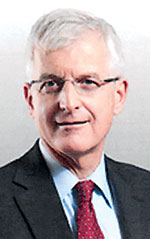
Alan Larson is a retired Foreign Service officer with the rank of Career Ambassador who served as under secretary for economic affairs, assistant secretary for economic and business affairs, and ambassador to the OECD. After retiring from the State Department, he advised businesses on their most complicated and consequential international challenges.
When sharing or linking to FSJ articles online, which we welcome and encourage, please be sure to cite the magazine (The Foreign Service Journal) and the month and year of publication. Please check the permissions page for further details.
Read More...
- “European Debt, The Trans-Atlantic Alliance, and U.S. Foreign Policy” by Alan Larson, The Foreign Service Journal, February 2012
- Economic Diplomacy from the FSJ Archive, The Foreign Service Journal, January-February 2019
- “Integrity First” by Alan Larson, The Foreign Service Journal, March 2020

Related Links
Featured Content from This Issue:
FOCUS ON AI IN DIPLOMACY
- Leading from the Edge: How Diplomats Are Actually Using AI
- Beyond Borders: What U.S. Diplomats Can Learn from Global AI Innovation
- AI Should Assist, Not Replace, U.S. Diplomats
- Transforming Diplomatic Productivity with AI
- Are AI Consular Officers in Our Future?
- US(AI)D: What Launching AI Tools for Communicators Taught Us
- At the Intersection of AI and Foreign Policy: A Q&A with Kelsey D. Atherton
FEATURE
LIFE AFTER THE FOREIGN SERVICE
EDUCATION SUPPLEMENT
- Education in the Foreign Service: Navigating Transitions, Neurodiversity, and Academic Pathways
- Education-at-a-Glance
PERSPECTIVES
- President’s Views: A Trifecta for 2026
- Letter from the Editor: It’s the People
- Speaking Out: Diplomats Required—Shaping the New International Economic System
- Reflections: The Trembling Earth—Guatemala, 1976
- Local Lens: Svalbard, Norway
DEPARTMENTS
AFSA NEWS