After the author’s house was attacked and looted, other embassy family members were evacuated across the river, into an uncertain future.
BY JOHN DUNLOP
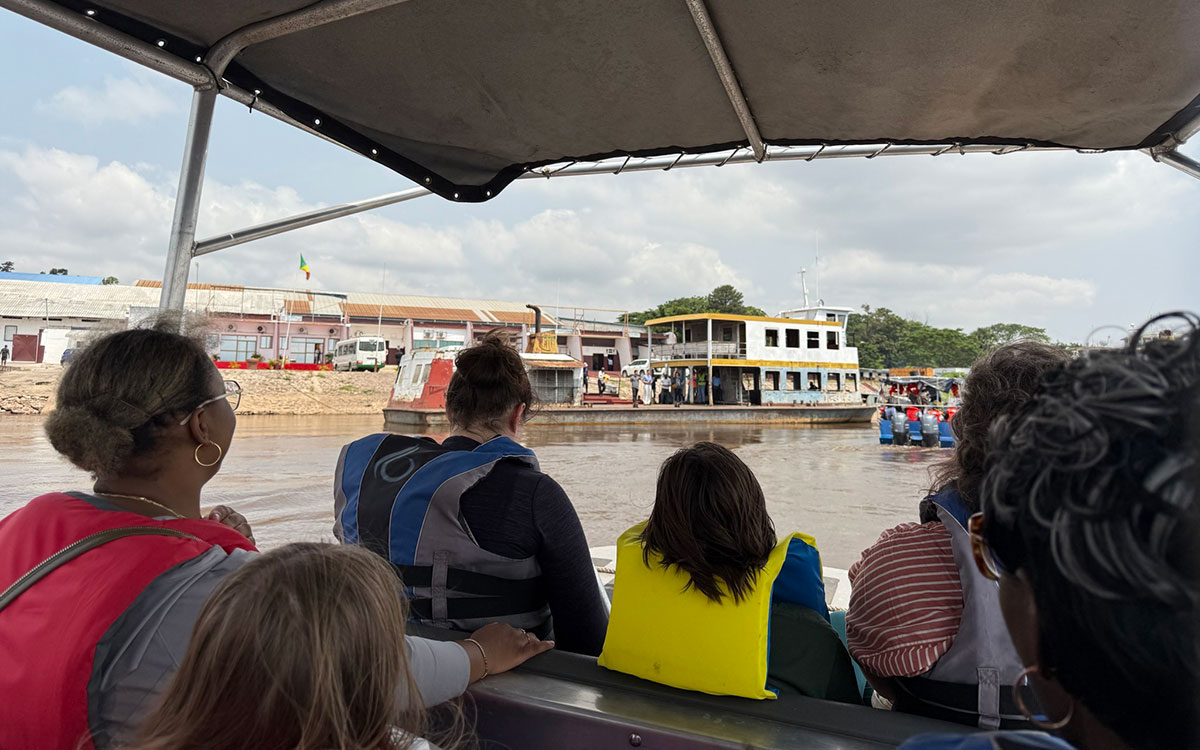
U.S. embassy family members on the Congo River arriving in Brazzaville.
COURTESY OF JOHN DUNLOP
The fall of Goma in mid-January 2025 sent shockwaves through the Democratic Republic of the Congo (DR Congo) that reached all the way to the capital, Kinshasa.
The U.S. embassy had announced on January 27 that unrest was possible. Early the next morning, it was already clear that the usual low-level protesting outside the embassy was going to be something else entirely. Staff traveling to work and buses going to the international school were turned around. Those already at embassy or USAID facilities were told to shelter in place.
By 7:30 a.m., large-scale demonstrations had erupted across the city, targeting foreign embassies and expatriate-owned businesses. By late morning, cars were burning in the streets and explosions could be heard in areas of town where many embassies were located. Both the U.S. embassy and its administrative compound, located roughly half a mile apart, came under attack.
Across the city, embassy and USAID mission staff sheltered behind compound walls with their families, monitoring radio traffic and waiting. They heard my radio calls, heard me report that my gate had been breached by demonstrators. Far from embassy security services, in a city with impassable roads, they called their children inside and secured their doors, waiting for instructions.
Later that afternoon, as the situation in the city stabilized, the deputy chief of mission (DCM) convened an Emergency Action Committee, and the ambassador approved its recommendation: immediate evacuation of all nonemergency personnel and their dependents.
The evacuation route had been rehearsed several times. All staff and their families were to go to the DCM’s residence before moving in groups to the river docks, where small boats would carry them across the Congo River to relative safety in neighboring Republic of the Congo (Brazzaville). The plan was straightforward. The execution, beginning at 2 a.m. on January 29, was not as smooth.
 §

The first complication had already occurred before the protests began. On January 27, most senior USAID leadership in Washington had been placed on administrative leave. In the preceding week, the new administration had systematically restricted USAID’s operational and financial systems, locking controllers and financial staff out of the payment platforms that govern everything from procurement to emergency reimbursements. By the time the evacuation was ordered, USAID had been badly hobbled at a system-wide level.
There were almost no officials in Washington with both the authority and the system access to support USAID’s share of the operation. Emergency support meetings in Washington that would normally have been filled with experienced and specialized staff dwindled rapidly as participants lost access or were directed to stand down. The dedicated staff who remained did what they could, but they operated in a near-vacuum of leadership, authority, and tools.
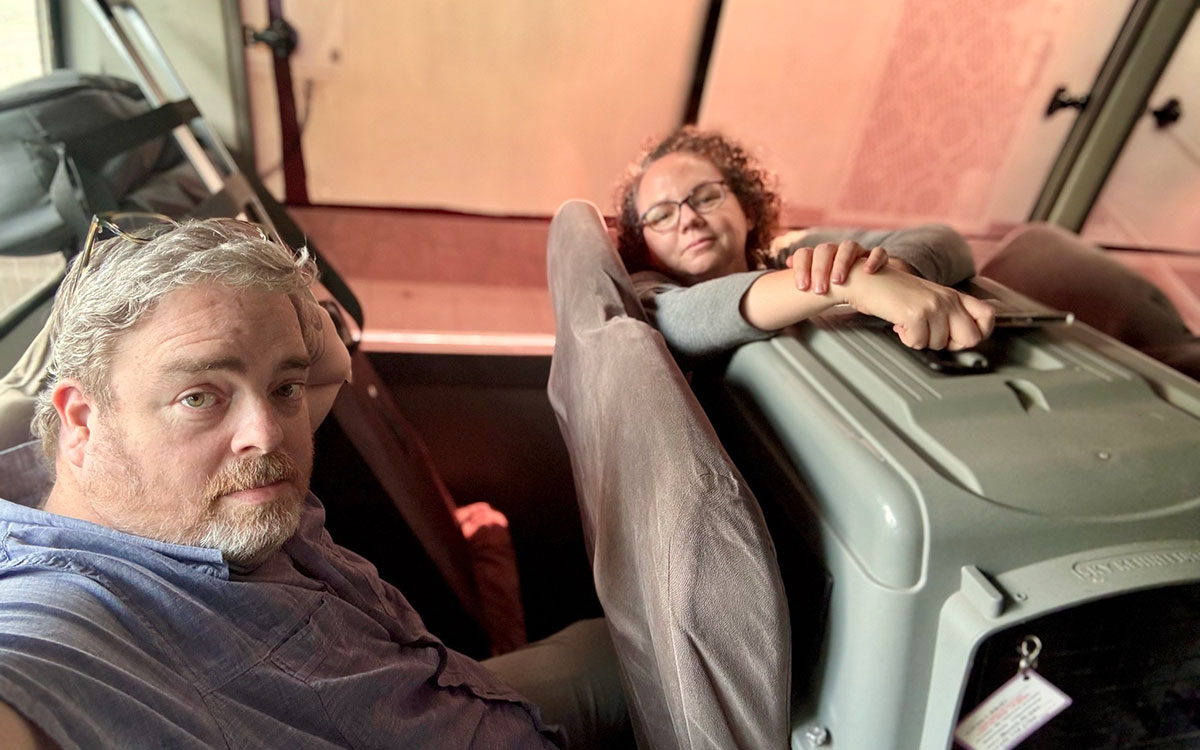
Evacuees on the bus with their dog headed to the port in Kinshasa.
COURTESY OF JOHN DUNLOP
The DCM’s residence told its own story. Anxious adults, children of all ages, toddlers, dogs, and cats covered every available surface, trying to rest before their group was called. The evacuation had begun at 2 a.m. and no one had slept meaningfully the night before. The air in the house was thick with exhaustion and worry. Potable water ran low.
Evacuation instructions had been clear: Bring one carry-on bag or backpack per person. Only what you can fit in your lap. Some families used their single bag to bring a pet. Others had to leave animals behind. Many evacuees had winter coats tied around their waists, an incongruous sight in the equatorial heat of Kinshasa, but everyone on those docks understood they were heading to Washington, D.C., in late January.
§Each river crossing took less than 10 minutes. On the far side, staff from U.S. Embassy Brazzaville were doing their best to support this sudden and overwhelming influx.
In Brazzaville, evacuees were housed in hotels overnight as the full weight of what had happened began to settle. Children who had been managing on adrenaline started to cry, from exhaustion, from confusion, from missing a parent who had stayed behind.
On the flight itself, people pulled together. Adults who were not parents circulated through the cabin entertaining the small children of their tired colleagues. Older children built blanket forts in the empty seats. Amid everything—the shock, the grief, the uncertainty about what waited on the other end—the people on that aircraft supported one another.
State Department personnel were met on arrival at Dulles, assisted with temporary housing and other needs. The system, though imperfect, functioned. People were seen and cared for.
§But for USAID staff, the arrival in the United States marked the beginning of a second ordeal. Stepping off the plane on a Friday evening, USAID employees were met by a few Africa Bureau professional staff—but in an informal capacity.
With talk of reductions in force (RIFs) widespread, it was unclear if USAID would support the evacuees at all. The first blow: Staff who were hoping to move on to safe havens elsewhere in the United States were told they would be required to stay in or near Washington, D.C., under newly imposed rules prohibiting telework.
Over the next few days, with hostility radiating from USAID HQ at the Ronald Reagan Building, staff scrambled to find and sign leases for expensive D.C.-area housing. They had no choice and no time; it was winter and shelter was critical.
Far from embassy security services, in a city with impassable roads, they called their children inside and secured their doors, waiting for instructions.
That Sunday night, just before the start of the workweek, an email arrived instructing USAID employees that the Reagan Building was closed and that no one would be allowed to enter. The email was unsigned. No explanation was offered. That same weekend, public statements began to circulate from senior officials in the new administration describing USAID as a criminal organization, calling for it to be destroyed, to be “fed into the wood chipper.”
For these FS members—parents and children who had just spent 20 hours on a plane after evacuating under threat of violence from a high-threat posting in service to their country—the words were not abstract. They were a direct betrayal of the contract of support and protection from the organization and the country they had spent their careers serving, just when they needed that support most.
No senior political leadership within USAID was willing to engage with the newly arrived evacuees, and requests directed to both State and USAID were met with silence. USAID families began accumulating significant debt to pay for food and temporary lodging, with no assurance that any of it would be reimbursed. Real fear began to set in: Did evacuees still have jobs? Were they facing liability for housing leases that would never be reimbursed? How would they enroll their children in school? Were they perhaps even facing homelessness?
The few USAID Washington employees who heroically worked to support people and keep them informed had almost no information to share. They explained, honestly, that they were reading the same news headlines and court filings as everyone else, trying to understand what was happening to the agency.
§Only after a direct appeal from the U.S. ambassador in Kinshasa did the State Department agree to extend evacuation subsistence and related allowances to USAID staff—initially promised for one month only. Even then, USAID’s internal payment systems had been largely locked, and reimbursement processing was repeatedly interrupted. Financial staff occasionally managed to regain temporary access to the system and began to process payments, but that access would again be revoked within a day or two.
Staff waited months for reimbursement. Several entry-level officers and contractors faced the genuine prospect of bankruptcy. For weeks at a stretch in February and March, evacuees did not know whether they were authorized to work. Communications from Washington were cryptic by design, calibrated more to intimidate than to inform.
Within a week of the evacuation, it was apparent that USAID itself was being systematically dismantled. Evacuated staff faced the threat of immediate termination as well as the real possibility that the agency would not support their return to post to retrieve household effects abandoned in their rush to escape ahead of the rioting mobs.
§As USAID mission director, I remained in Kinshasa while my wife was evacuated with the rest of the families. I left for the United States about one month later, returning to the DRC that summer with my deputy mission director, contracting officer, and deputy executive officer. Like so many others at missions around the world, we oversaw the closure of a $1.3 billion annual program for the Central Africa region and managed the termination of approximately 250 Congolese and regional staff.
The evacuation from Kinshasa was, technically, a success: Everyone got out, no one was hurt in the process, and the logistical machinery of river boats, airplanes, consular officer support, and host-country cooperation performed largely as designed.
But the USAID personnel who boarded that plane tell a different story, one of deliberate abandonment by the institution they had served, financial precarity, professional erasure, and the particular cruelty of being told, after risking everything, that their service had not mattered and their agency did not deserve to exist.
The emotional accounting of that year is harder to measure than the financial one, and it is far from complete.

John Dunlop was the USAID mission director in the Democratic Republic of the Congo and Central Africa region when the story below took place. He began his Foreign Service career as a health officer and has served in Kenya, Tanzania, Rwanda, Madagascar, Jordan, Iraq (two tours), and Afghanistan. He is a two-time recipient of the State Department Award for Heroism. Dunlop retired from USAID in September 2025 as a minister counselor.
Read about Dunlop’s harrowing escape from rioters in DR Congo in the September-October 2026 FSJ.
When sharing or linking to FSJ articles online, which we welcome and encourage, please be sure to cite the magazine (The Foreign Service Journal) and the month and year of publication. Please check the permissions page for further details.
Read More...
- “Mercy Is Its Own Reward” by Andrea Kormann Lowe, The Foreign Service Journal, October 2017
- “What to Expect When You’re … Evacuating” by Donna Scaramastra Gorman, The Foreign Service Journal, July-August 2022
- “They Left Nothing” by John Dunlop, The Foreign Service Journal, September-October 2026