The world is in a democratic recession. Can Americans work together to repair our democracy and fight back the global rise of competitive authoritarianism?
BY JENNIFER L. DAVIS
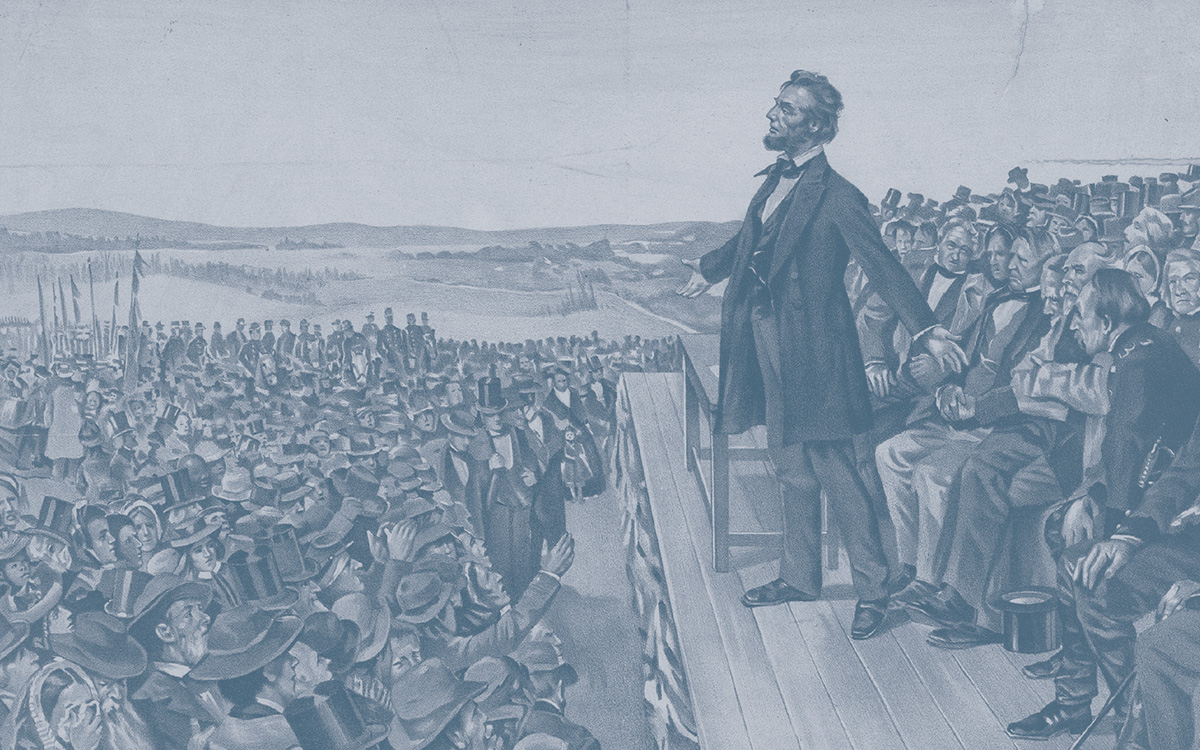
President Abraham Lincoln urges Americans to devote themselves wholeheartedly to the “unfinished work” of preserving the “new nation conceived in liberty and dedicated to the proposition that all men are created equal” in his famous address at the consecration of the Gettysburg National Cemetery on November 19, 1863.
LIBRARY OF CONGRESS
It is now 12 score and 10 years that our Founders “brought forth a new nation,” as Abraham Lincoln put it at Gettysburg in 1863. That nation was dedicated to the idea that self-governance was possible, but only within the context of a carefully crafted system of checks and balances that placed limits on power.
The Founders were not naive about the fragility of democracy or the relationship between domestic health and foreign power. Madison, Jefferson, and Hamilton shared a conviction that republican self-governance would be America’s most durable strategic asset. They built institutions accordingly: not perfect institutions, but ones designed to outlast any single leader, resist any single faction, and carry forward the accumulated expertise and judgment that democratic statecraft requires.
Democracy in Peril
Two hundred and fifty years on, those institutions are under a threat of the kind our Founders feared most. For myriad reasons, the United States has become so polarized that we are now more likely to identify as members of one political side or the other than to identify simply as Americans, aware of the unique privileges such identity grants. Across the political spectrum, our leadership is more inclined to point out what divides us than what binds us together. A consistent and reputable body of polling data shows that many Americans do not trust their government and do not believe our democracy is working. Young people in record numbers feel pessimism, not hope, about the future.
America’s democracy is not the only one under strain. The global order that emerged from the Second World War, led largely by the United States, allowed for an unprecedented 80 years of relative global peace and an increase in the number of electoral democracies in the world until 2000. In fact, a significant goal of U.S. foreign policy after that war was the promotion of democracy as the best form of government under the timetested theory that democracies are far less likely to go to war with one another and more likely to have strong economies and lower corruption, allowing for greater stability and global prosperity.
But for the past two decades, the world has found itself in a “democratic recession,” as Freedom House has termed it, in which the world’s democracies have steadily declined in number and the health of the remaining democracies has deteriorated. While democracy has been on its back foot, autocracy and “competitive authoritarianism” have enjoyed a period of expansion. These trends are blamed, in no small part, on the internet, social media, and the foreign malign influence campaigns with which authoritarian regimes control and interfere with the global information ecosystem. Today, less than one-fifth of the world lives in a country that Freedom House would define as “free.”
Competitive Authoritarianism on the Rise
“Competitive authoritarianism,” a term coined by Steven Levitsky and Lucan Way in 2002, describes a hybrid government in which leaders gain power through elections but then erode the established systems of checks and balances of their democracies to enhance their own power. It is recognizable to U.S. diplomats who have served in countries experiencing it and involves a familiar pattern: Leaders of competitive authoritarian countries attack the systems and sources of information that they fear may weaken their hold on power.
They attack the free press, free speech, universities and academics, the judiciary, and, importantly, nonpartisan career public servants, because each of these is a mechanism of accountability. Competitive authoritarians fear open and transparent information flow because they seek to conduct themselves without checks on their power by a well-informed citizenry. In fact, it is this very hubris and feature of authoritarianism—that its leaders decimate the sources of information that might help them avoid perilous errors of judgment—that has led to the eventual downfall of most such governments.
Once a healthy democracy descends into competitive authoritarianism, it is not doomed to that fate. Today, in countries such as Poland, Brazil, and now potentially Hungary following its recent elections, we have seen an engaged citizenry reverse some of the harm done to democratic institutions. But these reversals are hard fought and tenuous. Another feature of competitive authoritarianism that gives it its signature “frog in boiling water” feel is that citizens begin either to fear acting in defense of their democratic institutions lest they be singled out by authoritarian leaders or to feel apathy if they perceive that the harm to their democratic institutions is irreversible. This makes turning the authoritarian tide even more difficult.
A consistent and reputable body of polling data shows that many Americans do not trust their government and do not believe our democracy is working.
However, democracies must reckon with another uncomfortable fact: Strongman regimes may be on the rise because of the inherent challenges that democracy faced in trying to deliver for its people. The Information Age has fueled truth decay and polarization, generating major swings in the U.S. political landscape between hardening progressive and conservative poles as the moderate middle seemingly disappears. Infrastructure projects are mired in regulation; social benefit and health systems have become so byzantine as to be impossible to navigate; and real crises like affordable housing are convenient to acknowledge but inconvenient to resolve.
With these challenges at home, it is evident why Americans have been frustrated with the conceit of our nation-building experiments overseas in places such as Afghanistan and Iraq. The United States and its allies pursued a seductive but ultimately flawed theory: that democracy could be delivered from the outside in, installed through military force, constitutional drafting, and elections held before the deeper cultural, institutional, and civic foundations that sustain self-governance had been laid. What followed were two decades of tragic miscalculation, in which we relearned the painful lesson that democracy is not an export. It is a living culture, built over generations through civic education, independent institutions, and the slow accumulation of trust between citizens and their government.
Democracy at Home, Diplomacy Abroad
The health of our democracy at home has inevitably affected our ability to conduct effective foreign policy abroad. In 1947, at the start of the Cold War, Senator Arthur Vandenberg, then chairman of the Senate Foreign Relations Committee, asserted that “partisan politics must stop at the water’s edge.” Together, Vandenberg, a Republican, and the Democratic Truman administration forged bipartisan support for the Marshall Plan, the very foundation of the unprecedented 80 years of peace and democratic expansion that followed.
A year earlier, in 1946, George Kennan penned the Long Telegram to warn: “Much depends on the health and vigor of our own society. This is a point at which domestic and foreign policies meet. Every courageous and incisive measure to solve the internal problems of our own society … is a diplomatic victory. [T]he greatest danger that can befall us in coping with the problem of [authoritarianism] is that we shall allow ourselves to become like those with whom we are coping.”
Over the past two decades, America’s career nonpartisan diplomats have experienced the dangers about which Kennan warned. Certainly, the challenges to our democracy and our foreign policy are not the product of one party or one leader. They are myriad and deepening, although vastly accelerated in the past year.
For example, our government’s budgetary challenges have negatively affected our foreign policy. The modern budgetary process began in 1976, but the past 15 years have witnessed far more frequent government shutdowns of much longer duration within a far more politically polarized context. During these shutdowns, our diplomats must focus on preparing for the confusion that ensues instead of on the diplomacy they would otherwise be conducting.
Our nomination and confirmation process for presidential appointees is sclerotic and largely broken, especially for nonpartisan career ambassadors. Long gone are the days when a panel of career diplomats with decades of service would sit before the Senate Foreign Relations Committee for a speedy hearing and a timely confirmation. As well, the number of political appointee ambassadors has steadily increased to a percentage today most modern democracies find jarring.
This is not to diminish the contributions of extraordinary political ambassadors. It is simply to note that the balance between political and career appointments and the backgrounds of the political appointees has shifted in ways that have depleted the depth of experience that effective diplomacy requires. Today an unprecedented 100 or more U.S. missions abroad do not have a Senate-confirmed ambassador. And our strategic adversaries, China and Russia, are taking full advantage of that vacuum in U.S. leadership.
Most worrisome are the moments in which public servants are the subject of scorn for political gain. Phrases like “deep state” are as cynical as they are corrosive and a deliberate effort to delegitimize the very people whose expertise and integrity our diplomacy depends on. Nonpartisan public servants swear their oath to the Constitution and to the system of government it created. It is a dishonor to their sacrifices to suggest they want anything other than America’s enduring strength, the cause to which they have dedicated their lives. For Foreign Service members, the gilded names in the Department of State’s lobby of colleagues who made the ultimate sacrifice are a daily reminder of their dedication to our country.
America’s Soft Power
On the global stage, U.S. “soft power” has allowed us to attract and persuade rather than to coerce. But soft power depends on an audience’s belief that the exemplar is genuine. When democratic institutions visibly malfunction—when elections are violently contested, when government institutions are instrumentalized for political ends, when leaders are not committed to providing truthful information, when nonpartisan experts are prevented from serving—that credibility erodes.
Our adversaries do not simply take note. They weaponize the development. Russian and Chinese state media regularly amplify images of democratic dysfunction because discrediting the American model is itself a strategic objective. Every domestic fracture becomes a foreign policy liability for the United States.
Leaders of competitive authoritarian countries attack the systems and sources of information that they fear may weaken their hold on power.
Our democratic allies watch closely too, and what they see shapes their calculations. The network of alliances, international institutions, and norms that the United States designed was built on an implicit premise: that U.S. leadership was reliable, predictable, and underwritten by a durable domestic consensus. When that consensus frays, allies hedge. They ask whether U.S. security commitments and treaties will survive the next election cycle. They begin diversifying—economically, diplomatically, and militarily. This is not anti-Americanism; it is risk management in a fractured global disorder.
Finally, a dimension that is harder to quantify but impossible to ignore is America’s moral standing to speak on behalf of democratic values. U.S. diplomacy has always blended realpolitik and idealism in an uneasy tension. The idealist strand, which insists that how governments treat their own citizens is a legitimate subject of international concern, has been among the most consequential contributions the United States has made to the international order. That strand depends on a moral standing that must be continuously earned. It cannot survive on historical reputation alone.
Unfinished Work
Given these realities, it is clear that in order for our Foreign Service to compete effectively, we, the American people, must strengthen and repair our democracy. It will not be an easy path, but there is no other path worthy of our Founders’ vision. As Lincoln wisely counseled in the Gettysburg Address, it is “for us, the living, ... to be dedicated to the unfinished work” that our Founders and those who have served our nation nobly advanced.
At Gettysburg, Lincoln did not ask his audience to be hopeful. He asked them to be resolved. In hope, one waits. In resolve, one acts. For America’s diplomats, resolve means staying in the arena: writing, testifying, supporting AFSA and its right to serve as an advocate for the Foreign Service as outlined in the Foreign Service Act of 1980, and mentoring the next generation of officers who are watching to see whether a diplomatic career is worth the sacrifice.
For all Americans, resolve means understanding that democracy is saved in school board meetings, in local newsrooms kept alive by paid subscriptions, and in state legislatures where the rules governing free and fair elections are written.
Democracy is saved when we choose to listen to one another across our divides and seek out information beyond our own echo chambers.
Democracy is saved when we hold our leaders accountable for corruption and self-enrichment, or when we find the courage to demand that our leaders reject the politics of division, which serves them but diminishes us.
Democracy is saved when each one of us asks, “What can I do today to make my democracy stronger?”
Poland is slowly rebuilding its judiciary. Brazil is reclaiming its democratic institutions. Hungary finally rejected competitive authoritarianism in favor of something more hopeful for its people. They did not do so because conditions “became” favorable. They did so because enough of their citizens decided that the cost of inaction was higher than the cost of engagement. In his victory speech on April 12, the leader of Hungary’s winning opposition party Péter Magyar harkened back to President John F. Kennedy when he said: “Today, we won because Hungarians did not ask what their country could do for them; they asked what they could do for their country.”
Lincoln did not promise that our union would survive. He exhorted us to fight for it. The unfinished work remains, and it is incumbent on all Americans to undertake it together.

Jennifer Davis is the Knott Distinguished Professor of Practice at the University of North Carolina at Chapel Hill and a fellow at Georgetown University’s Institute for the Study of Diplomacy, where she focuses on democracy and diplomacy. She retired in 2025 as a Senior FSO, having served in the State Department’s Bureau of Population, Refugees, and Migration; at the U.S. Mission to the United Nations; in Türkiye, Colombia, Belgium, and Mexico; as the executive assistant to Secretaries of State Hillary Clinton and John Kerry; and as the special assistant to Secretary Condoleezza Rice.
When sharing or linking to FSJ articles online, which we welcome and encourage, please be sure to cite the magazine (The Foreign Service Journal) and the month and year of publication. Please check the permissions page for further details.
Read More...
- “Promoting Democracy in Tumultuous Times” by Bill Wanlund, The Foreign Service Journal, December 2022
- “Outside Observers See the United States in Ways We Ourselves Cannot” by Alexis Ludwig, The Foreign Service Journal, January-February 2020
- “What Future for International Democracy Support?” by Thomas Carothers, Rachel Kleinfeld & Richard Youngs, Carnegie Endowment for International Peace, July 2025