Modern diplomats are keeping Benjamin Franklin’s legacy alive, as the Association for Diplomatic Studies and Training’s oral history archives show.
BY TOM SELINGER
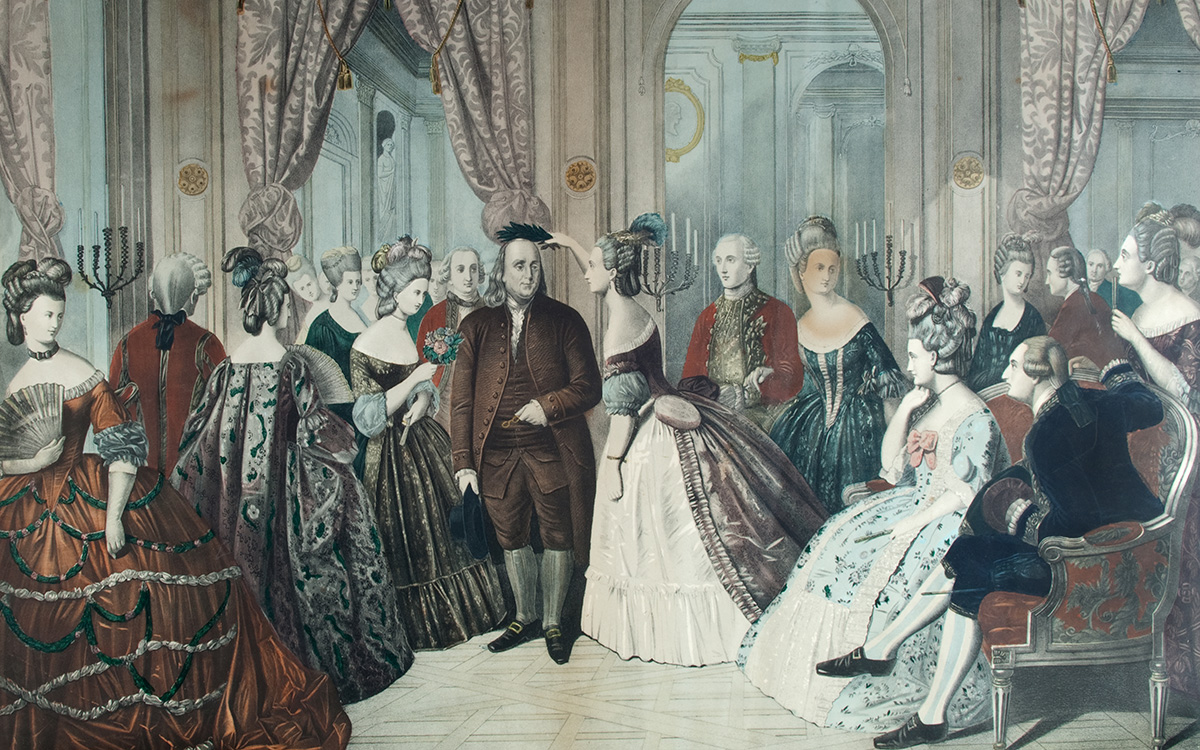
Benjamin Franklin, the first official U.S. envoy to a foreign government, is received at the Court of France in 1778, after signing treaties that established the two countries’ alliance during the Revolutionary War.
LIBRARY OF CONGRESS
Today’s diplomats walk in Benjamin Franklin’s footsteps every day, building on his achievements and echoing his tactics, perhaps without even knowing it. With this in mind, in 2012 the Association for Diplomatic Studies and Training (ADST) adopted “Cool Ben”—a portrait of America’s first diplomat sporting shades—as an emblem of the organization and its mission: capturing, preserving, and sharing the experiences of America’s diplomats. (Note that Cool Ben and ADST have no affiliation with the more recently created Ben Franklin Fellowship.)
ADST’s oral history collection now includes interviews with more than 3,000 diplomats and covers a century of U.S. foreign relations. An independent, nonprofit, educational organization, ADST has honored Benjamin Franklin throughout its 40-year history as the model for a kind of diplomacy that values strong alliances, promotes cultural understanding, and leverages mutual interests in international relations.
Famous for countless inventions, from bifocals to lightning rods, Benjamin Franklin was equally brilliant as the inventor of U.S. diplomacy. Dispatched to Paris by the Continental Congress and its Committee of Secret Correspondence as America’s first official envoy to a foreign government, Franklin crossed the Atlantic with few instructions and even fewer resources. His task was simply to secure outside assistance for the Revolution. The result was, as the celebrated biographer Stacy Schiff called it, “a great improvisation.”
At age 70, Franklin was famous around the world for his writings and experiments with electricity. He found Paris enamored with Enlightenment ideas yet still trapped in monarchical traditions. Walking into Versailles in simple suit and fur cap rather than court dress and powdered wig, Franklin became a sensation as the representative American—a frontier philosopher who has shed the burden of European excess.
Without democratic republics to serve as role models for his diplomacy, Franklin followed his instincts over the course of nearly nine years in France and created something new. Rather than representation of a monarch, Franklin’s diplomacy encompassed the full spectrum of our new nation’s interests through explaining our people and values, securing supportive allies, promoting our prosperity, and ultimately ensuring American freedom.
The following snapshots of Franklin’s diplomatic brilliance in Paris are paired with accounts drawn from ADST interviews showing modern diplomats keeping his legacy alive, as they have been doing for generations.
Exuding Confidence
As the famous representative of a relatively unknown country, Franklin became adept at bluffing his way past obstacles. No one wants to support a losing cause, so Franklin portrayed the colonies as invincible, even as the Continental Army was outgunned in every battle. He insisted that General Washington commanded 80,000 soldiers when the truth was closer to 14,000. When told in 1777 that British General William Howe has taken Philadelphia, Franklin replied, “You are mistaken. Philadelphia has taken Sir William Howe.” Franklin’s words proved prophetic: Cut off from supply lines, the British abandoned Philadelphia some nine months later.
Rather than representation of a monarch, Franklin’s diplomacy encompassed the full spectrum of our new nation’s interests.
As U.S. deputy chief of mission in Fiji in 2000, Ronald McMullen was just as bold as Franklin. When armed gunmen took over parliament, holding lawmakers hostage in a botched coup attempt, “Embassy Suva went into crisis mode,” McMullen recalls. “[We] went to authorized departure because of the unrest and rising danger. A few days later, an American journalist walked into parliament to interview hostage takers and was promptly taken prisoner himself.”
At the gates of parliament, McMullen managed to reach a senior insurgent on a cell phone and asked about the detained American. Here’s what happened next, in McMullen’s words:
“‘That’s right,’ the rebel said. ‘We’ve got him here. He’s now our prisoner.’
“‘Listen,’ I said. ‘You’re up to your eyeballs in trouble. You do not want to mess with the United States of America. If that American citizen doesn’t walk out the front gates of parliament in 20 minutes, all hell is going to rain down on your head.’
“And I hung up. It was a complete bluff. We had nothing—no resources, no plan B. Twenty minutes later, the American journalist walked free out the gates.”
Fueling the American Economy
Franklin convinced both the French and Spanish to keep their ports around the world open to American ships, allowing our businesses to continue growing despite a British blockade. He negotiated the Treaty of Amity and Commerce with France, which recognized American independence and established mutual commercial and navigation rights. As a printer, postmaster, and inventor, Franklin remained a proponent of free and open international trade throughout his life.
Benjamin Franklin set the standard for modern diplomatic practitioners, and his wisdom continues to resonate.
Lauri Fitz-Pegado continued Franklin’s work to promote American trade when she became director general of the U.S. and Foreign Commercial Service in 1994 and led a team that established new, stand-alone commercial centers outside embassy complexes to facilitate overseas access for the private sector.
“It was a team that worked well together,” Fitz-Pegado remembers. “We opened these centers in major commercial/business cities—Shanghai, São Paulo, Johannesburg. … When we traveled throughout the world, we took high-level business representatives involved in industries of importance to the country to meet with their counterparts: the trade ministers, the commercial people, companies, and presidents … decision-makers at the highest levels.
“We were traveling, seeing American businesses win where they hadn’t won before. They were competing against the French and the Germans, and they were winning contracts, and businesses were excited, because a lot of companies said that they didn’t really know what the Commerce Department could do for them. Well, now they knew, and now they had an advocate, and they had an effective one.”
Formalizing an Alliance
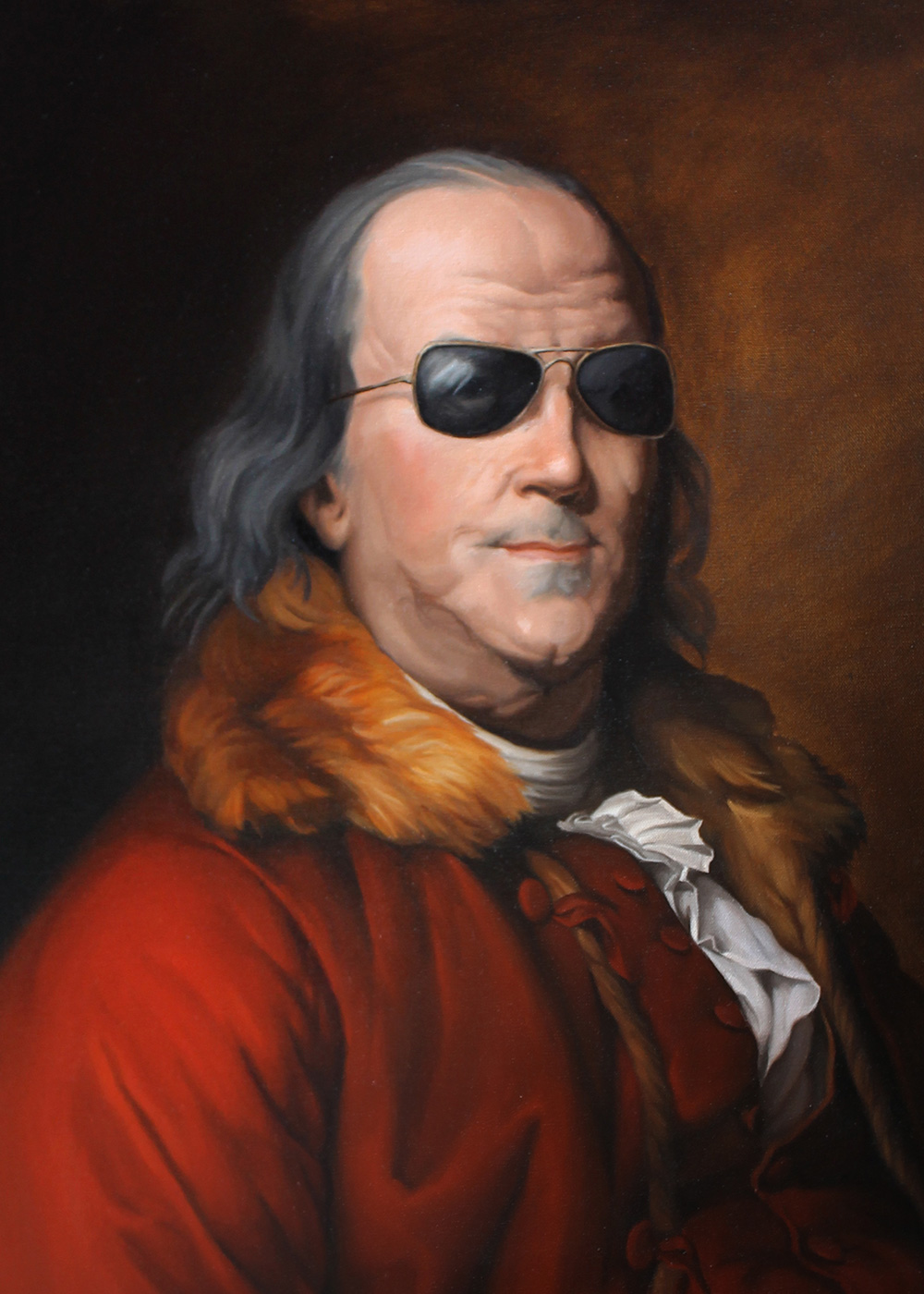
In 2012 the Association for Diplomatic Studies and Training adopted “Cool Ben,” America’s envoy in Paris sporting shades, as an emblem of the organization and its mission.
ADST
While trying to throw off the shackles of one monarchy, Franklin operated inside the court of another. This unsettled his fellow American commissioners, but Franklin realized the need to work on Versailles’ terms and at Versailles’ pace. He also understood the fundamental truth of diplomacy: Countries act in their own best interest. France’s greatest fear was reconciliation between Britain and the colonies, who together had defeated French and Spanish forces in the Seven Years’ War, and Franklin exploited it.
He arranged covert shipments of arms and critical supplies for the Continental Army through fictional trading companies financed by the courts in Paris and Madrid, appealing to their thirst for revenge without forcing them to return to open warfare with Britain. When the British offered a peace proposal, Franklin was quick to reject it but still made sure the French Foreign Minister was aware, insinuating that a more generous offer from London might produce a settlement without more clarity on where France stood.
Franklin was so successful in convincing Louis XVI that America’s victory was vital to France that it was the French who insisted on signing the 1778 Treaty of Alliance with the United States without delay. The treaty joined the two in a military alliance and guaranteed that neither side would consider peace until American independence was established. Spain’s 1779 declaration of war against Britain added to Franklin’s diplomatic triumph.
As U.S. permanent representative to the United Nations (UN) in 1990, Thomas Pickering was operating, like Franklin, in an environment with its own rules and pace when he got word of Iraq’s invasion of Kuwait. He organized a late-night UN Security Council session to call for an Iraqi withdrawal, then headed to the White House for an emergency National Security Council meeting. He realized that the administration was exclusively focused on defending Saudi Arabia from a continued Iraqi advance.
“I spoke up near the end of the meeting,” Pickering recalls, “and said I thought the credibility of the president’s foreign policy in the region hinged on our being able to make a commitment to liberate Kuwait. ... We could not allow the creation of a precedent for a continued kind of Iraqi gobbling up of other states and territories in the region.”
After inspiring a U.S. commitment to pushing Iraqi forces back, Pickering focused on creating the conditions to allow other nations to join the effort. This culminated with UN Security Council Resolution 678 authorizing the international community to “use all necessary means” to restore Kuwait’s borders.
Thanks to Pickering’s efforts, 33 other nations joined U.S. forces in the liberation of Kuwait. “We had shown,” Pickering remembers, “that the UN Security Council could be a force to support and strengthen American policy.”
Negotiating Terms of Peace
When the United States finally defeated the British, Franklin joined the delegation that negotiated a just peace. He rejected proposals for reparations to British loyalists and smoothed France’s ruffled feathers as talks proceeded without them. After the 1783 Treaty of Paris was signed and ratified, Franklin sent England’s ratification back to Congress, writing: “Thus the great and hazardous enterprise we have been engaged in, is, God be praised, happily completed.” America had gone from a rebellion to a republic.
As America’s first official envoy to a foreign government, Franklin crossed the Atlantic with few instructions and even fewer resources.
Miriam Sapiro, a legal expert on the State Department’s Policy Planning staff, joined the U.S. negotiating team at the Dayton peace talks in 1995. She helped craft an agreement to end the fighting in Bosnia and Herzegovina, but the challenge was daunting.
“We knew there needed to be a new constitution. There needed to be elections. We needed to protect human rights. There would be refugee issues, displaced persons issues, national monuments. … We were really starting from scratch thinking about what could help end this conflict and make Bosnia a country that could one day succeed. That’s what made it so interesting and challenging. We did a lot of drafting, redrafting, negotiating, redrafting, brainstorming, redrafting, negotiating.”
After 21 exhausting days, the warring parties finally reached an agreement. But when representatives of the multinational Contact Group gathered to initial as witnesses, Russian Deputy Foreign Minister Igor Ivanov hesitated.
“He said, ‘I cannot initial,’” Sapiro recalls, “‘because it refers to NATO in Annex One.’ And I said, ‘Well, the cameras are rolling. It’s a little bit late to raise that objection now. So I suggest you initial, and you can raise questions before the signing ceremony in Paris.’ So he initialed, but wrote ‘except for 1A.’ It’s ironic because if you actually looked at the annex, it talked about NATO states and non-NATO states cooperating. [The administration] worked hard to find a way for Russian troops to serve alongside American troops in Bosnia. And it worked.”
A Lasting Legacy
Benjamin Franklin set the standard for modern diplomatic practitioners, and his wisdom continues to resonate. In the same letter that accompanied the ratified peace treaty back to Philadelphia, Franklin left a prescient warning: “Our future safety will depend on our union and virtue. … If we do not convince the world that we are a nation to be depended on for fidelity in treaties, if we appear negligent in paying our debts, and ungrateful to those who have served and befriended us, our reputation, and all the strength it is capable of procuring, will be lost, and fresh attacks upon us will be encouraged and promoted.”

Tom Selinger is a recently retired Foreign Service officer currently serving as a project manager at the Association for Diplomatic Studies and Training (ADST). During his 27-year career, he served in five countries across three continents.
When sharing or linking to FSJ articles online, which we welcome and encourage, please be sure to cite the magazine (The Foreign Service Journal) and the month and year of publication. Please check the permissions page for further details.
Read More...
- “Defining Diplomacy” by Edward Marks, The Foreign Service Journal, January-February 2015
- “Why U.S. Leadership Matters for the Global Defense, Protection and Promotion of Human Rights” by Harold Hongju Koh, The Foreign Service Journal, June 2020
- “A Century of Service: Firsthand Accounts from U.S. Diplomats” by Tom Selinger, The Foreign Service Journal, March 2024