The rigorous and competitive process for becoming a Foreign Service officer is in jeopardy due to reforms instituted in 2025 and projected reforms being considered by State Department leadership.
BY STEVE ADAMS-SMITH
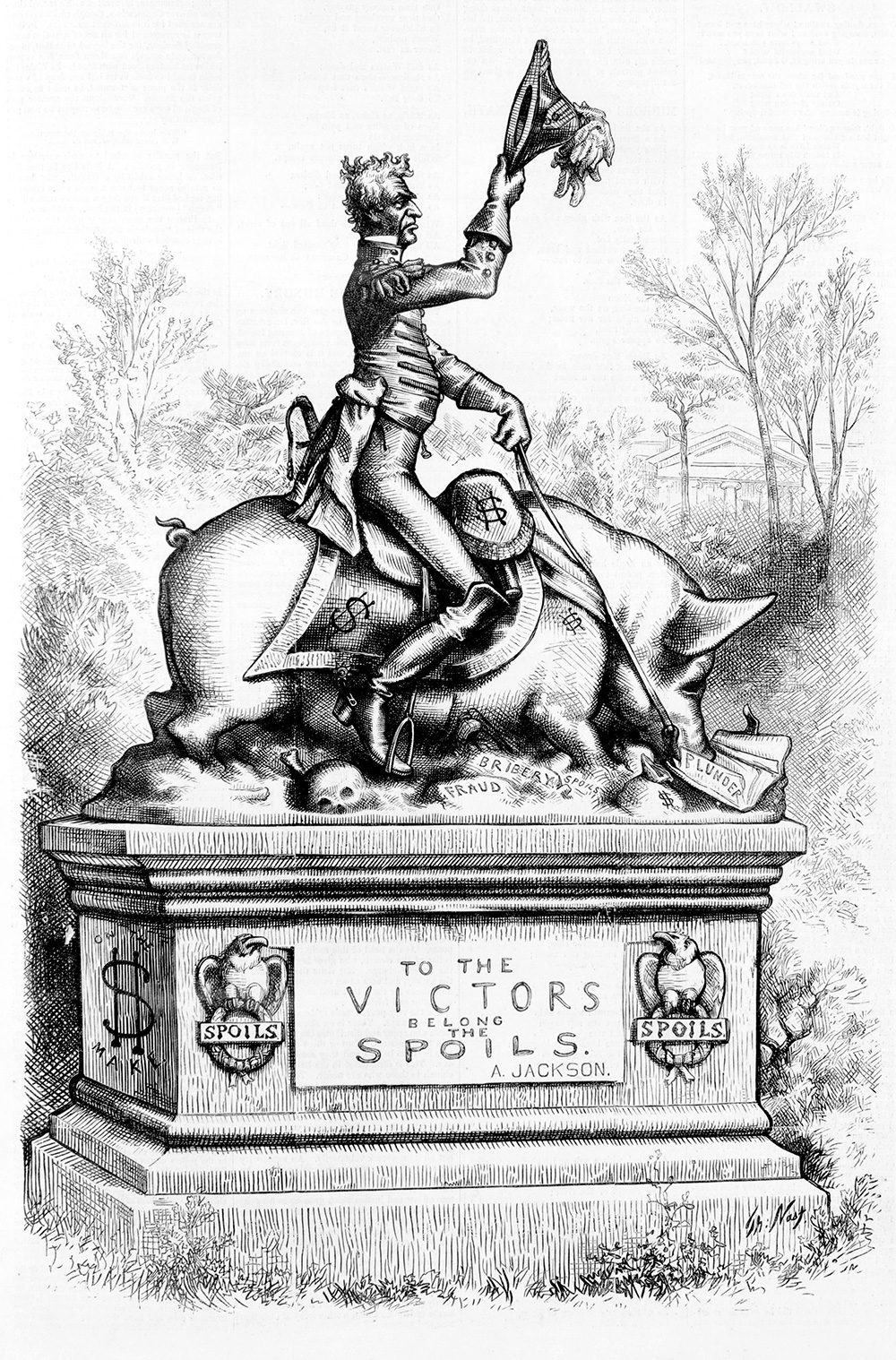
While he didn’t invent the spoils system, President Andrew Jackson (1829–1837) normalized and popularized it during his presidency as this 1877 political cartoon by Thomas Nast, “Our Civil Service As It Was,” indicates. Though merit system reforms took hold in the 20th century, political patronage remains a serious problem for professional diplomacy and the career Foreign Service.
LIBRARY OF CONGRESS
Historically, approximately 30 percent of ambassadorial nominations have gone to political appointees—campaign donors, friends of the president, and others with partisan affiliations. While political appointees have experience in business, politics, and other areas and often make important contributions to U.S. diplomacy, many are new to government service, lack foreign policy knowledge, and have never led large teams, especially teams of experts in diplomacy, commerce, defense, development, and intelligence.
By contrast, the Foreign Service, including career ambassadors, has long consisted of career professionals selected through a rigorous and competitive process that has included externally validated assessments based on job analyses that identify the key skills required in Foreign Service work. This process, studiously refined and improved over the last century to emphasize professionalism, is jeopardized by reforms instituted in 2025 and projected reforms being considered by State Department leadership.
The origins of the professional Foreign Service date to the late 1800s and the recognition that the then-predominant spoils system rewarded political allies but failed to provide the nation with a cadre of nonpartisan experts. The recent Netflix series about President James Garfield, “Death by Lightning,” based on Candice Millard’s book Destiny of the Republic, highlights the spoils system that staffed the government with loyalists until the late 1800s. Garfield began a transition toward a professional Civil Service, formalized in the 1883 Pendleton Act.
The 1924 Rogers Act, inspired by the Pendleton Act, prioritized merit-based hiring for Foreign Service officers, including through what would become the State Department’s well-known and widely respected written and oral exams. The Rogers Act started the department on a long journey that—with the exception of certain ambassadorships and other political appointee positions—abandoned the clubby and partisan networks of the spoils system in favor of a competitive selection process.
The competitive Foreign Service selection process is undergoing significant change. Rather than the norm of 30 percent of ambassadorial nominations going to political appointees, more than 90 percent of ambassadorships have gone to political appointees in the past year. In addition, a small, opaque, and ideologically aligned society of career officers and political appointees—the so-called “Ben Franklin Fellowship”—surfaced in 2025 to take up senior positions in Washington and overseas, appointments made outside prevailing competitive personnel assignment processes and without transparency. In 2025, for example, one Ben Franklin Fellowship member, an untenured FS-4, even served as acting Director General, a position normally filled by accomplished, multiterm career Foreign Service officers who have reached the rank of ambassador.
Finally, recently announced changes to the Foreign Service’s written and oral exams are calling into question whether entry into the Foreign Service—through a rigorous, nonpartisan, evidence- and merit-based process begun more than a century ago—will remain competitive.
A Brief History of the Foreign Service Exam
To understand the significance of these changes—specifically those to the Foreign Service’s exam-based entry process—a brief review of the history is helpful. The first Foreign Service written and oral exams took place in 1925 and were administered by the Board of Examiners (BEX). Passing the written exam—and in recent years achieving a certain Foreign Service Officer Test (FSOT) score combined with other evaluative factors—was required to proceed to the oral exam. Of the 199 people who took the written exam that year, only 20 eventually passed both the written and oral exams.
The written exam questions were on topics related to economics, political economy, geography, U.S. history and government, the history of different regions of the world important to U.S. interests, and international, maritime, and commercial law. There were also an English composition and comprehension section and a modern language component, including French, German, or Spanish. The oral exam consisted of an interview in which examiners asked questions about general education, culture, current events, and practical experiences. In 1927 BEX authorized the practice of providing general information about the written exam to the public, principally by publishing previous exams as practice tests, something that continues today.
More than 90 percent of ambassadorships have gone to political appointees in the past year.
Over subsequent decades, the department responded to the United States’ changing role in the world (especially after the end of World War II), the ongoing struggle to cast off the legacies of slavery and Jim Crow, and the necessity to build on the 19th amendment granting women the right to vote with the related obligation to enable equal access to federal employment opportunities. Some notable markers include:
• 1946, when a new Foreign Service Act created the Office of the Director General, gave BEX statutory standing, and reaffirmed the selection of Foreign Service officers based on merit;
• 1954, when lingering staffing challenges led Secretary John Foster Dulles to appoint the Wriston Committee (John Wriston was president of Brown University) to make recommendations to “strengthen the effectiveness of the professional service”;
• 1955 to 1957, when department officials and Foreign Service officers traveled the country to promote interest in the Foreign Service, eventually giving written exams in 65 cities in the United States and abroad and the oral exam in 23; and
• the 1960s, 1970s, 1980s (and not concluding until the 2000s) when, in response to widespread criticism that the Foreign Service was overwhelmingly male and white, the department faced—and lost—class action lawsuits brought by women such as Alison Palmer and Marguerite Cooper and Black diplomats such as Walter J. Thomas.
A Truly American Foreign Service
In the latter half of the 20th century, the written and oral exams remained highly competitive but also imperfect. The department endeavored to bring more rigor and scrutiny to the exams and was acutely aware of the directives of the Foreign Service Act of 1980: “The members of the Foreign Service should be representative of the American people, aware of the principles and history of the United States and informed of current concerns and trends in American life, knowledge of the affairs, cultures, and languages of other countries.”
The act reaffirmed admission to the Foreign Service through an “impartial and rigorous examination.” The 1980 act also tasked the Board of Examiners with periodic review of the examination process to test for adverse impact against any population of Americans and called for examinations that are “valid in relation to job performance.”
As the department tracked and analyzed successful applicants and received feedback from outside parties, the oral exam was partially “unblindfolded” during the George W. Bush administration and under the leadership of Secretary Colin Powell. Previously, examiners did not know the backgrounds of candidates. During the oral assessment, examiners began asking about candidates’ experience and motivation to join the Foreign Service. Candidates cited military and Peace Corps experience, language proficiency, a commitment to public service, familiarity with different regions of the world, and knowledge about different cultures and religions.
The Gold Standard of Assessments
During this period, the Una Chapman Cox Foundation commissioned a McKinsey and Company study of the department’s hiring process. McKinsey concluded: “The Department’s oral assessment is the gold standard of interview processes. The Department is at the cutting edge; the Foreign Service sets a standard for anybody else wanting to conduct one of these kinds of screens.” McKinsey’s one criticism was the lack of a “total candidate review,” including the candidate’s education and work history. As noted, the hiring process had been blind to such factors following the Palmer discrimination suit, but the McKinsey recommendation further emphasized the need for the department to develop a total candidate review procedure. That review ultimately resulted in the Qualifications Evaluation Panel (QEP), which would assess candidates after the written exam and before they could move to the oral assessment.
In 2007 the new QEP helped determine the number of written exam passers (the written exam was now known as the FSOT) who would advance to the oral exam (the Foreign Service Oral/Officer Assessment, or FSOA). Because BEX had established a new hurdle in the exam process—in the form of the QEP—the quality of candidates taking the FSOA improved. Candidates with military service, business acumen, and relevant leadership experience were demonstrating that the FSOT and QEP vetting were delivering the highest-quality candidates with the most relevant Foreign Service experience and skills to the BEX assessors during the FSOA. Data also revealed that as those with more experience passed at higher rates, the average age of incoming Foreign Service officers increased.
In addition, the 2020s brought one final significant change to the FSOA. In response to the COVID-19 pandemic, BEX initially halted all in-person assessments. Eventually, using lessons learned from numerous pandemic-necessitated adaptations, BEX moved the FSOA to an entirely virtual format, an innovation that also made the FSOA much more accessible by eliminating the requirement for applicants to pay for trips to Washington or other cities where the FSOA was conducted.
Evidence-Based, Competitive Entry Under Threat
Beginning with the Rogers Act, the State Department sought to perfect a merit-based entry process over the course of a century, using competitive exams and objective assessments to identify successful candidates. A written exam assessed a candidate’s knowledge of economics, history, and English usage (and, until this past year, workplace situational judgment). The QEP examined candidates’ backgrounds to identify those with relevant experience and skill sets for Foreign Service work, including foreign language and leadership skills.
The impartial and multifaceted oral exam looked at a candidate’s experience and motivation, assessed responses to challenging hypothetical questions, and judged the ability to work under pressure with colleagues. The entirety of the exam was evaluated and regularly improved with input from industrial psychologists and, in the case of the McKinsey study, was validated as best in class. Exam questions were studied for effectiveness in terms of their relevance for successful Foreign Service work and regularly revised based on job analyses—workforce surveys—that provided up-to-date feedback on contemporary skills required of Foreign Service officers. Many Foreign Services officers are aware of and have participated in these surveys.
This rigorous, merit-based entry process changed significantly in 2025. While the extent to which changes to the FSOT and FSOA will alter the profile of incoming Foreign Service officers is unknown, there are troubling signs. First, despite the recommendations from McKinsey and industrial psychologists, department leadership announced in a brief September 2025 press release the elimination of the personal narratives, a part of the QEP in which candidates wrote essays about their background and experience and addressed six core areas of Foreign Service work. Second, the same press release described a new logical reasoning section of the FSOT—evidently modeled on the Law School Admission Test—without explaining why the format and substance of a graduate school admissions exam might have relevance in selecting Foreign Service officers. The announcement did not include information about a new job analysis or workforce survey to explain why these changes would improve Foreign Service officer selection.
While the extent to which changes to the FSOT and FSOA will alter the profile of incoming Foreign Service officers is unknown, there are troubling signs.
Third, while the department has yet to unveil what will be in a new FSOA or whether the FSOA will even change, it is reasonable to assume that the FSOT and QEP changes will also result in FSOA changes. When the department announced the FSOT changes in September 2025, it also announced, without explaining why, that all candidates who had passed the previous version of the FSOT needed to retake the new version to remain eligible for the FSOA. The department administered the new FSOT in October 2025.
With the elimination of the personal narratives and, perhaps, the QEP altogether, will the department also eliminate the experience and motivation sections of the FSOA that were recommended by McKinsey to provide a whole-of-candidate review? If so, will the department explain why and provide evidence to support its case? Will time-tested FSOA elements such as the group exercise remain? If there are changes to the FSOA, will the department use, as it has for decades, information gathered from workforce surveys to indicate that the same level of detailed job analysis was done to identify skill sets needed by Foreign Service officers?
Perhaps most importantly, the Foreign Service Act of 1980 mandated in law that the State Department assess its exams for adverse impact on certain groups. The Palmer and Thomas settlements were also based on the department righting past wrongs in terms of discriminatory practices. Without rigorous analysis of the basis for any changes to the FSOT and FSOA and with the elimination of the personal narratives, it is unclear what the impact on candidates will be. Congress should insist that the department comply with the law and the settlements in class action suits and explain how it will monitor the FSOT and FSOA for adverse impact on certain groups.
Almost 150 years ago, the United States tested the spoils system and concluded that it was detrimental to American interests. Yet today, more than 90 percent of ambassadors are political appointees and the administration is selecting members of the Foreign Service who publicly affiliate with an ideologically aligned organization for senior-level positions. With these trends hinting at a return to the spoils system, the department has an obligation to prove that the career Foreign Service will remain nonpartisan, selection will be merit based, and the Foreign Service will represent all the United States.
Steve Adams-Smith is a retired Senior Foreign Service officer. During his 28-year career, he served in Brussels, London, Moscow, Sofia, and Tallinn, and in multiple positions in Washington, D.C.
When sharing or linking to FSJ articles online, which we welcome and encourage, please be sure to cite the magazine (The Foreign Service Journal) and the month and year of publication. Please check the permissions page for further details.
Read More...
- “Who is the ‘Total Candidate’? FSO Hiring Today” by Shawn Dorman, The Foreign Service Journal, June 2008
- “Examining State’s Foreign Service Officer Hiring Today” by Glenn J. Guimond, The Foreign Service Journal, July-August 2016
- “Schedule F: Let’s Deprofessionalize Government and Make America Irrelevant Again” by Dennis Jett, The Foreign Service Journal, January-February 2023
- “How Donald Trump's Plans Could Bring Back the Spoils System” by Michael Wolraich, Time, May 2024