Creative public diplomacy plays a vital, leading role in combating illegal immigration at U.S. Embassy Mexico City.
BY ANDREA STANFORD
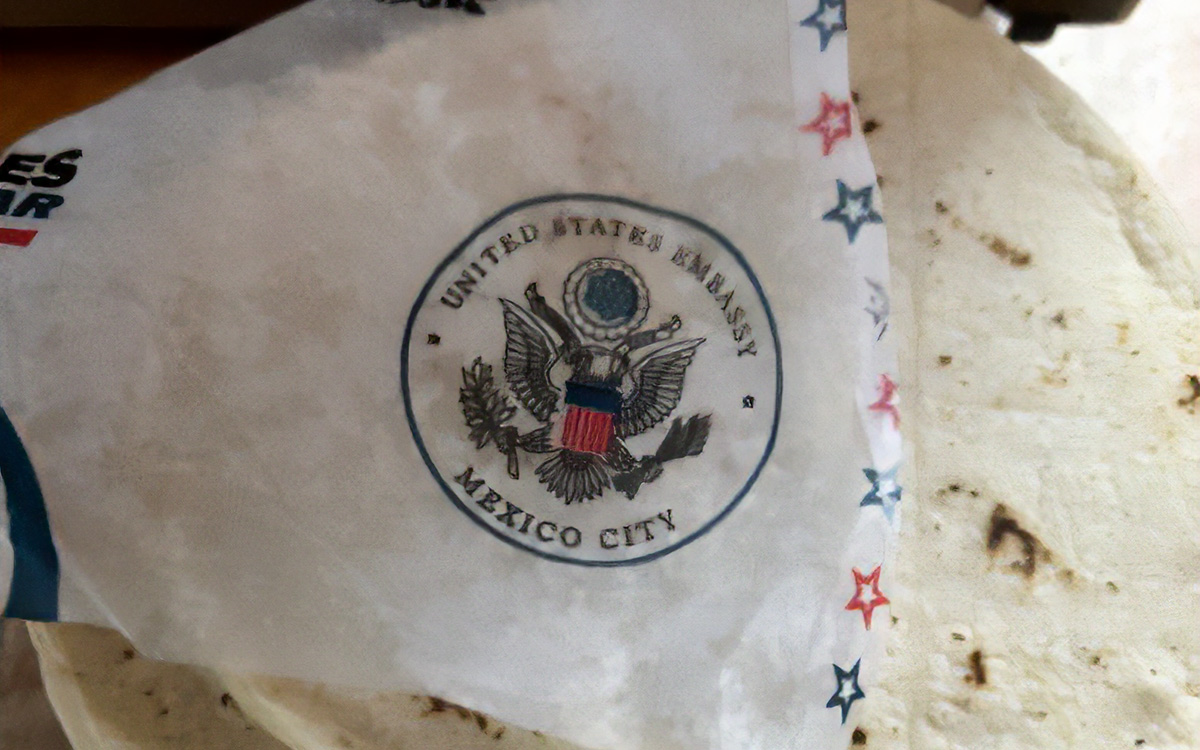
U.S. Embassy Mexico City launched the “Tortipapel” campaign to print important migration messages and QR codes directly on tortilla wrappers along with the embassy seal as shown here.
COURTESY OF ANDREA STANFORD
When I began my assignment at the U.S. embassy in Mexico City, migrant numbers were staggering. At the height of the crisis, more than 10,000 people reached the U.S.-Mexico border each day, many misled by false information. They were motivated but deceived by smugglers who had mastered social media better than we had. The smugglers’ message was simple and dangerous: “Cross today. The border is open.”
Countering illegal immigration drives Mission Mexico’s work, and as the lead for the messaging—and an experienced public diplomacy officer—I made sure public diplomacy joined the policy conversation from day one. When we shape policy—not just communicate it—we translate complexity into clarity, turn skepticism into understanding, and transform information into action.
Those are the moments when public diplomacy does its best work. We don’t just explain policy—where strategy meets storytelling, we make that strategy understandable, credible, and actionable for the people it serves.
A Policy Challenge with Human Consequences
COURTESY OF ANDREA STANFORD
Illegal immigration is one of our hemisphere’s most pressing challenges. Our public diplomacy team found that immigrants often lacked clear, reliable information about U.S. policies and fell prey to false promises from smugglers. The U.S. government had few direct ways to share timely updates, allowing criminal networks to spread false information. The result was confusion and tragedy: Families sold their homes based on lies and risked their children’s lives after hearing “Come today, the border will close tomorrow.”
We were uniquely positioned to understand the problem and respond. Our comparative advantage has always been listening—knowing what information people receive, how they interpret policy, and which messages move them to action.
We began with research, not rhetoric, turning everyday tools into strategic channels. Through more than 60 focus groups across Mexico, we asked migrants what they had heard and what would make them reconsider illegally immigrating to the United States. Those conversations became the backbone of our campaign.
The following describes how we used tools at hand to innovate at scale and launch effective campaigns to tackle the problem.
Tortipapel: Messaging on the Table
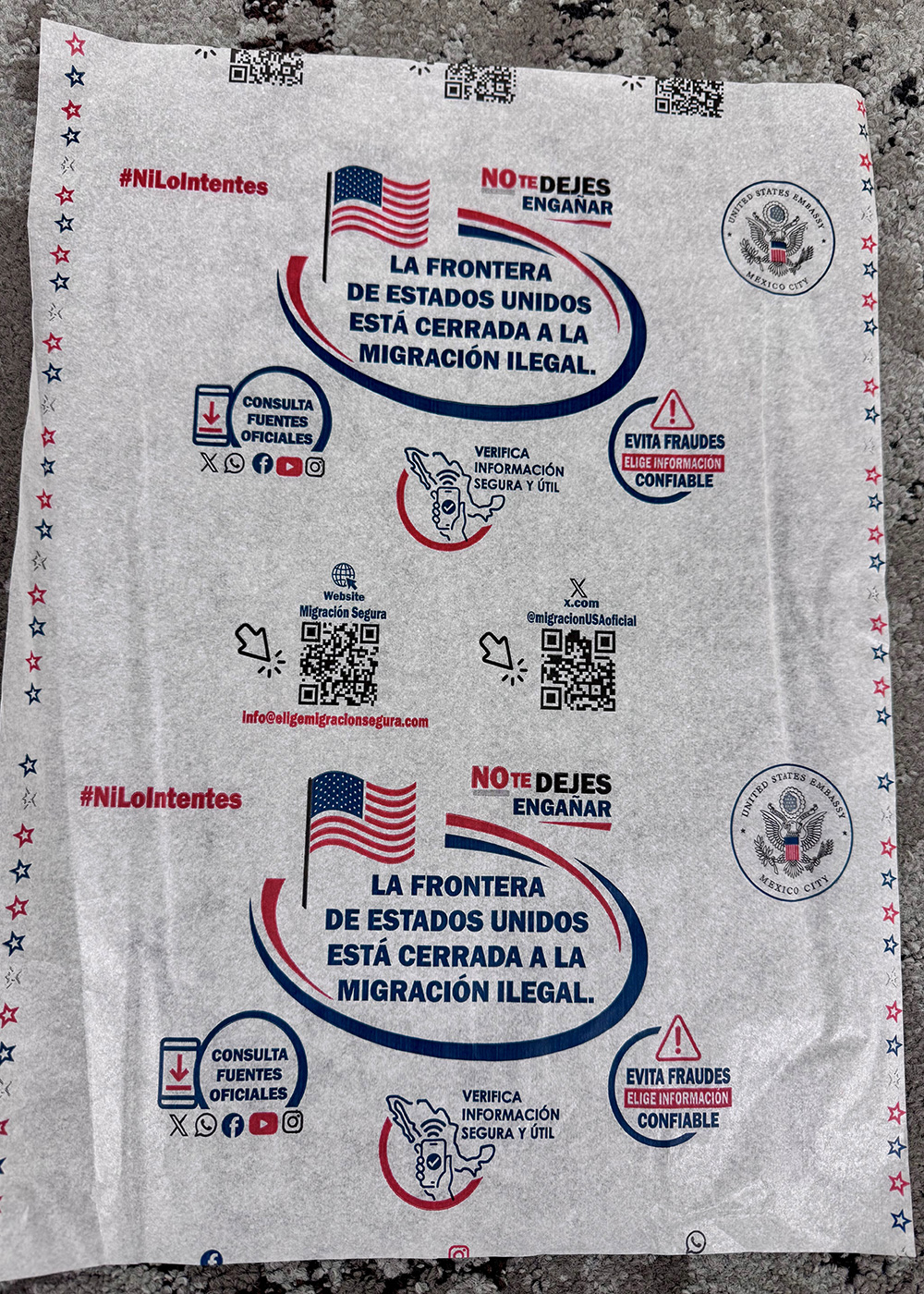
In Mexico, tortillas are universal—a daily staple on nearly every table. Recognizing their unmatched reach, we launched the “Tortipapel” campaign to print important migration messages and QR codes directly on tortilla wrappers. We distributed more than one million wrappers to tortilla shop owners in six strategically selected states—areas identified by the Department of Homeland Security’s U.S. Customs and Border Protection (CBP) agency data as having the highest outmigration and recidivism rates.
Shop owners used the wrappers in their daily sales, reaching an estimated 2.5 million people. Phase One shared verified information about safe, legal options, while Phase Two warned that “The U.S. border is closed,” urging migrants not to trust smugglers and to rely on official U.S. sources instead.
The campaign’s impact spread far beyond the table. Local media covered the story nationwide. Tortilla shop owners—trusted figures in their communities—became informal ambassadors, correcting rumors and pointing customers to official channels. The project also strengthened our partnership with a Bureau of Education and Cultural Affairs (ECA) exchange alumnus who founded Tortipapel, a company that uses foodgrade paper wrappers to deliver marketing messages.
The Tortipapel campaign became a true force multiplier—a cultural touchpoint carrying accurate information into millions of homes and conversations.
Proyecto Plantalla: Reaching Migrants Where They Are
We partnered with the International Organization for Migration to turn migrant shelter walls into projection screens, streaming real-time policy updates and Facebook Live sessions straight to migrants. The project reached more than 100 shelters across Mexico and connected with 70 percent of all migrants in transit who used the shelter network.
Migración USA: A New Digital Frontier
We saw the potential to reach migrants directly and built a messaging platform with funding from the Bureau of Western Hemisphere Affairs’ Public Diplomacy Office (WHA/PDA). With continued support from WHA/PDA and Global Public Affairs (GPA), we expanded it into the State Department’s first official migration messaging network, spanning Facebook, X, Instagram, YouTube, and a verified WhatsApp channel in Spanish. GPA helped brand and certify the accounts as official U.S. government platforms with .gov verification.
What began in Mexico quickly grew into a regional communication hub: The WhatsApp network expanded from 30,000 to more than 360,000 subscribers, while our other platforms grew from zero to roughly 600,000 followers across platforms. Together, they now reach audiences across the region and make up the U.S. government’s largest direct-to-migrant communication network.
Facebook Live: A First
Embassy Mexico City launched the State Department’s first monthly Facebook Live series from migrant shelters across Mexico, bringing our message directly to target audiences. In these sessions, Department of Homeland Security (DHS) officials answered individuals’ questions in Spanish, ultimately reaching nearly a million viewers. Online, Mission Mexico also began directly engaging smuggler videos, posting corrective responses, and flagging viral falsehoods. Many social media platforms then independently removed the accounts for violating their terms of use. Together, these tools pushed one goal: to reach people before the smugglers do.
Results and Lessons
Public diplomacy rarely lends itself to concrete metrics, but in this case, the data spoke for itself. Daily encounters—once soaring above 10,000—fell to fewer than 200 as clear, consistent messaging, reinforced by strengthened U.S. and Mexican enforcement, helped puncture smuggler narratives and empower people to make informed, safer choices.
The WhatsApp platform grew by more than 1,100 percent in six months. The weekly DHS media series—with spokespeople rotating across consulates—generated a reach of more than 100 million and created more than 200 news stories clarifying enforcement and repatriation policies. Border reporting tours brought 65 journalists from 10 countries to observe conditions firsthand, resulting in more than 1,000 balanced news reports across regional and national outlets.
The most important lesson: Deterrence messaging must be human, immediate, and trustworthy.
Collaboration deepened. With WHA/PDA funding and support, Mission Mexico used the Migration False Narratives Report to coordinate responses with Mexico’s Secretariat of Foreign Affairs (SRE) and other partners. The report has become a shared reference tool, with SRE now using our data to counter false claims—a model of bilateral coordination.
Public diplomacy is often described as “soft power.” But when policy and public diplomacy align, and the goal is to deter criminal organizations from exploiting vulnerable people, there’s nothing soft about it. The tools may be cultural, linguistic, and narrative, but their effects are strategic and measurable.
The most important lesson: Deterrence messaging must be human, immediate, and trustworthy. People don’t respond to policy language. Instead, they respond to people who sound like them, who meet them in spaces they trust, and who answer their questions in real time.
Building a Model for Our Hemisphere
To sustain this work, Mission Mexico—with WHA/PDA’s partnership and support—hosted the first WHA Migration Messaging Conference in October 2024. The Mexico City event gathered more than 50 U.S. missions and interagency representatives to share lessons and align regional messaging, resulting in the first unified communications framework on migration for the Western Hemisphere.
The model, now replicated across the region, rests on three pillars:
- Cultural proximity. Messages resonate when they feel local—through tortillas, telenovelas (soap operas), or trusted influencers.
- Digital agility. Rapid feedback loops allow posts to adjust messaging within hours, not weeks.
- Interagency integration. When agencies speak with one voice, illegal immigrants listen—and smugglers do too.
The migration campaign reiterated a larger truth: Public diplomacy is policy. When people act on false information, the consequences reverberate beyond borders. In that sense, public diplomacy is as much a national security tool as a communication tool. This is why PD professionals are necessary voices at the policy table—including at the National Security Council. We are often the first to sense how a policy lands, the first to spot a misinterpretation, and the first to identify the narrative space our adversaries could exploit.
We built the campaign’s success on collaboration, risk-taking, and agility. Public diplomacy professionals excel at building relationships over time, but today’s information space moves in minutes—sometimes in three-second clips. We must act with the same urgency as those who spread falsehoods.
This work also demonstrates that innovation thrives at posts. Many of our most effective ideas—from the tortilla campaign to WhatsApp engagement in Spanish—came not from Washington but from local staff, exchange program alumni, and partners who understand their communities best. The State Department should continue to cultivate that field-driven creativity.
Our work represents a collective achievement, over time, of local staff, American direct hires, ECA program alumni, WHA/PDA, GPA, embassy leadership that encouraged creativity, and partners who believed that information can save lives and combat illegal immigration.
In the end, our greatest innovation wasn’t technological. It was the simple act of listening—to migrants, journalists, and shelter volunteers—and translating policy into something human, immediate, and true.
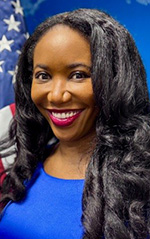
Foreign Service Officer Andrea Stanford is currently serving at the U.S. embassy in Mexico City. Over the past 14 years, she has served in the press office of the Western Hemisphere Affairs Bureau (WHA), at the U.S. Mission to the United Nations in New York, in the Bureau of Educational and Cultural Affairs (ECA), in the Foreign Press Center, and at Mission China.
She earned the University of Southern California Center on Public Diplomacy’s 2025 Ameri Prize for Innovation in Public Diplomacy, which recognizes U.S. officers whose creativity and leadership advance the practice of public diplomacy worldwide. The views expressed are her own, not necessarily those of the U.S. government or the State Department.
When sharing or linking to FSJ articles online, which we welcome and encourage, please be sure to cite the magazine (The Foreign Service Journal) and the month and year of publication. Please check the permissions page for further details.
Read More...
- “Migration Seizes the Spotlight” by Andrew Erickson, The Foreign Service Journal, June 2019
- From the FSJ Archive: Migration and Immigration Policy, The Foreign Service Journal, June 2019
- Migration Diplomacy in Mexico–United States Relations: Decision-Making Under Asymmetric Structures by Natalia Saltamacchia, Cambridge University Press, March 2026