Take a look inside one of the U.S. government’s oldest, largest, and most significant responsible transparency undertakings.
BY LYNETTE EVANS-TIERNAN AND JAMES GRAHAM WILSON
Think diplomacy is all handshakes and summits? Think again. Behind the scenes, historians at the State Department are uncovering and preserving the real story of U.S. foreign policy through the Foreign Relations of the United States (FRUS) series, a remarkable effort in government transparency and historical documentation.
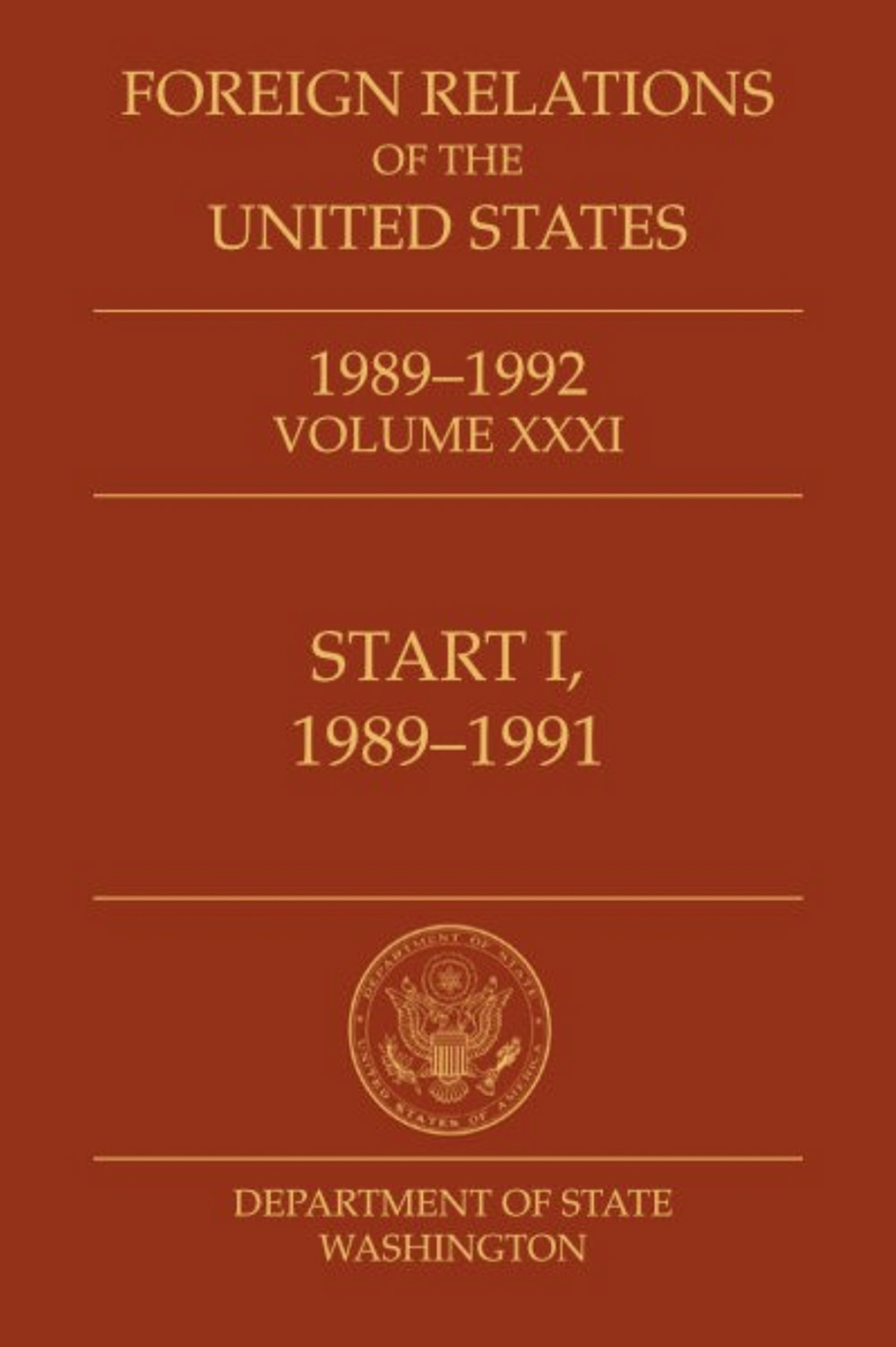
On September 30, 2025, the State Department’s Office of the Historian released the latest in this series, Volume XXXI, START I, 1989-1991, the second of two volumes on the 1991 Strategic Arms Reduction Treaty.
“The past is never dead,” as William Faulkner famously put it. “It’s not even past.” As we commemorate America’s 250th birthday, nuclear arms have returned to the fore of U.S. national security and diplomacy—just as they were for the bicentennial in 1976. They pose difficult problems. Unlike 50 years ago, however, U.S. diplomats as well as anyone else with access to a computer can now draw on the decision-making and negotiating record of a treaty that reduced strategic offensive arms. Covering 1982–1991, the two START I FRUS volumes include 584 documents totaling 2,705 pages—a small fraction of the 310,000 documents available at https://history.state.gov/.
Following the book’s release, I sat down with the compiler, James Graham Wilson, to learn how these volumes came together, why this work matters, and the surprising discoveries that can turn up in the archives.
—Lynette Evans-Tiernan
Lynette Evans-Tiernan: For readers who may not know the Foreign Relations of the United States series, what is it, and what exactly does a compiler do?
James Graham Wilson: Most people have never heard of FRUS, which is a shame because it’s one of the biggest and most significant transparency projects the U.S. government has ever undertaken. We’ve been publishing FRUS since 1861, starting with the Lincoln administration, and today it runs to hundreds of volumes covering every presidency since, as well as a book on its own history. Anyone can read the series for free at https://history.state.gov/.
It takes a lot of work to produce a volume. We have statutory access to official government records that are 20 years and older, meaning we look through hundreds of thousands of documents on a particular topic—in this case, internal U.S. deliberations and U.S.-Soviet negotiations on strategic offensive arms from 1989 to 1991. We go through unprocessed, still-classified records from not only the Department of State but also the Department of Defense, Central Intelligence Agency, and Presidential Records including the National Security Council.
We select a few hundred of them, then annotate them as a volume in the appropriate presidential subseries within the broader FRUS series. The draft volume then undergoes an internal peer review process to ensure it meets the series’ stylistic guidelines and the accuracy and completeness standards required by law.
We also have to send each volume out for declassification review by every government agency that has equities in the documents included in it. Declassification can take years; add on another year or two for editing, proofreading, and prepping for publication, and you can see that it takes a host of people and a great deal of time to prepare the series.
Our mission is laid out in Section 198 of Public Law 102-138, which President George H.W. Bush signed on October 28, 1991: FRUS should be “a thorough, accurate, and reliable record of major U.S. foreign policy decisions and significant U.S. diplomatic activity.” The origins of the mission lie in congressional requests to the executive branch for information, which by 1800 had become an established procedure, with allowances made for reservations to balance the public’s right to know with the government’s duty to protect.
LET: Why does this work matter right now, as we mark 250 years of U.S. history?
JGW: FRUS is an institution you can trust. And as Ronald Reagan would say, “Trust, but verify.” We lay out in the preface to each volume the sources we consulted and our logic for crafting the volume or chapters. We also describe the stages of review and quality assurance. If we cannot locate a document, we say so in the annotations. If interagency declassification partners protect three lines of a document, we write: “three lines not declassified.”
LET: What’s the most challenging part of compiling a volume like START I?
JGW: I think the fundamental challenge is trying to tell a coherent story while being judicious and fair to the individuals who lived it. I hope that the 584 documents in the START I volumes add up to more than the sum of their parts. We have a strict page limit, and it’s hard to leave things out!
Longtime State Department nuclear expert Ed Ifft led the State Department’s declassification review of this volume. He had been an important member of the U.S. delegation in Geneva during the period 1989–1991, and he was not happy that I had not included all the thousands of pages that he and others on the delegation had sent via front channels, and back channels, from Geneva to Washington. How could I leave all that out? Well, it’s not easy.
I think the fundamental challenge is trying to tell a coherent story while being judicious and fair to the individuals who lived it.
LET: What’s the most rewarding part of the job?
JGW: It’s wonderful to hear a diplomat say some variant of “I used FRUS in college, and it opened up a new world to me.” As we inch closer to the present with these volumes, more of the participants in them are still alive—and in even more instances the work of their mentors appears in the volumes. Let me be completely honest though: Seeing a volume appear in print and online is the single most rewarding part. It is deeply satisfying.
We have more than 40 volumes in the interagency declassification pipeline. That means my colleagues and I have selected and annotated all the documents, the volumes have gone through multiple internal peer reviews, and in many instances, the volume is 99 percent declassified. And it’s that final 1 percent that can take a decade.
LET: Do you have a favorite “hidden gem” from the START I research?
JGW: Even though the latest volume formally covers 1989–1991, I found a really interesting document from September 1988, where Vice President George H.W. Bush meets with Soviet Foreign Minister Eduard Shevardnadze—during the height of the U.S. presidential campaign—and tells him that should he win, he would have to work very hard to win the support of conservative Republicans to ratify a START agreement.
It’s a gem that shows Bush’s private candor—what he said to Shevardnadze is not quite how he would have phrased things publicly.
LET: How did you find your way into this career?
JGW: I trace my interest in the Cold War back to watching the CNN documentary series about it in high school in the mid-1990s. I was in the Vassar College Main Library on the morning of September 11, 2001—everyone alive then remembers where they were. In subsequent years, I became moderately obsessed with the ideas, events, and people that brought about the end of the Cold War. From 2005 to 2011, I was fortunate to be writing a dissertation at the University of Virginia, with a wonderful adviser, Melvyn P. Leffler, on the latter years of the Cold War just as the transcripts of the summits of the Reagan-Gorbachev encounters were being declassified.
In 2011 the Office of the Historian was looking for folks with a background in the Reagan archives to keep digging into the documents and produce the FRUS volumes for the Reagan administration. They hired both me and Elizabeth Charles, who has been a dear friend and colleague. So, my career has featured cascading good fortune.
LET: What’s one FRUS volume you think every American should read, and why?
JGW: My longtime colleague Kristin Ahlberg’s Foundations of Foreign Policy, which is Volume I in the FRUS set on the Reagan administration [1981–1988]. Kristin reviewed several dozen Reagan volumes while also preparing that one; it covers the foundational documents of not only 1981–1988, but also important moments in Reagan’s campaign for the presidency [1975–1980]. Kristin has played some role in virtually every FRUS volume the office has released this century. She’s a national treasure.
It’s wonderful to hear a diplomat say ... “I used FRUS in college, and it opened up a new world to me.”
LET: Is there a particular period or policy area you find especially fascinating to work on? Why?
JGW: I have spent much of the past 20 years focused on the end of the Cold War. I conceive of that period as roughly 1979–1991. What’s fascinating to me is to discover the origins of a story that becomes really important and also the fact that there is always another angle to consider.
With respect to START I, 1989–1991, one such story is how the United States and Russia—after the Soviet Union collapsed in December 1991—sketched out the follow-on negotiations that led to START II, which President George H.W. Bush and President Boris Yeltsin signed in January 1993.
START II was supposed to eliminate multiple independent reentry vehicles [MIRVs] on land-based intercontinental ballistic missiles [ICBMs]. While it never entered into force, it was a landmark achievement I think policymakers ought to consider when they are thinking about the long-term goals of any potential negotiations.
LET: How do you hope students or the public will use these volumes?
JGW: I hope that students will use FRUS volumes to write good papers. I don’t just mean an “A” paper—though I certainly think FRUS provides an avenue toward achieving that. I mean that they will empathize with the humans who appear throughout the pages of FRUS volumes, and grapple with the dilemmas and trade-offs they face. How would you do it better? That question endures beyond grading. “Go to the sources” is the mantra I learned in college.
LET: How do you hope policymakers will use these volumes? Asked another way, what role do you think historians play in strengthening diplomacy?
JGW: I hope that readers actively working on national security and diplomacy will take consolation from FRUS. There’s an evocative passage from a speech that then Under Secretary of State Dean Acheson gave at the Harvard Club in New York City in June 1946: “The problems that bedevil American foreign policy are not like headaches. With those, you take a powder and they are gone. Instead, they are like the pain of earning a living. They will stay with us until death.”
That still resonates today, 250 years into American history. Policymakers sometimes presume that they are the first to encounter a particular set of challenges. They are not. Just peruse FRUS, and you will see that no one is the first. Nor did the so-called “Wise Men” of the early Cold War have it all figured out.
Redactions result from efforts to protect national security information, not because something might embarrass a particular U.S. agency.
LET: What do you wish more people understood about your work?
JGW: It sometimes amuses me—though does not upset me—when people presume that FRUS volumes consist only of State Department documents. The proportion of agency documents varies based on the topic. For instance, in a volume I worked on that focuses heavily on nuclear strategy, National Security Policy 1977–1980, we included no more than a small handful of State Department documents. The documents are mostly from the National Security Council [NSC] and Department of Defense—with a smattering from the Central Intelligence Agency.
Also, if an NSC staffer sends a handful of papers to the national security adviser or the president, and one of them is from the State Department, and the staffer has written, “the State Department paper is bad,” we print all that. We do not sanitize anything to put the State Department in a better or worse light. We include the material we think is most important. Redactions result from efforts to protect national security information, not because something might embarrass a particular U.S. agency.
LET: How has technology changed the way you do your job compared to earlier generations of compilers?
JGW: Technology has made certain things—such as the retrieval of basic factual information—easier. For end users of FRUS, you can use the filters and keyword searches on the website to isolate particular episodes, for example the 13 days of the Cuban Missile Crisis. You can see everything else that happens in October 1962, including the war that breaks out between China and India.
In compiling the volumes, we are limited by the fact that we have an immense number of historical documents, and we need to abide by whatever classification they were given 40 years ago. That makes it difficult to scan everything into one repository that we can access from our desks. Still, we are doing our level best to incorporate generative AI into various parts of the production cycle to accelerate outputs.
But our “thorough, accurate, and reliable” mandate prohibits any margin of error. We can’t have 99 percent Optical Character Recognition [OCR] accuracy of a PDF; we need 100 percent. We can’t allow a single line of text or code that reveals classified information. So, here and everywhere else, we need to maintain constant human vigilance.
LET: Any closing thoughts?
JGW: START I doesn’t offer a blueprint for every future endeavor, but it does show what sustained, serious diplomacy can achieve under real pressure. If the volumes help students, citizens, and policymakers see that more clearly, then all those hours in the archives were worth it.

Lynette Evans-Tiernan is a public affairs officer at the U.S. Department of State, where she serves as strategic communications adviser in the Office of the Historian. Over a 20-year career, she has worked across Washington bureaus and diplomatic missions overseas on a broad range of regional and thematic foreign policy issues. Her expertise includes strategic communications, digital engagement, and global campaigns advancing U.S. foreign policy with diverse audiences. She received a BA from the University of Virginia in 2006 and an MA from The George Washington University in 2013.

James Graham Wilson is a supervisory historian in the Office of the Historian at the Department of State, where he has compiled 10 volumes in the Foreign Relations of the United States (FRUS) series. He is also the author of America’s Cold Warrior: Paul Nitze and National Security from Roosevelt to Reagan (Cornell University Press, 2024) and The Triumph of Improvisation: Gorbachev’s Adaptability, Reagan’s Engagement, and the End of the Cold War (Cornell University Press, 2014). He received a BA from Vassar College in 2003 and a PhD from the University of Virginia in 2011.
When sharing or linking to FSJ articles online, which we welcome and encourage, please be sure to cite the magazine (The Foreign Service Journal) and the month and year of publication. Please check the permissions page for further details.
Read More...
- “Diplomatic History Lessons: A Model of Government Transparency” by Tracy Whittington, The Foreign Service Journal, June 2016
- The Foreign Relations of the United States (FRUS) Series: Historical Documents, Office of the Historian, U.S. Department of State
- “The Best and Worst Foreign Policy Decisions in U.S. History” by James M. Lindsay, Council on Foreign Relations, January 2026