When a ship’s seizure threatened to bring Great Britain into the Civil War on the side of the South, smart diplomacy averted the crisis.
BY RICHARD HINMAN
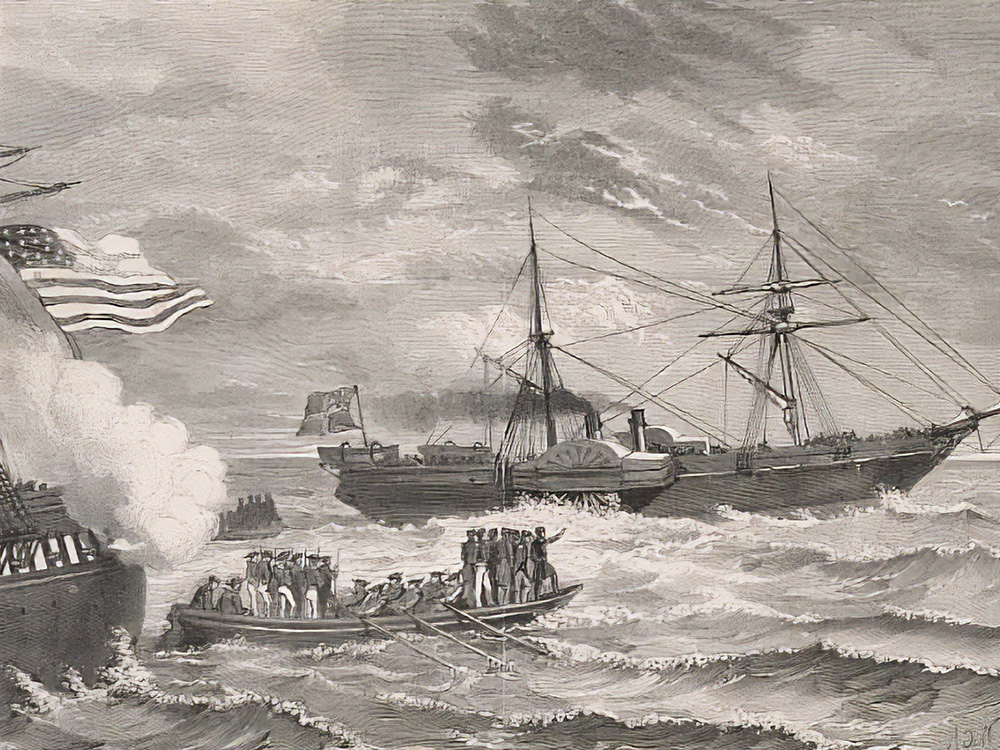
The Union ship San Jacinto halts the RMS Trent.
THE CHRONICLE
Relatively few people remember the Trent affair of 1861–1862 or know the role that statecraft and diplomacy played in preventing a potentially catastrophic outcome in the U.S. Civil War.
U.S. boarding of the mail ship RMS Trent led the United States and Great Britain to the precipice of another conflict, one the Lincoln administration ultimately avoided with sound diplomacy and competent crisis management.
In late 1861, hoping for European recognition and even intervention in America’s internecine conflict, Confederate President Jefferson Davis dispatched two envoys, James Mason and John Slidell, to Britain and France to press the Confederate cause. The Virginia-born Mason was a longtime advocate for slavery and secession who had helped draft the infamous Fugitive Slave Law of 1850 as a then U.S. senator. Slidell similarly represented Louisiana in the Senate until secession. He had previously served as President James Polk’s envoy to Mexico during and after the Mexican-American War. To circumvent logistical challenges and avoid prowling Union warships, the pair went first to the Caribbean and subsequently booked passage to London from Havana on a British mail ship, the RMS Trent.
The Union government caught wind of the diplomatic mission and ordered the fleet to intercept the duo. On November 8, 1861, Captain Charles Wilkes of the USS San Jacinto, having learned of the mission via Cuban newspapers, intercepted the Trent and boarded it. After some deliberation, Wilkes seized Mason and Slidell, deeming the pair to be “contraband of war.” Wilkes permitted the Trent to proceed to Britain, but he brought the two envoys as prisoners to Hampton Roads, Virginia.
News of the seizure electrified both the United States and Britain, animating public opinion in both countries with righteous anger and patriotic fervor.
News of the seizure electrified both the United States and Britain, animating public opinion in both countries with righteous anger and patriotic fervor. Emboldened by the ambient Anglophobia of 19th-century America, the U.S. public praised Captain Wilkes. Congress unanimously passed a resolution saluting his conduct. Newspapers and public figures throughout the country extolled the Navy’s actions. Even typically savvy and effective members of Lincoln’s Cabinet welcomed war with Britain, harboring the delusional belief that the conflict would reunite North and South against a common foe.
When the news reached London on November 27, British opinion exploded in rage and indignation. Prime Minister Palmerston quickly came under pressure from all parts of the body politic to prepare for war with United States. In an era where “national honor” was a sacred totem to be defended even at the price of war, British papers were uncompromising in the early stages of the crisis.
Viewing Wilkes’ action as an outrageous violation of neutral rights little short of piracy, European opinion largely backed London, although each state’s reaction also incorporated its own geopolitical calculations. Tsarist Russia, for example, still recovering from its humiliating defeat in the Crimean War, backed the United States. Though opinion was still malleable at this stage in the conflict, the Civil War was even then assuming a central role in Europe’s century-long social battle between autocracy and republicanism. Liberal opinion was tilting toward Washington, and it would break decisively so after the Emancipation Proclamation.
Public Opinion and the Practice of Diplomacy
For a diplomatic historian, the Trent affair marks one of the first instances in Western history in which public opinion played a crucial role in foreign affairs. Before the emergence of republican governments expanded the aperture of public participation in politics, monarchs and ministers enjoyed broad freedom of action in affairs of state. Advances in literacy, the rise of a bourgeoisie, and the growth of newspapers and journals, however, expanded the body politic. At the same time, rapid spread of the telegraph in both countries and the speed with which steamships traversed the ocean created a prototypical version of today’s news cycle, with all the accompanying churn and drama. In 1861 public opinion and a media feeding frenzy was pushing both governments toward war.
Beneath the bluster, however, both sides were apprehensive at the prospect of fighting. For the Lincoln administration, conflict with Britain and possibly France presented a worst-case strategic scenario. European recognition of the Confederacy would be disastrous, and actual military intervention on its behalf would be worse. The Union government realized that customary international law contravened Wilkes’ actions, and it now found itself defending actions that it had considered a casus belli against Great Britain in 1812. Wilkes’ intemperate seizure of Slidell and Mason threatened to bring about the very purpose for which the Confederates had dispatched the pair.
Britain, however, was itself dismayed at the potential challenges of a major conflict with a rapidly mobilizing United States. Canada was virtually defenseless against a U.S. incursion, and London scrambled to find even a token force of 8,000 troops to reinforce it from a putative U.S. invasion force many times larger. Though Britannia ruled the waves, the U.S. Navy was itself a rapidly growing rival. Furthermore, though there were hotbeds of pro-Southern sentiment in England, many Britons were appalled at the idea of a de facto alliance with a Confederacy fighting to maintain slavery.
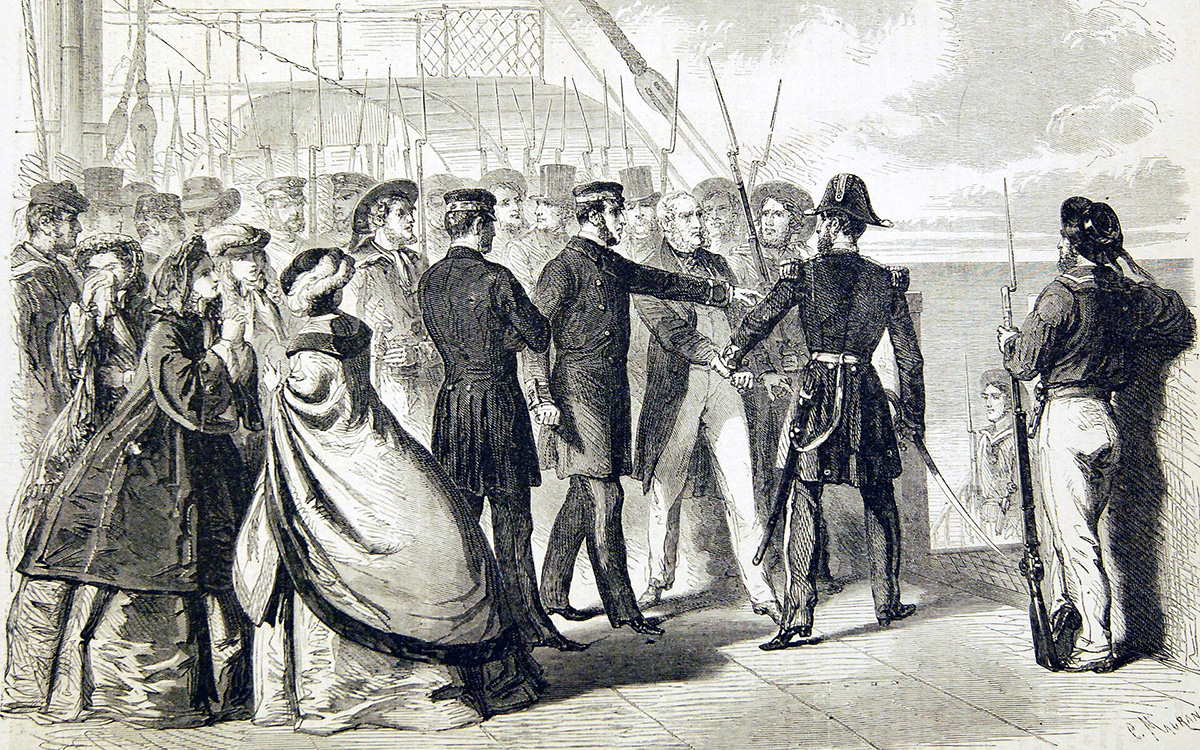
Confederate supporters James Mason and John Slidell are removed from the RMS Trent by Union captain Charles Wilkes on November 8, 1861.
COURTESY OF THE LIBRARY OF CONGRESS
The Diplomats Get to Work
As events unfolded, Britain and the United States were both exceptionally well served by their respective diplomats. In Washington, D.C., Lord Richard Lyons had established a solid working relationship with the government. Charles Francis Adams Sr., the scion of the Massachusetts Adams family (he was the son of President John Quincy Adams and grandson of John Adams), had likewise cultivated a web of prominent contacts and built mechanisms to gather information and influence British policy. Adams effectively communicated the depth of British outrage over the seizure, leaving Washington in no doubt over the gravity of the crisis.
The first break in what seemed an inevitable path to a lose-lose war came when Queen Victoria’s consort, Prince Albert, urged a slight softening of what was still a harsh letter from the British foreign minister to Washington, D.C., demanding an apology and the envoys’ release. Albert’s modified text allowed the possibility that Washington was unaware of Wilkes’ plan and that it did not reflect U.S. policy. After presenting this communication to Lincoln’s shrewd and effective Secretary of State, William Seward, Lyons adroitly ignored the seven-day suspense stipulated in the letter for a U.S. response, allowing time for tempers to cool and for both sides to reconsider the cost of conflict.
Seward and Lincoln used the time and the modified text wisely. After weeks, public opinion pivoted to other matters, and seizing on Albert’s added opening, Lincoln decided to deescalate the brewing confrontation with Britain, telling Cabinet hawks, that the United States should fight “one war at a time.” Without explicitly disavowing Wilkes’ action or issuing the abject public apology sought by London, the U.S. government nevertheless released Mason and Slidell and allowed them to proceed to London. Seward told Lord Lyons that Wilkes should have brought the ship to maritime prize court for disposition rather than seizing the two envoys.
A Victory for the Union
The Trent affair ended as quickly as it began, and bilateral relations resumed a stable—if uneasy—trajectory. The outcome was a crucial defeat for Richmond. Prime Minister Palmerston would again consider recognizing the Confederacy the next year, but that discussion was preempted by the Union victory at Antietam in September 1862. Even a hypothetical recognition at that stage would have been a far cry from the de facto co-belligerency that could have resulted from the Trent affair.
Slidell and Mason’s best service to the Confederacy was probably their captivity by the Union. Once ensconced in London and Paris, they proved singularly ineffective. Although Slidell enjoyed a measure of access to French elites, he was unable to secure French recognition or meaningful support, although he did secure a loan for the Confederacy. In London, though Mason appealed to a “Confederate Lobby” among some merchant and upper-class circles, many power brokers were put off by his long-winded pro-slavery diatribes and constant chewing of tobacco. Although he would later facilitate covert purchases of Confederate warships from British shipyards, he never seriously influenced British policy.
U.S. Minister Charles F. Adams, however, proved to be one of the most effective American diplomats of the era. After skillfully helping avoid war over the Trent, Adams would later cultivate religious, labor, and abolitionist leaders, and he gradually forged a powerful pro-Union constituency in Britain. Just as public opinion was a factor in the Civil War that it had not been in Europe previously, it could also be said that Adams weaponized the abolition of slavery to orchestrate one of the earliest and most consequential public diplomacy campaigns in U.S. diplomatic history.
Lessons for Today’s Diplomats
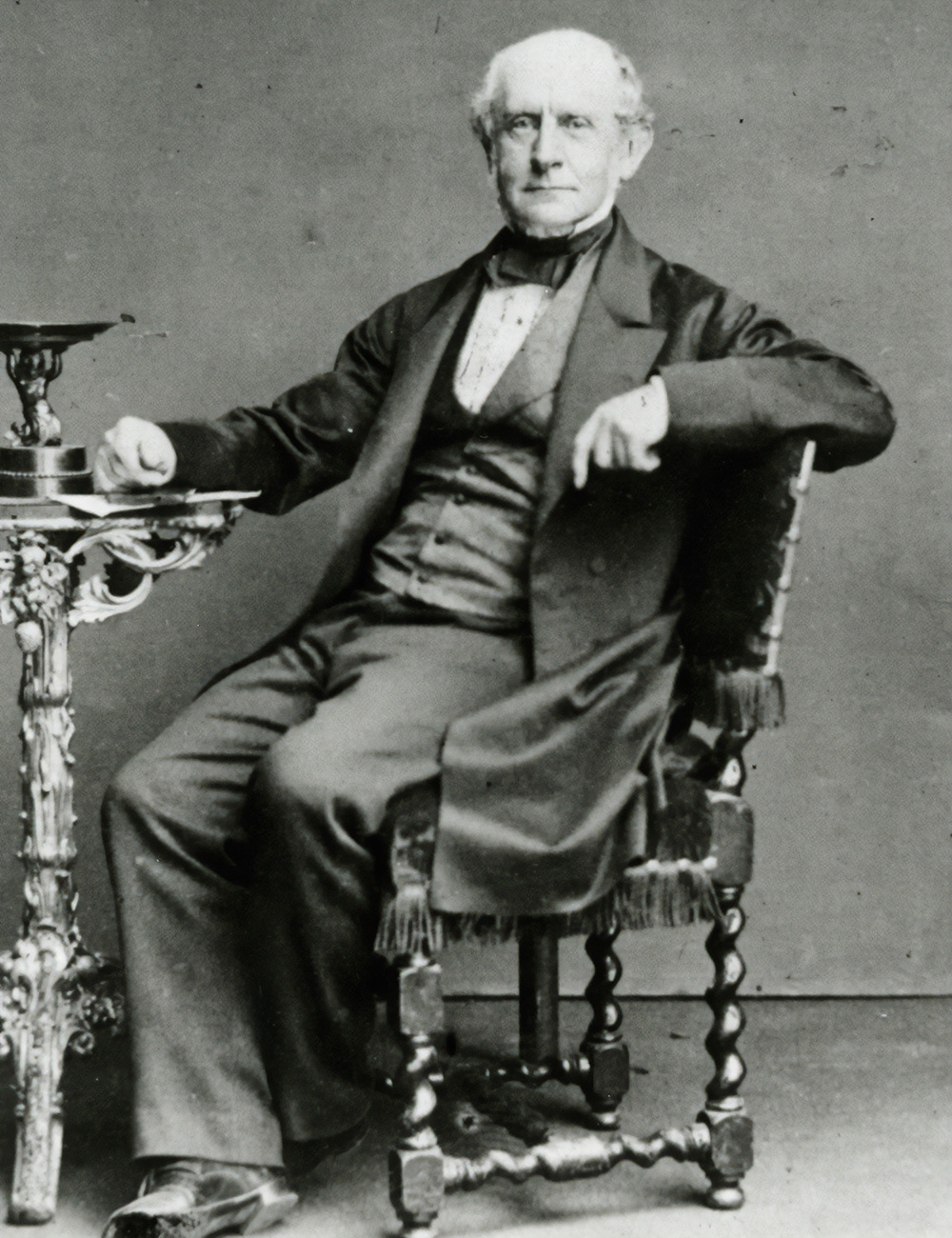
Charles Francis Adams, son of John Quincy Adams and grandson of John Adams, served as ambassador to Great Britain during the Civil War.
WIKIMEDIA COMMONS
Out of this existential diplomatic scuffle in 1861–1862, several points still reverberate today.
Public opinion. This was one of the first instances in Western history in which public opinion had a significant impact on policy deliberations. It necessitated a more nuanced approach to political messaging and diplomacy than was previously the norm.
Communications. Although the advances in mass communications were far from uniform, even these helped create an early version of the media feeding frenzies that accompany modern crises. In the face of furious popular demands for action, both governments avoided feeding the media beast. They consciously took time to formulate a response and also allowed the other side time to reply with the cool light of reason.
International law. The Lincoln administration privately realized early in the crisis that Wilkes’ seizure of Mason and Slidell was contrary to prevailing international law and that other neutral states were largely arrayed against the United States on the facts of the case. Then, as now, international law proved particularly useful in helping resolve disputes that both sides needed to settle but that also entailed confronting powerful domestic influences.
Appeasement. Now used almost exclusively as an epithet, appeasement was discredited as a policy by the experience of the 1930s. Nevertheless, it is sometimes a viable tactic to avoid a disadvantageous conflict. In this case, the Lincoln administration’s decision to largely accede to British demands incurred some immediate editorial disfavor (though less than might have been expected), but it also helped both sides avoid a catastrophic lose-lose conflict. Policymaking by analogy is usually misguided, and despite the experience of Munich, appeasement is sometimes a canny approach.
The leadership of both sides in the Trent affair defused a spiraling crisis and kept their focus on broader national interests in the face of furious public moods. Both governments recognized that there is, after all, no real victory in a war one should never have fought.

Rich Hinman is a retired Foreign Service officer who served in the Czech Republic, India, Jordan, Tunisia, Russia, and Afghanistan. He is also a retired Army officer, former Secret Service agent, and an avid outdoorsman and amateur historian.
When sharing or linking to FSJ articles online, which we welcome and encourage, please be sure to cite the magazine (The Foreign Service Journal) and the month and year of publication. Please check the permissions page for further details.
Read More...
- “Publicizing Foreign Relations in Time of War: The Foundation of the Foreign Relations of the United States Series” by Aaron W. Marrs, Office of the Historian, U.S. Department of State, June 2011
- “Robert C. Schenck: Political Ambassador and Scoundrel” by Stephen H. Muller, The Foreign Service Journal, November 2014
- “TWE Remembers: The Trent Affair” by Anna Shortridge, Council on Foreign Relations: The Water’s Edge, November 2021