Life After the Foreign Service: Diplomacy in Demand: University Students Are Eager to Learn from Practitioners
Students study international relations theory, but they want to know how the diplomatic sausage is actually made, this retired FSO found.
BY MARK C. STORELLA
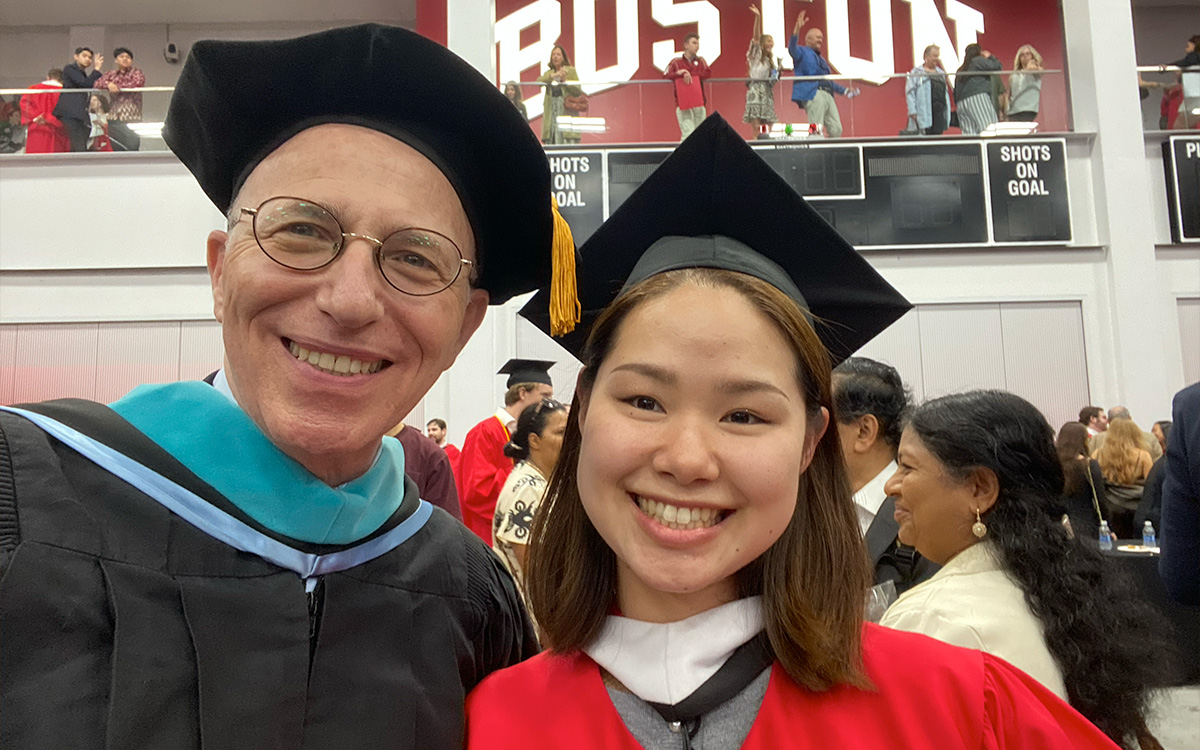
The author celebrates with a former graduate student, Yuka Seto, now a Japanese diplomat serving in South Sudan.
Courtesy of Mark Storella
When I retired from my three-decade career in the Foreign Service in 2020, I joined the faculty of the Pardee School of Global Studies at Boston University.
I was asked to apply for the slot as a Professor of the Practice of Diplomacy in part because of experience I had garnered in two stints as a fellow at Georgetown University’s School of Foreign Service and dean of the Leadership and Management School at the Foreign Service Institute. Pardee reserves several faculty positions for practitioners from the worlds of diplomacy, development, intelligence, and security. No PhD required!
The application involved assembling a dossier of résumés, publications, teaching experience, and the like. Pardee then invited me to campus to teach a class, play speed dating in short interviews with a dozen faculty and students, and give a “job talk” to the faculty, who then subjected me to an impromptu thesis defense.
I loved all the scholars and students I met, and I was eager to move back to Boston, my hometown. So, when they made the offer, I jumped.
Still, I wondered what students would think of what a former diplomat had to offer.
Practitioners in Demand
Six years in, I am happy to report that diplomacy—and the experience former foreign affairs professionals can offer—is very much in demand among university students. Here are a few reasons why.
First, students are intellectually curious about our professions. They study international relations theory but are also eager to know how the diplomatic sausage is actually made. In courses on international negotiation and health and humanitarian diplomacy, students are thrilled to hear how diplomats use the tools available to practitioners to build a coalition to advance a resolution in an international organization. They are wide-eyed about how an embassy is run, what diplomatic immunity means “in the wild,” and how diplomats protect their citizens from everything from terrorism to corrupt foreign practices.
Students are fascinated by our war stories about VIP visits, representational events, the dangers and rewards of dealing with the press, and our often minor roles in major events.
Second, they want to learn the real-life skills practitioners know best. In all my classes, I eschew formal research paper assignments in favor of decision memos and policy briefings based on State Department formats. Students love to try their hand at negotiation simulations. In the fall semester, my undergraduates negotiated a bilateral tariff deal between two fictional countries—a success—and peace between Ukraine and Russia in a multilateral conference—not so much of a success.
My graduate students role-played an interagency policy coordination committee to make recommendations to the president on how changes in Syria could herald new opportunities for durable solutions for Syrian refugees and internally displaced persons.
One of my students, who later landed a job in the prime minister’s office of her home country, told me that she used the State Department memo formats she learned at Pardee to prepare her principal. She found her practice conducting “elevator briefings” in class invaluable when she had to brief her principal on the run. “That is what they actually do, and I knew how,” she told me.
Third, university students today are laser-focused on getting their first job. Despite all the turmoil in our profession, these students are looking over the horizon and considering how they can establish a beachhead in a career they will grow into. They seek advice from practitioners on how to network and even introductions to prospective employers.
Finally, students are eager to meet our former colleagues in class or through speaking events.
In the last year alone, a senior UNHCR official, a former head of the USAID Office of Foreign Disaster Assistance, a former U.S. ambassador to Myanmar, and a senior civil servant who was a top expert on humanitarian assistance all addressed my classes.
While it can be humbling, my student evaluations often point to guest lecturers as the most exciting part of my courses.
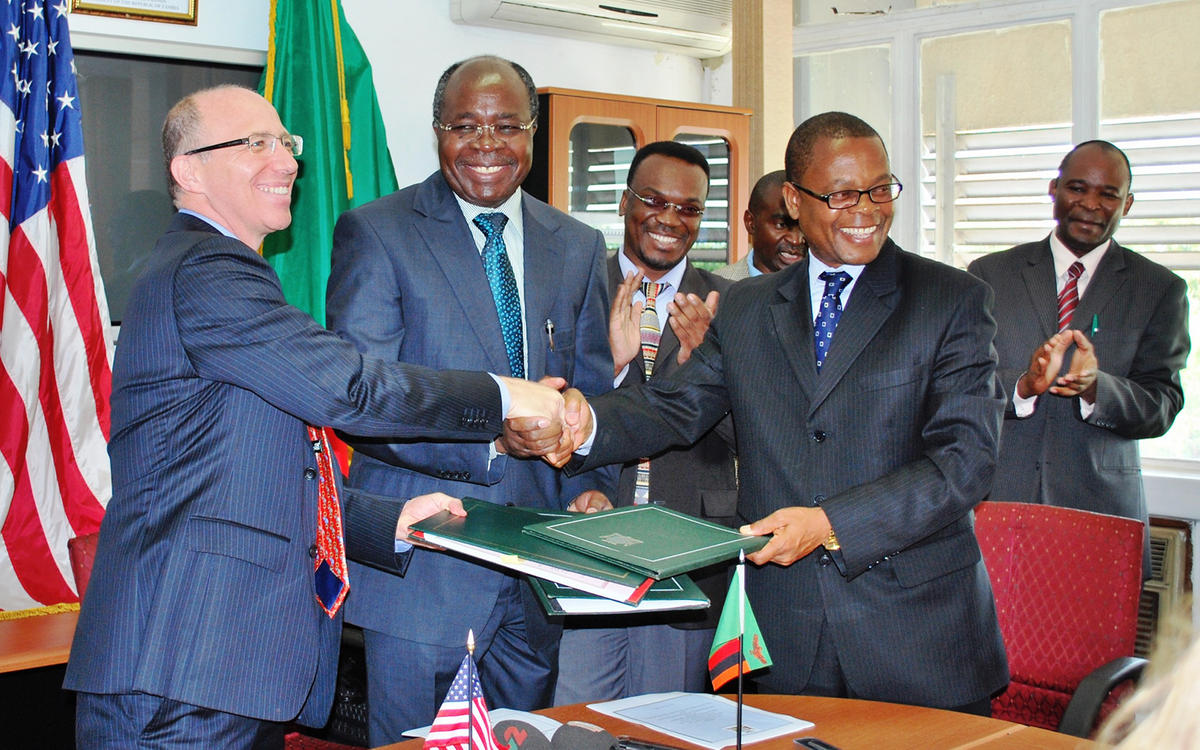
Ambassador Mark Storella (left), Zambian Minister of Finance and National Planning Situmbeko Musokotwane (center), and Minister of Health Kapembwa Simbao shake hands on signing the PEPFAR framework in November 2010. This photo appeared on the May 2017 FSJ cover.
U.S. Embassy Lusaka
Getting Started
For those of you who are contemplating academia as an encore to a foreign affairs career—whether in a faculty position or as an adjunct or guest lecturer—I urge you to jump in. Assemble ideas on the practical experiences you want to share. Consider the specific job skills you could teach. Think about how you could connect students with potential employers. And consider the great former colleagues who might dazzle young minds.
It would also be valuable to consider courses you would like to teach and begin preparing a syllabus. AFSA lists resources for teaching at https://afsa.org/teaching-diplomacy.
Also consider a job talk you might deliver to faculty or an existing class. For my interview with Pardee, I spoke to a class on great power competition in Africa and delivered a (premature?) talk to faculty on the coming centrality of multilateral diplomacy.
If you seek a full faculty position, it certainly helps to have the title of ambassador, but it is not required. There are about a dozen universities around the country that explicitly employ former foreign affairs professionals as full faculty members. Among them are Georgetown, George Washington, Princeton, Davidson, the University of Colorado, Boston University, Simmons University, Tufts University’s Fletcher School of Law and Diplomacy, and the University of Virginia.
For more leads, please consult the article Jillian Burns and I wrote on the subject in the January-February 2020 FSJ. [Also see the January-February 2015 FSJ Focus on teaching diplomacy.]
You can also get your foot in the door through guest lectures and adjunct teaching (which is notoriously poorly compensated but may help you learn if you enjoy the work). With most universities facing increasing budget pressures, some are not filling vacated faculty slots and will need more adjunct faculty to teach classes. Taking the initiative to reach out to universities to offer your services may pay dividends in the current environment.
An easy way to get started is to speak to civic associations and the like. I recently delivered a talk called “The Diplomat: Fact or Fiction?” to the Wellesley Club in Massachusetts based on the popular Netflix series “The Diplomat.”
In 2024 I was fortunate to receive the Gitner Family Prize for Faculty Excellence. In a sign of appreciation for what practitioners bring to the academy, one of the student nominations noted: “What sets Professor Storella apart is his commitment to go beyond conventional teaching methodologies. He seamlessly integrates his wealth of real-world experiences into his classroom, bridging the gap between theory and practice.”
Despite all the turmoil in international affairs—and maybe in part because of it—students want to learn what we know, and they hope to do what we did. You have a wealth of experience to share that students and universities will value.
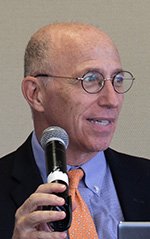
Mark C. Storella is Professor of the Practice of Diplomacy at the Frederick S. Pardee School of Global Studies at Boston University. From 1985 to 2020, he was a Foreign Service officer who worked on five continents, including as ambassador to Zambia, deputy assistant secretary of State for the Bureau of Population, Refugees, and Migration, and dean of the State Department’s Leadership and Management School.
When sharing or linking to FSJ articles online, which we welcome and encourage, please be sure to cite the magazine (The Foreign Service Journal) and the month and year of publication. Please check the permissions page for further details.

Related Links
Featured Content from This Issue:
FOCUS ON NUCLEAR SECURITY
- The Nuclear Security Summits: Keeping the World Safe from Nuclear Terrorism
- Negotiating Nuclear Security: A View from the First Trump Administration
- A Brief History of U.S.-China Nuclear Diplomacy
- Responding to the Fukushima Nuclear Accident: U.S. Assistance to Japan
- Is Nuclear Testing Needed?
FEATURES
FS HERITAGE
RETIREMENT SUPPLEMENT
PERSPECTIVES
- President’s Views: Toward Common Goals
- Speaking Out: Our Professional Foreign Service Is in Danger
- Speaking Out: What’s Wrong with the Ben Franklin Fellowship?
- Reflections: Did Wyatt Earp Smuggle a Puppy into Sweden?
- Local Lens: Ben Nevis, Scotland
DEPARTMENTS
AFSA NEWS