
Many people know about the Red Scare; less well known, perhaps, is a case that helped bring an end to McCarthyism and its democratic backsliding—that of Wolf Ladejinsky.
BY MICHAEL CONLON
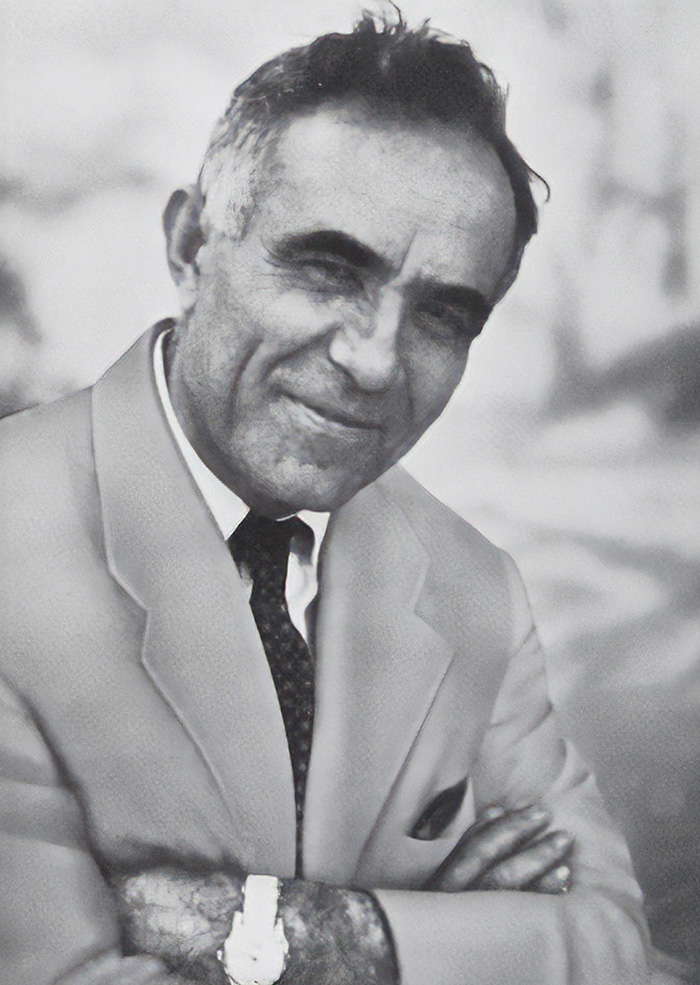
Wolf Ladejinsky
Wikimedia Commons
Over its 250-year history, the United States has struggled to live up to its ideals of democracy, including the belief that public service should be a public trust and free from political influence.
Many people know about Joseph McCarthy and the Red Scare, a period in the late 1940s and early 1950s when hysteria swept across the country. During this time, fears grew that communists had infiltrated every part of American life, including the U.S. State Department and other government agencies. Thousands of U.S. government workers were caught up in this panic and lost their jobs.
Less well known, perhaps, is a case that helped bring an end to the Red Scare and McCarthyism—the case of Wolf Ladejinsky. Ladejinsky was a Soviet émigré who worked as an economist for the U.S. Department of Agriculture (USDA) and, after World War II, became the chief architect of Japan’s land reform, one of the most successful land reform programs in history, which provided poor farmers with land titles and stopped the spread of communism.
In 1954, USDA fired Ladejinsky as a security risk because of his Soviet origins.
This is his story and the lessons it offers today for fighting democratic backsliding.
Early Life and Career
Born in Dnipro in 1899, the son of a prosperous Jewish miller and grain merchant, Wolf Ladejinsky was forced to flee after the 1917 Russian Revolution unleashed pogroms throughout Ukraine, then part of the Russian Empire. His elder brother was killed in the pogroms, and the family decided that he should flee; his sisters would stay back to care for their elderly parents.
Making his way to the United States, Ladejinsky worked odd jobs to learn English and then pay his way through school, graduating with a degree in economics from Columbia University in 1928 and becoming a naturalized U.S. citizen the same year. In 1935 he began working for the USDA and became an expert on Japanese agriculture, especially land tenure issues.
Small in stature with graying black hair, Ladejinsky was “soft-spoken, charming, with a continental manner and an intriguing Russian accent,” and often smoked a pipe. One acquaintance noted that he had a “penchant for pessimism.” Before being assigned to Japan, he had reportedly told a friend that he would never be an American official abroad with his Russian accent and birth: “They just wouldn’t listen to me there.”
Lucky for America and Japan, Ladejinsky was wrong about that. He was assigned to Japan and played a crucial role in the U.S. occupation.
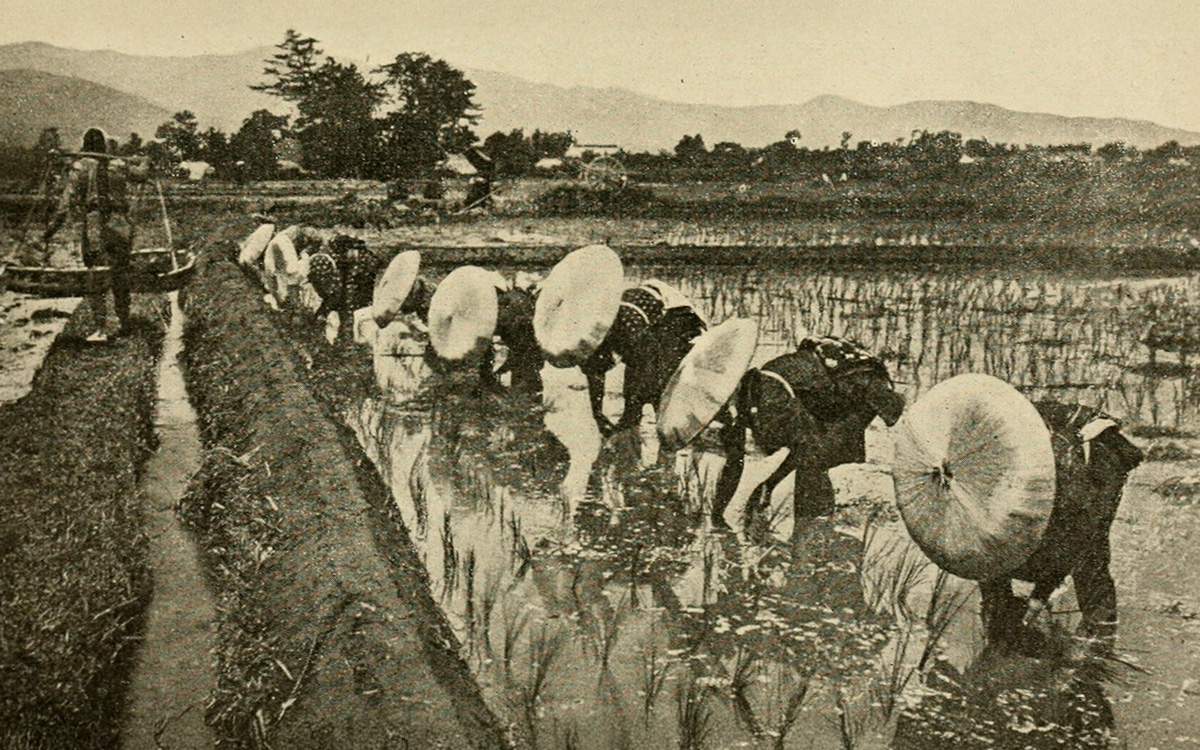
Japanese farmers worked by hand, with the help of oxen, at the time of the postwar land reform.
Internet Archive Book Images / Wikimedia Commons
Serving His Adopted Country in Japan
Because of Ladejinsky’s expertise, in 1944 the U.S. military asked him to write the agricultural section of the Civil Affairs Handbook: Japan, which had been created to educate occupation forces on planning for postwar Japan. Early in the Allied occupation, General Douglas MacArthur, Supreme Commander of the Allied Occupation Forces, decided to move forward with radical land reform based on Ladejinsky’s ideas.
In December 1945, USDA sent Ladejinsky to Tokyo to assist in implementing the land reform. He became the main architect of the program, which gave 3 million farmers ownership of the land they tilled and dismantled the power of landlords who had long controlled Japanese agriculture, thus preventing the spread of communism in the country. According to Gen. MacArthur, “The land reform program did more to cut the ground from under the Japanese communists than any other measure taken during the occupation.”
Novelist James Michener called Ladejinsky “communism’s greatest enemy in Asia.” With his achievements in Japan and growing international reputation, Ladejinsky became a highly sought-after expert on land reform in Asia. His efforts and ideas significantly contributed to the success of land reform programs in Taiwan and South Korea.
Wolf Ladejinsky’s story demonstrates that democracy is never guaranteed and that defending it requires individuals willing to speak out.
In 1950 USDA assigned Ladejinsky to the State Department to serve as the agricultural attaché in Tokyo. Like today, the attaché’s job was to expand the Japanese market for U.S. agricultural products, and Ladejinsky excelled in this role. During his time as the agricultural attaché, Japan became a major importer of U.S. agricultural products.
Like many immigrants, he appreciated the opportunities his adopted country provided him. In a 1954 letter to James Russell, the farm editor of the Des Moines Register & Tribune, Ladejinsky noted: “I arrived in the states at the age of 22 without the knowledge of language, money, friends, etc. But I had the country to fall back on and all it has given to the generation of immigrants in the past. I have taken, and I have given in return to the best of my ability, with but one guiding thought in my mind—the welfare of the United States.”
The McCarthy Era Scandal
On September 1, 1954, agricultural attachés were transferred from the State Department to USDA’s newly created Foreign Agricultural Service, and Ladejinsky was set to return to USDA as the agricultural attaché in Japan. In early December, he attended a conference in Washington, D.C. Although he had recently received a security clearance from the State Department, USDA dismissed Ladejinsky during his visit to Washington. He was not given any notice of charges or a hearing.
Initially, USDA claimed that Ladejinsky was being terminated because he lacked a farm background in the United States and wouldn’t be able to effectively represent U.S. agriculture abroad, despite having performed well in that role in Japan for several years. Later, USDA changed its explanation, stating he was being dismissed because he was perceived as a security risk. Ladejinsky had worked as an interpreter for the Soviet’s Amtorg Trading Company in New York for several months in 1931, visited Ukraine in 1939, and the fact that he had family in the Soviet Union could make him susceptible to blackmail.
News of his firing broke just before Christmas 1954, and the public reaction was swift. On December 18, Clark Mollenhoff, an investigative reporter for the Des Moines Register & Tribune, published a series of articles about the Ladejinsky case, which remained on the front page of newspapers across America for several weeks. Influential figures from all parts of the political spectrum, such as Congressman Walter Judd (R-Minn.) and Senator (and later vice president) Hubert Humphrey (D-Minn.), came quickly to Ladejinsky’s defense.
He had reportedly told a friend that he would never be an American official abroad with his Russian accent and birth: “They just wouldn’t listen to me there.”
Suddenly, he became one of the most recognizable figures in America and a symbol of the evils of McCarthyism. Though Joe McCarthy’s influence was already in decline (on December 2, 1954, the Senate voted to censure him for conduct unbecoming a senator), the Ladejinsky case seriously undercut McCarthyism’s broader appeal.
Embarrassed by the controversy, on January 12, 1955, President Dwight Eisenhower announced that Ladejinsky had been hired by the Foreign Operations Administration (FOA), the predecessor to the U.S. Agency for International Development (USAID), to serve as an agricultural adviser in South Vietnam.
On January 18, Harold Stassen, the director of FOA, granted Ladejinsky a security clearance to work for his agency. Under pressure, Secretary of Agriculture Ezra Taft Benson, an enthusiastic anti-communist, withdrew his “security risk” designation but maintained that USDA had acted correctly.
Later that year, on September 27, 1955, during testimony before a Senate subcommittee looking into the administration’s security program, Benson admitted he had made a mistake in denying security clearance to Ladejinsky. Benson said the program had been overhauled as a result of the affair.
Ladejinsky’s Importance for Democracy
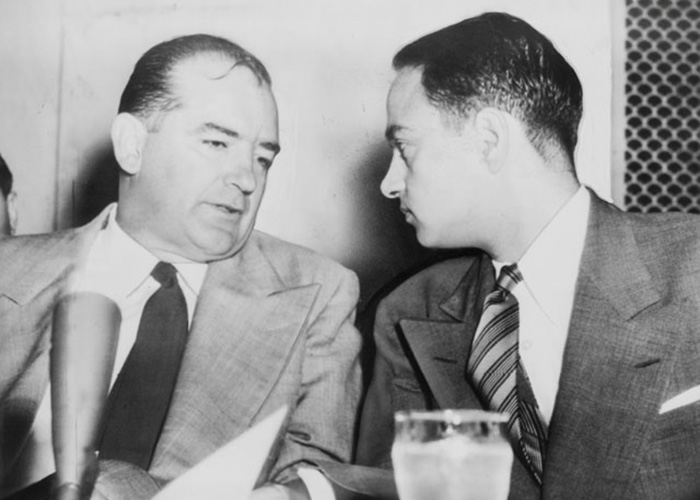
Senator Joseph McCarthy chats with his attorney Roy Cohn during Senate subcommittee hearings on the McCarthy-Army dispute, 1954.
Library of Congress
Although agrarian reform efforts in South Vietnam met more obstacles and ultimately proved less successful than those in Japan, Ladejinsky spent the rest of his life working “in the field” on land reform issues in Asia with the Ford Foundation and the World Bank. Still dedicated to helping the rural poor in Asia at age 76, when others his age had long since retired, he suffered a stroke in India and died on July 3, 1975.
Ladejinsky was an extraordinary person. An immigrant who didn’t speak English when he arrived in the United States, he started with nothing but, through hard work and determination, earned a college degree and rose through the ranks in the U.S. government and international development agencies.
His essential work on land reform lifted millions of farmers out of poverty in Asia, helped prevent the spread of communism in Japan, South Korea, and Taiwan, and played an important role in a U.S. security case that contributed to ending the threat of McCarthyism.
Wolf Ladejinsky’s story demonstrates that democracy is never guaranteed and that defending it requires individuals willing to speak out. At a time when civil servants again face suspicion, his story reminds us that justice, even when it takes time, is worth fighting for. As Martin Luther King said, “The arc of the moral universe is long, but it bends toward justice.”
Michael Conlon is a retired USDA Foreign Service officer with 36 years of global experience. He writes about international agriculture and diplomacy. This article was adapted from a longer piece, “The Firing of Wolf Ladejinsky,” published in the online publication Quillette on June 4, 2025.
When sharing or linking to FSJ articles online, which we welcome and encourage, please be sure to cite the magazine (The Foreign Service Journal) and the month and year of publication. Please check the permissions page for further details.
Read More...
- “The McCarthy Years Inside the Department of State” by John W. Ford, The Foreign Service Journal, November 1980
- “Fertilizer Diplomacy” by Michael Conlon, The Foreign Service Journal, September 2024
- “FAS: Agricultural Economic Diplomacy in Action” by Evan Mangino, The Foreign Service Journal, June 2025

