Since its founding, the Peace Corps has been inextricably linked to the Department of State, and many of its volunteers have gone on to excel at the department.
BY BEN EAST
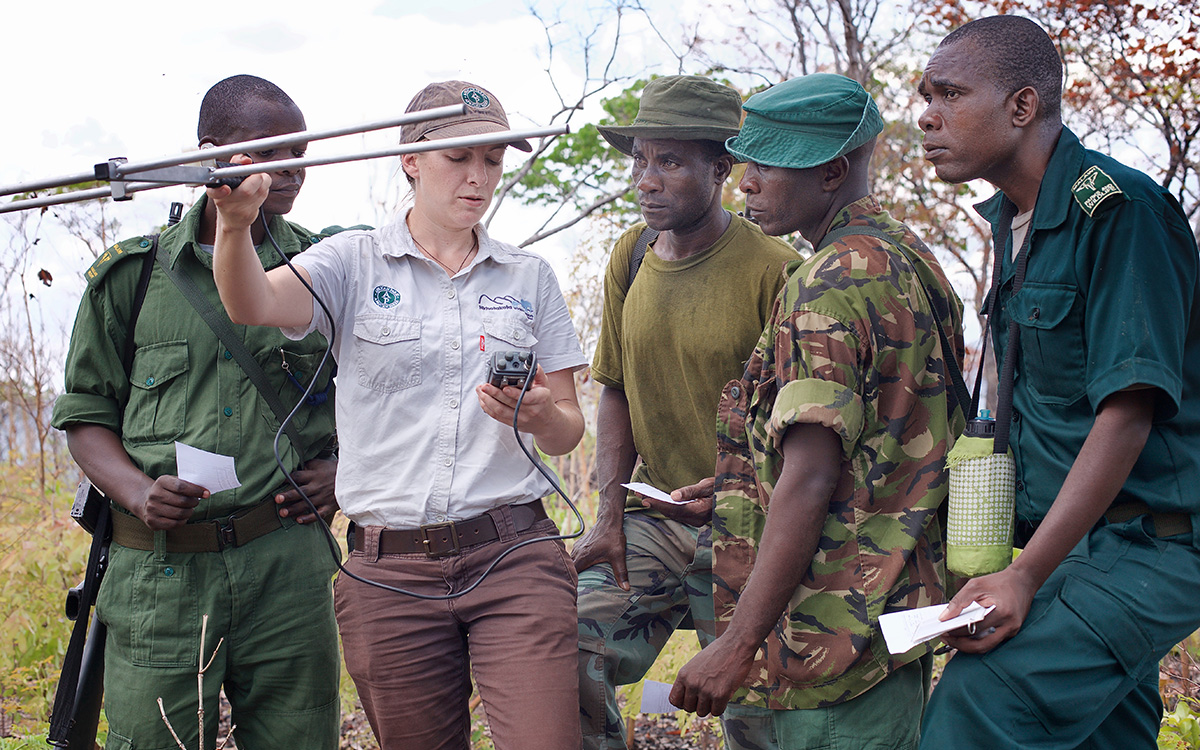
Peace Corps Response Volunteer Betsy Holtz trains Malawian wildlife reserve rangers in radio-tracking for elephants in 2016.
Courtesy of Peace Corps Media Center
Sixty-five years ago, on March 1, 1961, President John F. Kennedy signed Executive Order 10924, creating a Peace Corps within the Department of State. That was a logical home given one of JFK’s stated purposes for establishing the agency. Stumping in San Francisco the previous November, Kennedy said: “The key arm of our Foreign Service abroad are the ambassadors and members of our missions. Too many have been chosen who are ill equipped and ill briefed. … Men who lack compassion for the needy here in the United States were sent abroad to represent us in countries, which were marked by disease and poverty and illiteracy and ignorance, and they did not identify us with those causes and the fight against them. … How can they compete with communist emissaries long trained and dedicated and committed to the cause of extending communism in those countries?”
Kennedy then proposed “that our inadequate efforts in this area be supplemented by a peace corps of talented young men and women, willing and able to serve their country in this fashion for three years, as an alternative or as a supplement to peacetime selective service.”
From the beginning, the Peace Corps experience was intended to develop a new talent pool for a diplomatic corps JFK considered unprepared to face Cold War realities. One measure of the agency’s success in this regard might be the number of returned Peace Corps volunteers (RPCVs) to enter government service in foreign affairs. One estimate suggests that roughly 10 percent of Foreign Service officers from across all agencies are RPCVs.
Another measure of the Peace Corps’ contribution to Foreign Service talent is the number of RPCVs to reach the pinnacle of overseas representation. Eighty of the roughly quarter million Americans to serve as volunteers have gone on to become U.S. ambassadors, beginning with Parker Borg, who was nominated by Ronald Reagan as ambassador to Mali in 1981. Borg was a volunteer with the first group to arrive in the Philippines, in October 1961, a cohort that also included future U.S. Ambassador to Togo Brenda Brown Schoonover.
Testimonials from foreign leaders who got to know the volunteers in their local communities show the ways these volunteers spread U.S. ideals around the world over the last 65 years and give us hope for the next 65.
Household Names in Career Diplomacy
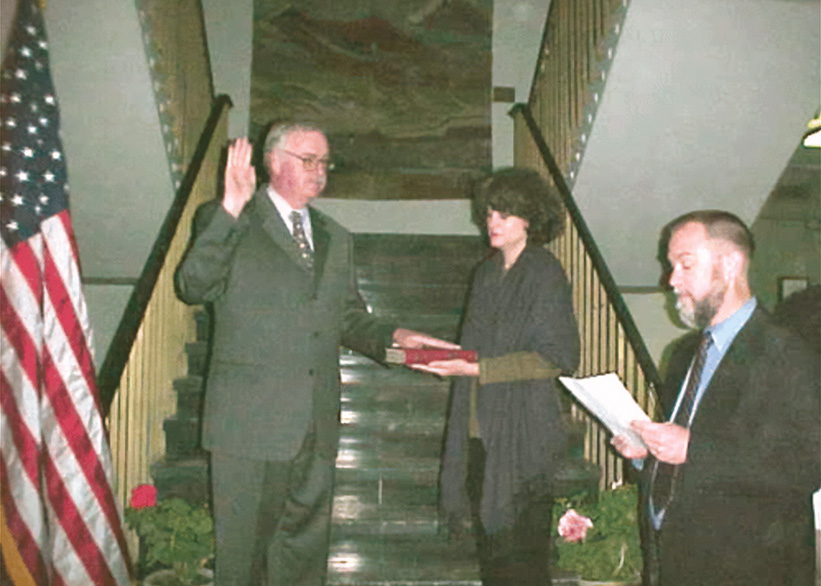
In 2002 Consular Officer Michael Metrinko, an FSO and RPCV from Iran (right), administers the oath of office for Ambassador Robert Finn, an FSO and RPCV from Turkey, at the chancery in Kabul as Executive Assistant Cheryl Helm (center) holds the Bible.
Sally Hodgson / U.S. Department of State
Most Journal readers will recognize the name Brian Aggeler, creator of the “Lying in State” comic series that once graced State Magazine. His cartoons were also a popular regular feature in the FSJ for about a decade. He and his wife, Angela Aggeler, U.S. ambassador to North Macedonia from 2022 until her December 2025 recall, served as volunteers in the Central African Republic. Aggeler himself headed the Organization for Security Cooperation in Europe (OSCE) mission to Bosnia and Herzegovina from 2022 to 2025. (An unofficial accounting of all RPCV ambassadors appears at https://bit.ly/PCV-list.)
Two department spokespersons, the late Richard Boucher and Mark Toner, served as volunteers—Boucher in Senegal (1973–1975) and Toner in Liberia (1986–1989), where he also served as ambassador (2024–2025). Four others were ambassadors in their country of Peace Corps service, bringing unparalleled depth for interpreting and navigating local language, culture, and customs: Robert Gelbard (Bolivia), David Greenlee (Bolivia), Thomas Hull (Sierra Leone), and Kathleen Stephens (South Korea).
At least four RPCV ambassadors served as assistant secretary of State, including Christopher Hill (East Asian and Pacific Affairs), Johnnie Carson (African Affairs), Donald Lu (South and Central Asian Affairs), and Richard Boucher (Public Affairs). The four distinguished themselves in a total of 11 ambassadorships.
Four of the 52 diplomats held hostage in Iran for 444 days had previously been volunteers—three in Iran itself. Two went on to become ambassadors, including past AFSA President John Limbert, ambassador to Mauritania from 2000 to 2003 (and PCV in Iran, 1964–1966). Limbert would help Iraq National Museum personnel round up looted antiquities after the 2003 U.S. invasion.
Victor Tomseth served as ambassador to Laos from 1993 to 1996. Before that, as deputy chief of mission in Tehran during the 1979 hostage crisis, Tomseth used his aptitude for foreign languages, first acquired as a volunteer, to communicate in Thai with chef Somchai Sriweawnetr, evading eavesdropping and getting six Americans to safety inside the Canadian embassy.
As consular officer in Kabul, Michael Metrinko (RPCV Turkey 1968–1970 and Iran 1970–1973) administered the oath of office for FSO Robert Finn (RPCV Turkey 1967–1969), the first post-9/11 U.S. ambassador to Afghanistan.
Other RPCVs have gone on to serve the country in various ways. Former U.S. Senators Paul Tsongas (D-Mass.) and Christopher Dodd (D-Conn.) served in Ethiopia and the Dominican Republic, respectively. At least a dozen RPCVs have served in the U.S. House, including currently John Garamendi (D-Calif.), who served in Ethiopia (1966–1968).
Foreign Leaders Weigh In
The Peace Corps Legacy Project hosts testimonials by foreign leaders on the influence volunteers have had in their communities. One particularly touching story came from former Peruvian President Alejandro Toledo (2001–2006).
In 1963, Toledo, a shoeshine boy from Chimbote, persuaded his mother to take in one of two volunteers despite an already full house of 16 children. Volunteer Nancy Deeds became for Toledo a focus of endless curiosity about the world. “She was part of the family,” he says. “She shared the small table with the very precarious food.”
From the beginning, the Peace Corps experience was intended to develop a new talent pool for a diplomatic corps JFK considered unprepared to face Cold War realities.
Both Deeds and fellow volunteer Joel Meister taught Toledo English. They helped him apply for a scholarship to the University of San Francisco, where he taught Spanish at the Peace Corps training center. In 2001 they would attend Toledo’s inauguration as South America’s first democratically elected president of indigenous descent. One of his first decisions that year was to ask President George Bush to reinstate the Peace Corps in Peru, absent since political instability in 1975 drove the agency from the country.
“I’m the only child in my family, until now, who’s gone to the university,” Toledo told the Legacy Project in 2025. “Had I not met Joel and Nancy, I would have never gone. My life changed substantially thanks to a dream of the United States, to the wisdom of constructing a bridge between the United States and the world. To a large extent, thanks to the Peace Corps.”
Toledo would lead Peru through strong economic growth, reduce extreme poverty by 25 percent, and foster democratic principles after the human rights abuses, corruption, and authoritarianism of his predecessor, Alberto Fujimori.
At his 1999 credentialing ceremony in Tegucigalpa, U.S. Ambassador Frank Almaguer heard unexpected candor from Honduran President Carlos Roberto Flores Facussé. Beyond earshot of either entourage, Flores leaned in and shared with Almaguer his concerns about having a U.S. ambassador with Peace Corps roots, saying: “Peace Corps people know the country better than we politicians do, and it is dangerous to have an ambassador from the U.S. who knows the country and its people so well!”
Almaguer, RPCV Belize (1967–1969) and a Peace Corps country director in Honduras (1976–1979), felt his heart pump with pride in what he considered the best investment the U.S. government made anywhere. Except for a bump to $430 million for 2025, the agency has operated on $410 million annually since 2016—slightly less than the amount allotted for U.S. military bands.
The agency’s work is more exchange than development and by most accounts does more for Americans than for the populations it serves.
Presidents, Supreme Court justices, and important political advisers across Africa share similar stories. Current President of Ghana John Mahama remembers his high school science teacher, volunteer John Woodfin. Curious about spaceflight after the Apollo missions, Mahama and his classmates looked to Woodfin to understand the enormity of space. “Mr. Woodfin made a lot of us fall in love with science. And so many of my friends who continue to do science today are doctors and engineers, probably did so under the influence of John Woodfin,” Mahama told the Legacy Project.
Afghanistan also proves rich in national figures with fond memories of specific volunteers. In 2002 interim Head of Finance and Foreign Assistance Ashraf Ghani told Peace Corps Director Gaddi Vasquez and RPCV FSO Michael Metrinko about a volunteer named Tom Gouttierre. Ghani (also Afghanistan’s fifth president, 2014–2021) could hardly be contained talking about “Mr. Tom” and other volunteers at Kabul’s Habibia High School, who taught more than English, math, and basketball. They taught fair play, he said, and the meaning of democracy. He credited PCVs with his selection to attend an Oregon high school for a year, altering the course of his life.
After leaving Ghani, the delegation called on Sima Samar, interim vice chair and minister for women’s affairs, and Minister of Higher Education Mohammed Sharif Fayez. Both shared similar memories of experiences in their youth with volunteers.
The Vasquez delegation was still in Kabul when President George W. Bush announced plans to double the number of volunteers to 14,000, to include possible site placements in Afghanistan, during his 2002 State of the Union address. In attendance at the Capitol were Samar and future Afghanistan President Hamid Karzai—also a Habibia High School alum. Though security would prevent the agency from reestablishing a presence there, nobody could say Vasquez’s visit hadn’t demonstrated the program’s worth.
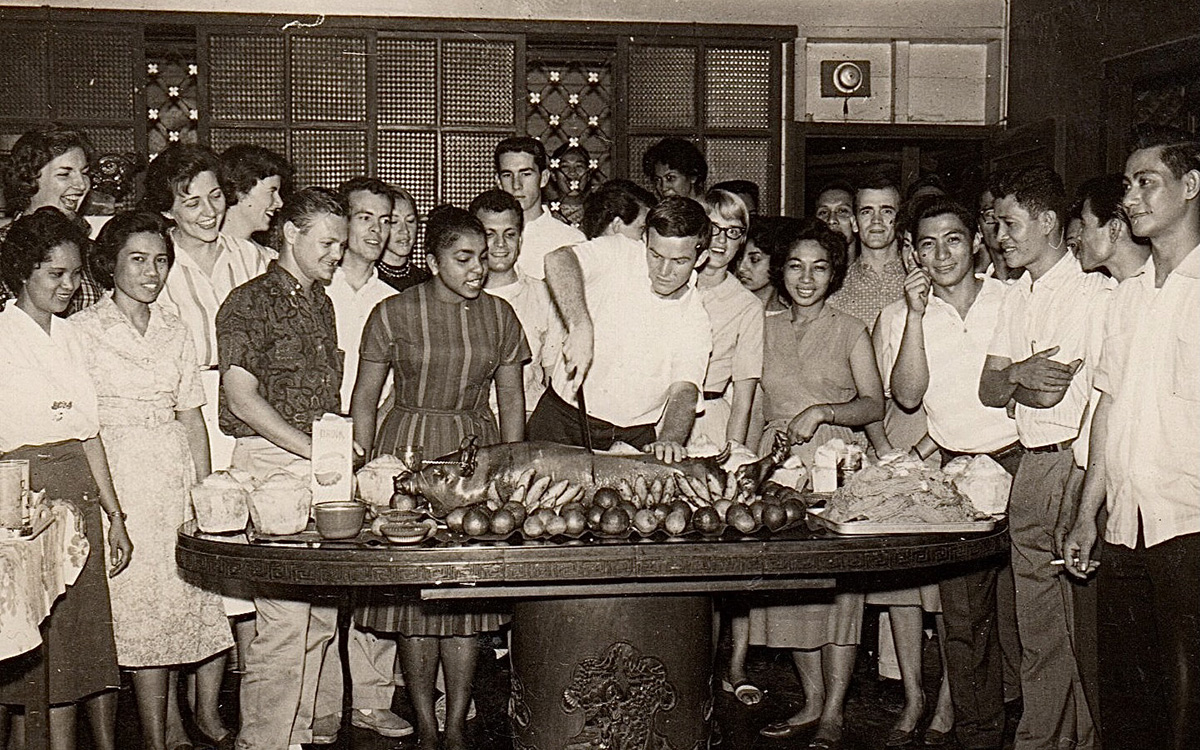
Then-PCV Parker Borg with a carving knife at the end of Philippines training in 1961; to his right is future Ambassador Brenda Brown Schoonover; at center behind them is another future FSO and deputy assistant secretary of State, Richard Dertadian.
Courtesy of Parker Borg
The Next 65 Years
Peace Corps remained an independent agency under the State umbrella until a Nixon executive order (EO) in 1971 merged it with other volunteer programs, including Volunteers in Service to America (VISTA), under a new entity called ACTION. A 1979 Carter EO moved it back within State, and legislation three years later gave the agency the full independence within the executive branch it enjoys today.
To hope the Peace Corps works itself out of a job in the coming decades is to miss the point. The agency’s work is more exchange than development and by most accounts does more for Americans than for the populations it serves. Volunteers currently work across six sectors—agriculture, community economic development, education, environment, health, and youth in development—earning the gift of cross-cultural communication, natural adaptability, and resilience. They hone their classroom techniques, become green thumbs, build fishponds, and test entrepreneurial ideas. They learn how to integrate with an unfamiliar community, to lean on others and be leaned on.
The Peace Corps has evolved over the decades. A high of 15,000 served in 1966, fewer than 5,000 during the 1980s, and around 7,000 leading up to the pandemic, when all volunteers were evacuated. The numbers have recovered somewhat, reaching above 3,000 in 60 countries at present. To boost recruitment, the agency offers flexible ways to serve beyond the traditional 27-month commitment: a six- to 12-month overseas option and a virtual service commitment of five to 15 hours per week for three to six months.
Whatever other developments await, one thing seems certain. The Peace Corps’ three goals, unchanged since 1961, will continue to steer its mission: to provide skilled human capital in countries that request it, share U.S. culture and values in communities abroad, and share volunteers’ newfound understanding of the world with people back home.
In meeting these goals, the Peace Corps makes JFK’s vision a reality and deepens the skills of our diplomatic corps.
Ben East retired from the Foreign Service in 2025 after three decades telling America’s story to the world as a Peace Corps volunteer (PCV), educator, and diplomat. A detail to the Association for Diplomatic Studies and Training in 2022 enabled him to research Peace Corps–Foreign Service connections. His nonfiction narrative, Profiles in Service, covers 50 years of diplomatic history focused on ambassadors who started out as PCVs. He serves on the FSJ Editorial Board and can be reached at ben@beneastbooks.com.
When sharing or linking to FSJ articles online, which we welcome and encourage, please be sure to cite the magazine (The Foreign Service Journal) and the month and year of publication. Please check the permissions page for further details.
Read More...
- “From the Peace Corps to the Diplomatic Corps” by Steven Alan Honley, The Foreign Service Journal, October 2008
- “The Peace Corps at Middle Age” by Shawn Zeller, The Foreign Service Journal, October 2008
- “The Card from Kabul” by Ben East, The Foreign Service Journal, May 2018
- Profiles in Service: Peace Corps Roots in American Diplomacy, by Ben East, February 2026