A key player in the Nuclear Security Summits (2010–2016) explains what diplomats achieved then—and what more needs to be done to keep bad actors from accessing nuclear materials.
BY LAURA HOLGATE
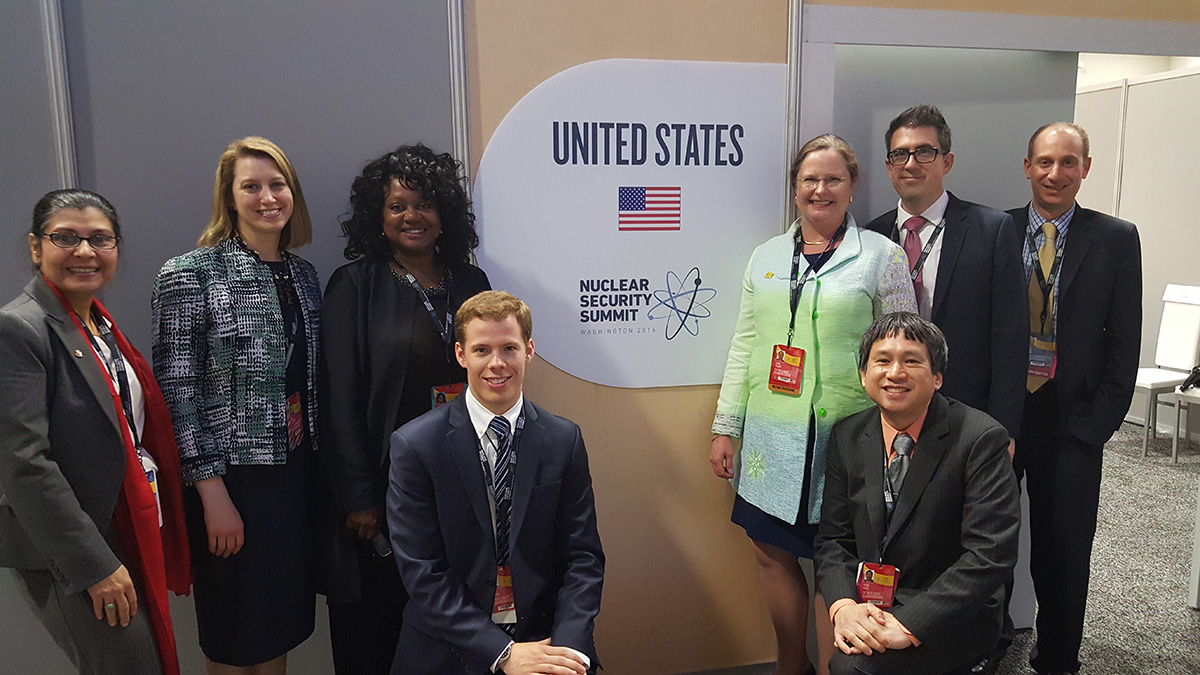
Laura Holgate (center right) with members of her “sherpa team” at the final National Security Summit, in Washington, D.C., in March 2016.
Courtesy of Laura Holgate
My path to leading the Nuclear Security Summits between 2010 and 2016 began in my undergraduate days, when I wrote a thesis on terrorism and marched against the 1980s nuclear arms race. It was not until the collapse of the Soviet Union—and the sudden risk that thousands of nuclear weapons and hundreds of tons of their key ingredients, uranium and plutonium, could be stolen or diverted by rogue generals or nonstate actors—that these two interests converged into the very real threat of nuclear terrorism. I worked at the center of U.S. efforts to reduce these threats through direct cooperation with the nations that emerged from that collapse, initially at the Department of Defense and later at the Department of Energy and a nongovernmental organization, Nuclear Threat Initiative.
A combination of bureaucratic creativity, skillful diplomacy, and patriotic Russian, Ukrainian, Kazakhstani, and Belarusian individuals, who suddenly held the keys to the largest proliferation event in history, prevented the worst fears from becoming reality. A decade later, al-Qaida’s attacks on 9/11 showed how vulnerable the world was to apocalyptic ideologues with extensive resources and disciplined operations. Another decade later, Anders Behring Breivik—the far-right terrorist responsible for the 2011 attacks in Oslo and Utoya Island in Norway—drew attention to his manifesto containing highly detailed descriptions of how to carry out a nuclear attack. This screed, along with the dystopian novel The Turner Diaries, continues to inspire violent attacks around the globe.
Theft of actual weapons from the nine countries that currently have them would be extremely difficult, but hundreds of tons of uranium and plutonium exist in 22 countries, whether in weapons programs or as part of civilian nuclear energy fuel cycles or research facilities. These materials are often transported by land and water to and through other countries. Were terrorists to steal or divert even modest quantities of uranium or plutonium, they could fashion it into one or more improvised nuclear devices that could be delivered by truck or small boat into cities or critical infrastructure locations and detonated.
In today’s interconnected world, even a single nuclear weapon could have devastating consequences, not only from initial blast and radiation effects that could kill hundreds of millions of people and decimate infrastructure, but also the political and economic consequences that would circle the globe along with the physical fallout. No matter where the attack took place, the global impacts would fall hardest on regions least capable of managing them.
The truth is inescapable: Terrorists are seeking the combination of public shock and physical devastation that even a crude nuclear weapon can provide, and no country can stop them alone.
Keeping America safe means working through multilateral bodies and with partners around the world to raise standards and improve implementation for securing nuclear materials.
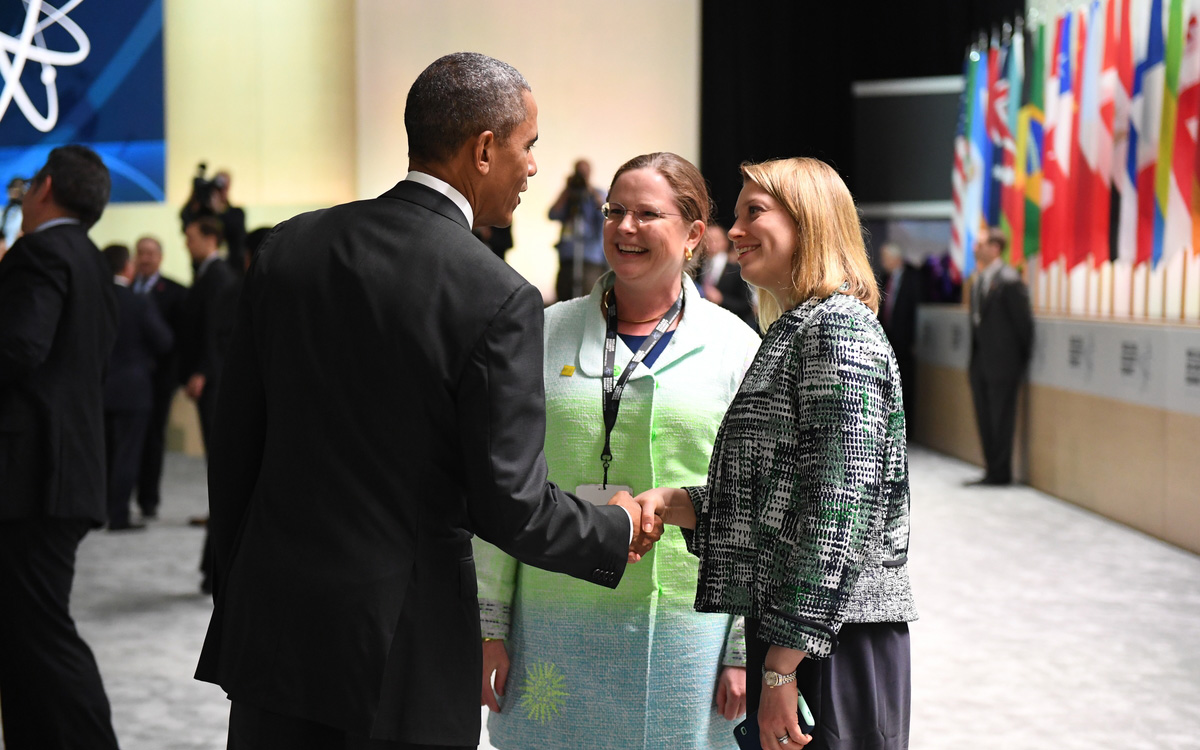
The author (center) introduces her friend and sherpa team colleague Corey Hinderstein to President Barack Obama at the National Security Summit in Washington, D.C., in March 2016.
Courtesy of Laura Holgate
The Summit Initiative
The United States has been a leader in the international response to these threats. The U.S. Departments of State, Defense, Energy, and Commerce have put in place domestic laws and export controls, delivered bilateral assistance, and supported multilateral treaties and institutions to build our own and other nations’ capacities to prevent nuclear terrorism.
The Nuclear Security Summits, an initiative that I led from 2010 to 2016, is a good example of these efforts. The summit idea reflected President Barack Obama’s intent to use and strengthen multilateral institutions to achieve U.S. policy goals. When I arrived at the National Security Council as senior director for WMD Terrorism and Threat Reduction in August 2009, I was handed a thin file labeled “NSS” and the responsibility to design this initiative. Working with a few talented experts from the relevant agencies, our group set as its first goal defining the objectives and participants in the summit: What outcomes would make it worthwhile to convene presidents, prime ministers, and kings?
We identified some 50 countries, from every continent and with a wide range of experiences with nuclear weapons, nuclear energy, and nuclear materials. While these countries hold more than 98 percent of the world’s total weapons-usable highly enriched uranium and plutonium, participants were far from like-minded. President Obama wanted a group small enough and with enough at stake to have a meaningful discussion, which meant holding the summit outside existing multilateral structures. This ad hoc approach also allowed us to custom design a process that would avoid some of the negotiating pitfalls of traditional United Nations–based procedures.
The focus on convening leaders was driven by the recognition that the prescription for improving nuclear security was well understood, but what was lacking was the political will to take hard and often expensive decisions to do it. All leaders understood the need for international cooperation to combat the nuclear terrorism threat—when nuclear weapons material is only as secure as the weakest link, all countries must work together to prevent its theft, detect its illicit transfer, and make sure it is never used in a terrorist weapon.
We also recognized that even if these concerns were not top of mind for every attending leader, President Obama’s “star power” would attract their participation and help extract meaningful commitments to increase security at nuclear facilities, reduce quantities of risky materials, build up detection capacity, increase cooperation with allies and neighbors, and take other concrete steps. These pledges became known as “house gifts,” and in many cases, they were the outcome of extensive demarches from U.S. embassies and direct outreach by senior officials to their counterparts to offer technical assistance or simply political encouragement. These diplomatic touch points were evidence of the high priority placed by the U.S. government on achieving real progress on nuclear security.
Once the summit guest list was final, we began briefing D.C.-based embassies and attending relevant meetings of the International Atomic Energy Agency (IAEA) and the G8 Global Partnership Against the Spread of Weapons and Materials of Mass Destruction to explain our approach. Many diplomats feared the summit would distract from or compete with the existing multilateral infrastructure involved in preventing nuclear terrorism.
Hundreds of tons of uranium and plutonium exist in 22 countries, whether in weapons programs or as part of civilian nuclear energy fuel cycles or research facilities.
But the summit was explicitly designed to enhance, energize, elevate, and empower this complex network of institutions and processes to take meaningful steps to improve security of weapons-usable nuclear materials. This approach demonstrated pragmatism in assembling capable and willing partners to achieve specific outcomes, but also a broader commitment to institution-building, by connecting the can-do spirit of those coalitions to increasing the capacity and stature of associated international organizations.
Preparations for the summit were led by “sherpas” and “sous-sherpas”—terms borrowed from Group of Seven and Group of 20 summit processes that refer to senior officials who could speak authoritatively about their leader’s intent and concerns and who could effectively coordinate inside their government to deliver on leaders’ promises. Many of the sherpa meetings were absorbed with the mechanics of the summit itself: who would speak when, delegation size, seating arrangements. As the U.S. sous-sherpa, I led meetings with my counterparts that focused on the substance of a consensus communique, on identifying national pledges, and on topical briefings to create a common set of understandings about the threat of nuclear terrorism and the tools necessary to manage it.
The initial Nuclear Security Summit, held in Washington, D.C., in 2010, was followed by summits in Seoul (2012) and The Hague (2014). A decade ago, the U.S. hosted the final summit in this format.
Securing Nuclear Materials
The key to preventing nuclear terrorism is to keep the nuclear materials out of the hands of those who could use them for deadly harm. Securing nuclear materials includes a wide range of activities, from shrinking overall quantities to reducing locations where they are stored or used and increasing physical protection around these materials and facilities. It also involves monitoring staff for insider threats, detecting and recovering stolen materials, determining the origin of intercepted nuclear materials or devices, and prosecuting those involved in nuclear theft or use.
At the heart of the summits’ purpose was the strengthening of the structures that guide and support states in implementing their sovereign responsibility to secure their nuclear weapons, materials, and facilities against theft, diversion, or, worst of all, use. These structures include the United Nations (UN), the IAEA, the International Criminal Police Organization (INTERPOL), and several treaties and initiatives involving government officials, nuclear industry, and civil society. Summit communiques and national commitments emphasized the strengthening of these components of the global nuclear security architecture. For example:
• The summits contributed to the 10-year extension, in 2011, of the only global, binding requirement that states secure their nuclear material: UN Security Council Resolution 1540, originally adopted in 2004.
• The UN, which also serves as depository for the International Convention on Suppression of Acts of Nuclear Terror, found that the convention’s adherents more than tripled during the period of the Nuclear Security Summits, significantly strengthening the criminalization of nuclear theft, trafficking, and sabotage.
What outcomes would make it worthwhile to convene presidents, prime ministers, and kings?
• IAEA, which has a central role among multilateral institutions on nuclear security, saw its nuclear security office elevated in status and its funding consistently increased based on summit pledges.
• In 2011, IAEA published its first update of nuclear security guidelines since 9/11 and is currently conducting a second update. More and more countries requested peer reviews of their nuclear security procedures and practices through IAEA.
• IAEA held its first minister-level meeting on nuclear security in 2013, after the first two summits, and since 2016, it convenes once every four years.
• IAEA is also the depository for the Convention on Physical Protection. As a result of the visibility provided by the summits, ratifications of a 2005 amendment significantly broadening the application of this treaty quadrupled after 2009, allowing the amendment to enter into force in May 2016.
• INTERPOL also has responsibilities and activities on nuclear security, including training in forensics at nuclear crime scenes and posting international notices regarding nuclear smugglers. Their profile in the nuclear security arena was significantly lifted by the summits.
At the final summit, in 2016 in Washington, D.C., leaders agreed to a set of action plans that specified how they will work together, as member states of these institutions, to further strengthen their nuclear security efforts. This upgrade of the multilateral institutions was a major legacy of the summit process. By recruiting capable partners to take swift action, the summit process avoided the paralysis that can often afflict international organizations, but by explicitly engaging the international organizations in the solution set, and by executing necessary actions through and with them, the United States strengthened the legitimacy of its actions. The summit process applied the energy of the coalitions to increase voluntary contributions, on top of regular dues and assessments, to support these international organizations in playing their critical roles.
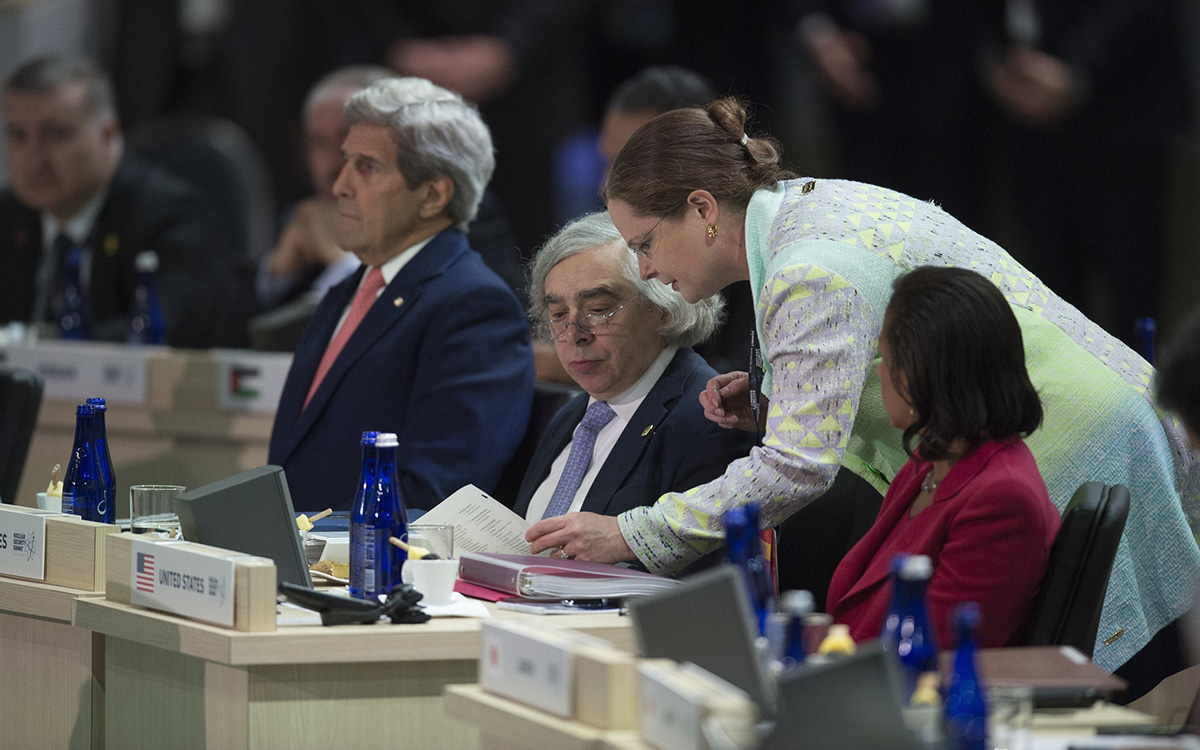
The author briefs Energy Secretary Ernest Moniz at the National Security Summit in Washington, D.C., in March 2016. Also pictured: Secretary of State John Kerry and National Security Advisor Susan Rice.
Courtesy of Laura Holgate
Challenges Ahead
Ten years after the last Nuclear Security Summit, the nuclear terrorism risk persists and evolves. With the summits and other programs, we have made enormous progress across the nuclear security agenda, but nuclear material holdings are still increasing, terrorism is on the rise, and national leaders have not given these efforts the political attention and resources they deserve.
Many of the 935 national commitments and institutional achievements made during the summits were irreversible and continue to contribute to reducing current threats, but global attention to nuclear terrorism has undeniably waned.
Hopes that diplomats on the ground in forums like IAEA would reflect the consensus of their leaders have not borne out, and broader geopolitical trends have made multilateral progress even more difficult to achieve. Diplomatic efforts to use the IAEA nuclear security ministerials to continue the summits’ “culture of deliverables” have foundered, and in 2024 delegations were unable to find consensus on a final statement.
The North–South divide on nuclear threat perception, which may have closed slightly during the summits, has since widened again. As long as the nonaligned states believe that nuclear security is a favor they do for the West, or that nuclear disarmament will eliminate the nuclear terrorism threat, nuclear security will be stuck in bloc politics. Active voices and organizations in civil society may be important advocates for the global nature of the threat, showing the need for global action.
In the context of rising interest in nuclear energy, the next great challenge of nuclear security is to embed it into the thought process and behavior of those national and private entities with nuclear security responsibilities. This includes incentivizing good security practices with benefits that are attractive to designers, builders, and operators of all types of nuclear facilities. As long as nuclear security remains an unpredictable externality to be resisted, it will be fragile. All nuclear actors have a stake in preventing nuclear terrorism.

Laura S.H. Holgate was a two-time U.S. ambassador and Permanent Representative to the United Nations International Organizations in Vienna and to the International Atomic Energy Agency. As special assistant to the president for weapons of mass destruction (WMD) terrorism from 2009 to 2016, she led the preparation and execution of the four Nuclear Security Summits.
When sharing or linking to FSJ articles online, which we welcome and encourage, please be sure to cite the magazine (The Foreign Service Journal) and the month and year of publication. Please check the permissions page for further details.
Read More...
- “Restoring Nuclear Diplomacy” by Joseph Cirincione, The Foreign Service Journal, May 2020
- “Getting State Back into Nuclear Arms Control and Nonproliferation” by Laura Kennedy, The Foreign Service Journal, January-February 2021
- “Laura Holgate on the Promise and Perils of Nuclear Innovation,” Center on Global Energy Policy at Columbia University, February 2026