The work of a political officer requires moral clarity in highly ambiguous situations and an acceptance of mortal risk and the personal costs of exile.
BY WILLIAM ROEBUCK
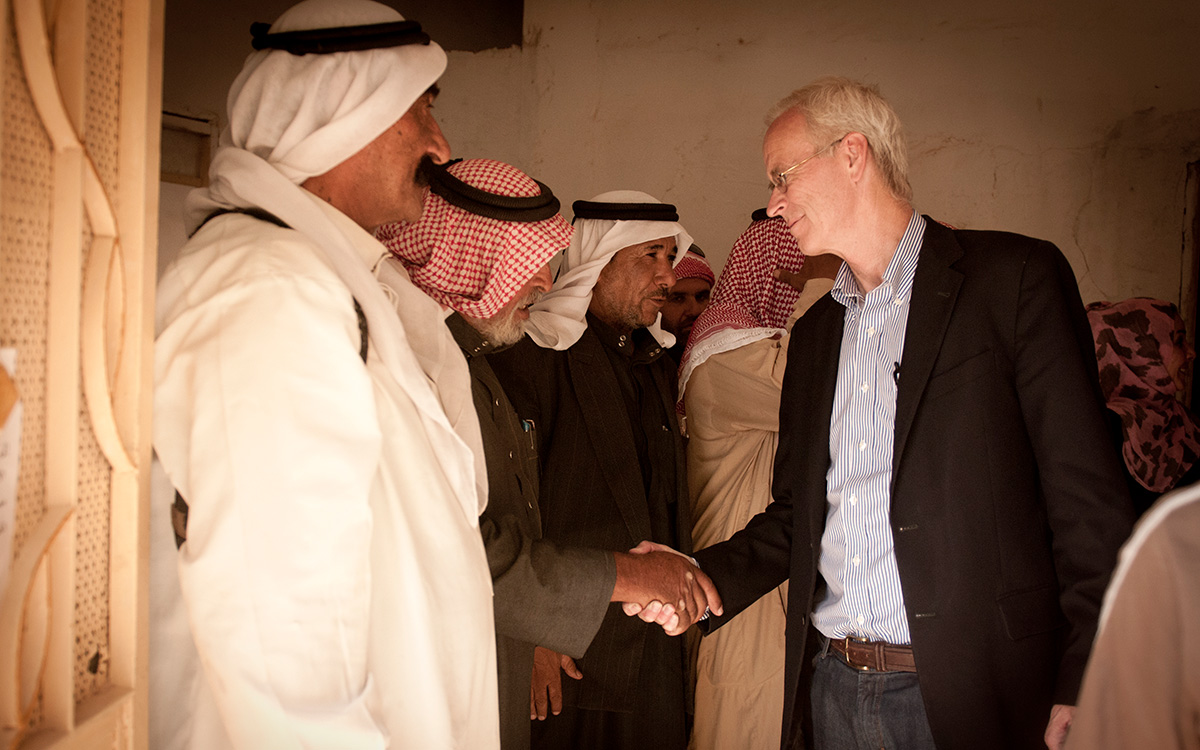
William Roebuck shakes hands with Suwar Civil Council Co-President Mushan Abdullah, in Suwar, Syria, August 26, 2018.
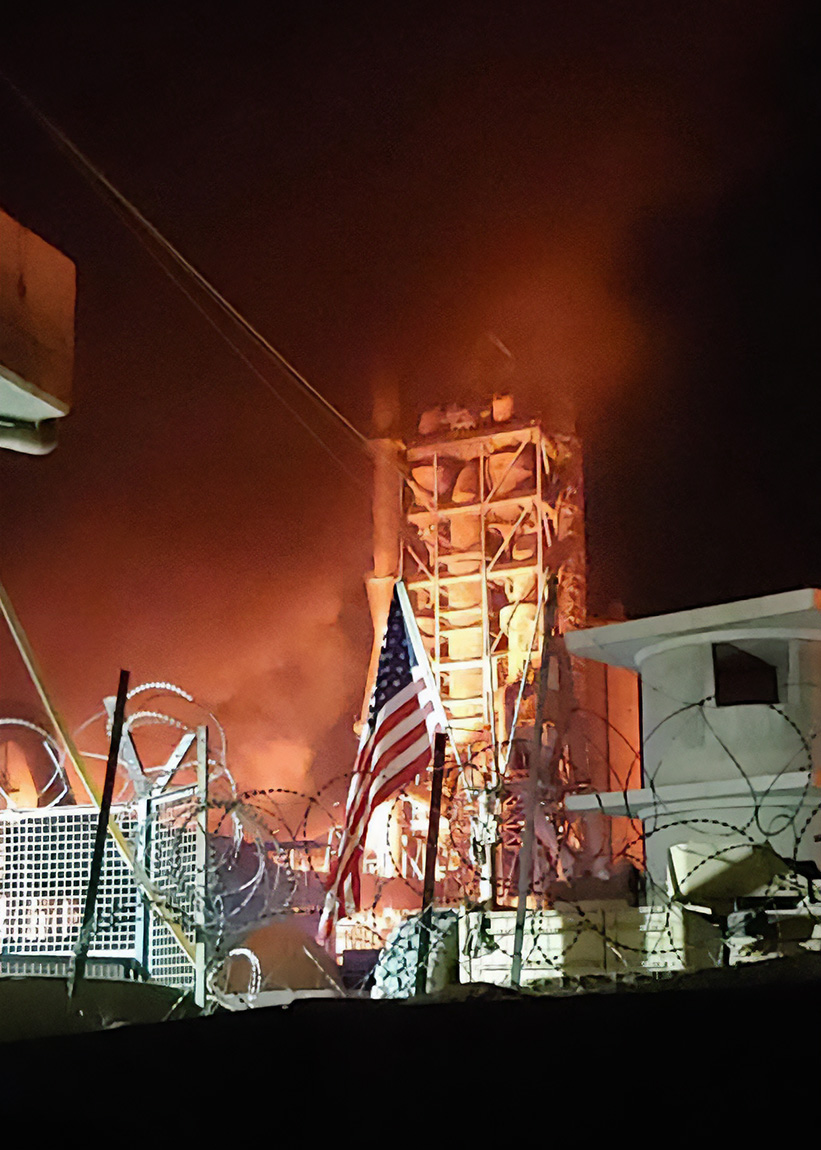
As invading Turkish-supported forces closed in in October 2019, a fire at the Lafarge Cement Factory compound, a U.S. military base in northeastern Syria, forced the precipitous withdrawal of all U.S. personnel. U.S. forces bombed the compound the following day to prevent its ammunition cache from being seized by the Turkish-backed forces.
Courtesy of William Roebuck
On a jet-black winter night the cold mud on the edge of the landing strip oozed over my ankles and seeped through my socks. It was January 2018 and my last assignment as a Foreign Service officer. A C-130 had just dropped me off in rural northeast Syria, where I would spend much of the next two years embedded with Green Berets and other Special Forces elements.
I quickly realized that I needed to put aside my current job title as a deputy envoy helping with the Global Coalition to Defeat ISIS (Islamic State of Iraq and Syria) and go back in time rapidly, to a time before my previous assignment as ambassador in Bahrain and before I worked in the interagency trenches in Washington. I would need to go back to earlier days when I was a more junior political officer assigned to U.S. embassies and reporting on unrest and turbulence, elections and political maneuvering, in volatile places like Baghdad, Tripoli, and Damascus and their far-flung hinterlands.
The work of a political officer is said to be a kind of “secret sharing,” to paraphrase the famous 19th-century writer Joseph Conrad. He had his own intentions for the phrase in his short story, “The Secret Sharer,” with its focus on the personal costs of exile, the rewards of professionalism in a demanding vocation, and the requirements of moral clarity in highly ambiguous, sometimes even duplicitous, situations.
For me, secret sharing usefully describes my efforts in the field over the years, recording my sense of the realities, possibilities, and personalities, and sharing that with Washington. Secrecy is a function of the discretion needed, and I was sharing my observations and insights with a small circle of readers in the State Department and another restricted circle of readers—“consumers” in proper bureaucratic parlance—in other U.S. government agencies.
As I ventured professionally far outside the confines of working in an embassy during that “Wild West” twilight assignment, I combed back through my Foreign Service career to draw on the fundamentals of my life’s work.
No Ordinary Diplomatic Assignment
The night we landed, I had been held up in the cargo bay (aka seating area) of the aircraft, thanking the pilot for the safe landing, executed with only night-vision goggles and on-board navigational equipment, in the absence of any runway lights. The brief delay—and the impressive darkness—explained the mud I stood in: The few hardy souls who disembarked before me had already found their way, via a graveled path, to a forlorn light several hundred yards distant, marking the tent that served as the arrivals terminal.
Not seeing the circuitous path or anyone to show me the way, I had struck out directly for the light (hence, the cold mud around my ankles). Finally, I reconnected with the hard-packed—if still very wet—ground of the dirt runway and made my way to the tent-pole terminal.
Several grizzled U.S. Special Forces guys greeted me without ceremony; we climbed into roughed-up armored Land Cruisers and headed down a small highway to the inelegantly named Lafarge Cement Factory military base. It was past 3 a.m. when the plainspoken master sergeant/mayor, in charge of the ramshackle base’s logistics, greeted me sleepily, gave me the Wi-Fi code, and showed me to my small trailer, delicately pointing out “the showers and the shitters” in the adjacent trailer as we passed by.
I lived on that sprawling, long-shuttered French cement factory complex. Its hulking, lifeless structures loomed above us as we made our way each day to the unpainted, plywood-walled, six-table café where we shared our meals. Some of us would also trudge to the still-dusty former storage depot turned weight room. Reporting logistics were similarly lean: I had a curtained-off cubby hole about the size of a broom closet, with a scuffed-up laptop, in a small warehouse-type facility retrofitted to sleep, at any given time, 10–15 hot-bunking special forces elements. The makeshift, spartan conditions served as a useful reminder that this was no ordinary diplomatic assignment: The U.S. had closed its embassy in distant Damascus years earlier and severed diplomatic relations with the Syrian government.
From that base, I radiated out on day or overnight trips. I visited Arab tribal chiefs in a remote farmhouse in the province of Deir a-Zour, near the border with Iraq, to check on recovery from the aftermath of war and urge them, despite war fatigue and frictions with other ethnic members of our local partner force, to continue supporting the U.S.-led fight against ISIS.
I spent time in the heavily damaged city of Raqqa with municipal officials who were working with a handful of State Department personnel to restore basic services, clear the tons of rubble in the streets left over from the titanic fight in the latter half of 2017 to rid the city of ISIS, and refurbish damaged schools and medical facilities.
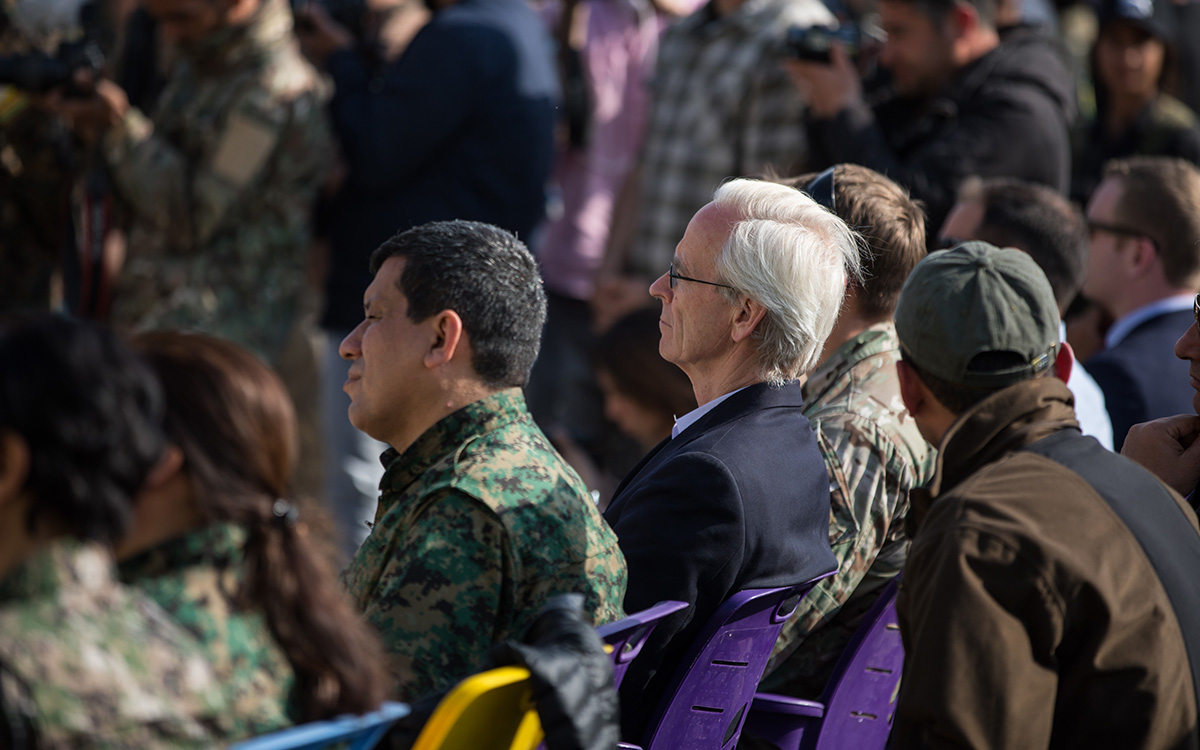
General Mazloum Abdi (center left), commanding general of the Syrian Democratic Forces, and William Roebuck (center right), deputy special envoy for the Coalition to Defeat ISIS, attend a liberation day ceremony marking the final surrender of ISIS forces in Syria at Omar oil field compound, Dayr al-Zawr, Syria, March 2019.
Staff Sgt. Ray Boyington / U.S. Army
Cold and Muddy Realities
On one such visit, as I walked the city’s streets, assessing the appalling levels of damage to the city’s homes and businesses, a local resident accosted me. “Why are you here?” he angrily demanded to know, as he eyed my security detail warily. Understanding I was an American diplomat, he followed up, rapid-fire: “Who did this?” He pointed to the vast destruction, adding: “Who will fix it?”
His barbed, rhetorical questions were not hard to decipher: He, like many locals, blamed the American side for a significant part of the horrific damage the city had suffered in the fight against ISIS. “The people of this city deserve respect,” he spat out, again speaking somewhat elliptically but making clear he thought the U.S. and the broader international community were refusing to adequately fund recovery efforts.
I dutifully shared this exchange with Washington and tried to describe the catastrophic damage, hoping it might convince policymakers that the relatively limited levels of assistance we were providing were insufficient and risked creating grievances and a political vacuum that ISIS could exploit for a resurgence.
Throughout my career, I usually had three goals in mind for political reporting: generally, keeping the State Department and broader U.S. government informed; occasionally, feeding State its “broccoli”—getting it to consume information I felt was good for the health of U.S. foreign policy; and sometimes trying to strengthen one side in an interagency tussle.
I was regularly reminded that policy (made in Washington) trumps reporting. I took refuge in the somewhat comforting corollary that information from the field and diplomatic realities on the ground help inform that policy, while also recognizing begrudgingly that policy was as likely shaped by budget constraints, security considerations, staffing gaps, interagency turf jousting, and domestic concerns tied to congressional and media scrutiny—all centered back in Washington and aloof from the cold mud of Syria.
Nonetheless, I continued sharing the information from my many contacts across northeastern Syria with Washington. Among my most important interlocutors was General Mazloum Abdi Kobani, the self-made Kurdish commander of the Syrian Democratic Forces (SDF) who formed and molded the SDF into a formidable fighting force against ISIS in 2015–2016. By the time I arrived in early 2018, ISIS and its accompanying family members were on the run, falling back to the more remote towns of Deir a-Zour province farther east, and over the next year and a half the general and I met often.
The Feeling of Betrayal
But in the fall of 2019, Türkiye was on the verge of invading Syria’s northeast, and General Mazloum felt betrayed and abandoned by the U.S. At our meeting in October, he was furious. Neighboring Türkiye’s military, with a ragtag Syrian proxy force lending a hand, had invaded and was attacking SDF positions all along the northern border. I was delivering what I knew to be threadbare talking points, noting to Mazloum U.S. diplomatic efforts in Ankara for a ceasefire but offering no U.S. assistance to his forces under attack.
“You are leaving us to be slaughtered,” he told me. “We partnered with you in good faith, and this is what we get in return?” I absorbed the blast of his anger in a couple of meetings. I had worked closely with the SDF leadership and knew in detail how valuable their contributions had been to the bloody fight against ISIS.
I took refuge in the somewhat comforting corollary that information from the field and diplomatic realities on the ground help inform that policy.
As it happened, there were other meetings. Tempers calmed, and the tough business of diplomacy and cold calculation took precedence for Mazloum. In the end, we weathered the storm. President Donald Trump decided against withdrawing U.S. forces from Syria, and those of us, military and civilian, who stayed behind were able to repair the relationship with the SDF relatively quickly once a U.S.-Türkiye negotiated ceasefire tamped the fighting.
Somewhere along the way, however, my conversation with Mazloum had been leaked, with a transcript ending up on CNN. The whole world could read of Mazloum excoriating me and the U.S. government. Separately, an informal dissent message I sent to Washington, objecting to what I perceived as a weak, inconsistent U.S. response to the Turkish military offensive into northeast Syria, was leaked and ended up on the front page of The New York Times. I made clear I had not leaked the message, nor had I made any public comment. The furor over my memo died down fairly quickly, as the relentless U.S. news cycle powered on by.
This was secret sharing taken to a new—and uncomfortable—level.
Empathy and Craft
While I liked General Mazloum and his commanders and the Syrian Kurdish politicians who supported him, it wasn’t always a natural instinct to empathize, to try to see the world as they did and put myself in their shoes. They were heavily influenced by a rigorous ideology, termed “Ocalanist” after its original and still influential proponent, Abdullah Ocalan, the Kurdish founder of the PKK (Kurdistan Workers’ Party) who had been imprisoned in Türkiye since the late 1990s. The ideology and the hermetic, somewhat cult-like bureaucratic practices it spawned struck most Westerners who saw it in practice as strange, even jarring. But I knew that empathy makes you a more effective political officer; it is a fundamental aspect of secret sharing.
I vividly recall experiencing this during a midcareer posting to Damascus. In a chilly, spartan apartment in Douma, on the outskirts of Damascus, in winter 2006, I was talking quietly with Yassin, a well-known Syrian dissident who had spent 16 years as a political prisoner of the Assad government. He was analyzing the brutal, organized, relentless nature of the Assad regime and making clear there was no serious difference between the rule of the father, Hafez al-Assad, and the son, Bashar, who replaced him when he died in 2000. In a matter-of-fact tone, Yassin described the horrors of prison, including Tadmour, the infamous desert prison from which he was finally released in 1996. He noted he had been a medical student in Aleppo, with aspirations to become a doctor, when he was first arrested and sent away to the Syrian gulag, shattering his professional prospects.
What struck me, overwhelmed me even, when I left that first meeting, was a sense that I had been in the presence of a powerful moral witness, a dissident of high order, who had completely preserved his humanity, intellect, and modesty in a sustained confrontation with brutality and oppression. As the embassy driver ferried me home in the cold night, I sat quietly in the back of the car, shaken and humbled.
The meeting with Yassin brought out a sense of shared experience that emerged from the conversation and the charged effort afterward to write about it persuasively. The participation takes place on the level of empathy: active listening, a willingness to see the world from the perspective of others. The professional craft of good writing captures and shares that encounter so that it resonates for others.
I had already begun to identify empathy as a crucial quality in my very first assignment as a political officer, working out of the U.S. consulate in Jerusalem in the late 1990s. It was a schizophrenic reporting mandate: Jewish settlements and Palestinian political developments in the West Bank, territory Israel had occupied since prevailing in the ’67 war. I visited settlers in Hebron one day and Palestinian activists, Fatah party politicians, and Palestinian Authority security figures in the tense southern West Bank city the next.
Feeling empathy with Palestinians was not that hard; the challenge was not to get overwhelmed to the point you couldn’t report objectively. With the settlers, empathy was more challenging, but I strove to see their perspective and avoided the urge to argue. Washington wanted to hear their views and perceptions, not mine.
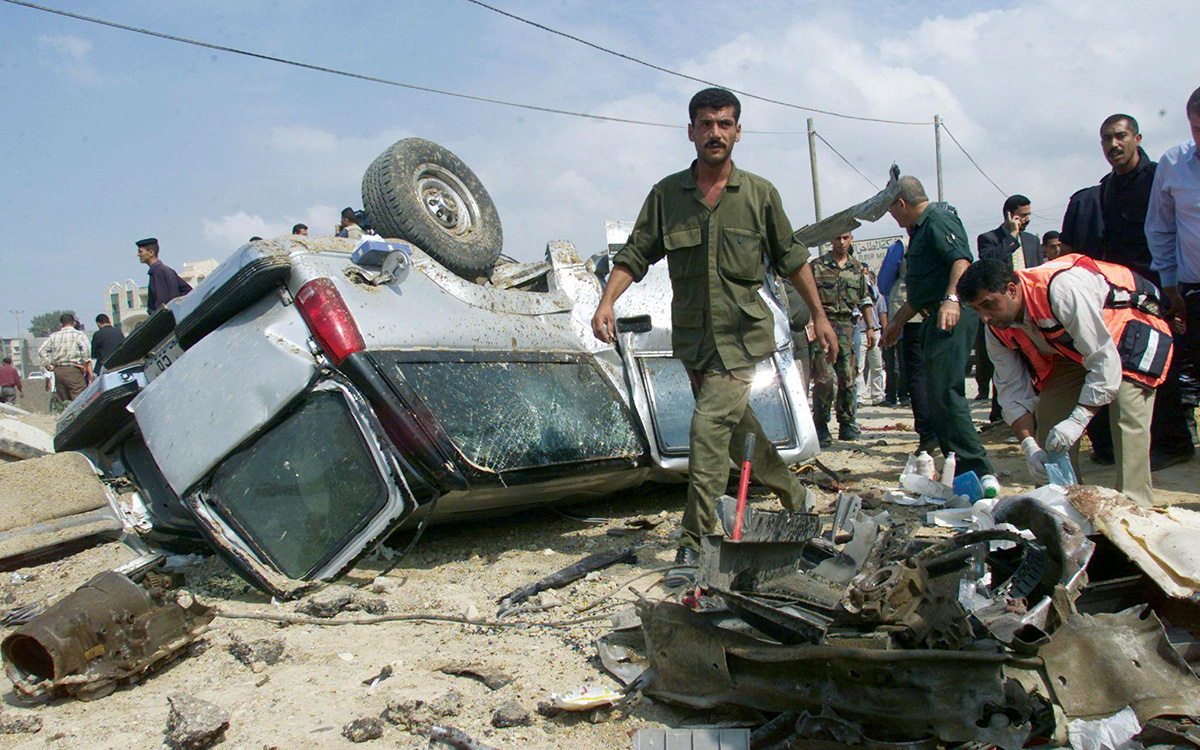
Political reporting from the field can involve serious risk. William Roebuck learned this very early in his career, when he was Gaza political officer, during a routine trip from Israel into Gaza territory on October 15, 2003. Suddenly, near the village of Beit Hanoun, there was a loud explosion just behind the lead vehicle in which he was riding. Radio contact was lost, and the driver made an immediate U-turn. This is what they saw: four tons of SUV steel flipped upside down in a crater in the road and piles of mangled parts and debris. Three members of Roebuck’s security detail were killed, and a fourth seriously injured.
Mahmud Hams
A Professional Commitment
Finally, the work of secret sharing requires a commitment forged in professionalism, a shared sense of mission, and pride of service because there can be costs involved, and they can be exacting. I learned this during a routine trip into Gaza in October 2003 as Gaza political officer.
After crossing from Israel into the territory in a small convoy of heavily armored Suburbans, there was an explosion just behind the lead vehicle in which I was traveling. We lost radio contact. We made a U-turn and looked across the median: Four tons of SUV steel had been flipped upside down and left in a crater in the road. Three members of my security detail were dead, and a fourth was seriously injured in the attack. It was a painful, permanently searing reminder of the risks—and human costs—at stake in continuing to be active out in the field as diplomats in the Middle East.
Now, in having worked my way back to the beginnings of my Foreign Service career, I realize that I learned my first lessons about secret sharing as a youth growing up in the South I loved and hated in the 1960s and 1970s: Keep your eyes open to the world, have some empathy, despise injustice and racism, and embrace reserve and a sense of modesty about one’s own society.
Implicated in and increasingly estranged from a history drenched in racism, violence, and tattered remnants of Jim Crow, I eventually went abroad, joining the Peace Corps and teaching English overseas. It took some years abroad, an exile of sorts, and the opportunity as an FSO to forge that volatile mix into my vocation as a secret sharer. I’m not sure my political reporting ever changed the course of history, but I am deeply proud of my service to my country and feel that I have been repaid handsomely.
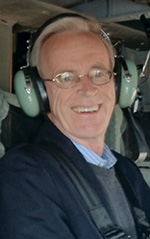
William Roebuck retired from the U.S. Foreign Service in November 2020. During a 28-year diplomatic career, he served as U.S. ambassador to Bahrain and completed postings in Jerusalem, Baghdad, and Tripoli; he also did political reporting in Gaza while posted in Tel Aviv. Ambassador Roebuck received the State Department Distinguished Honor Award for his work in Syria.
When sharing or linking to FSJ articles online, which we welcome and encourage, please be sure to cite the magazine (The Foreign Service Journal) and the month and year of publication. Please check the permissions page for further details.
Read More...
- “The Art of Political Reporting” by Dan Lawton, The Foreign Service Journal, July-August 2014
- “Hippocrates and Hobbes, Assad and ISIS” by Raymond Smith, The Foreign Service Journal, May 2016
- “Raqqa’s Inferno—A Diplomat Reads Dante in Syria” by William Roebuck, The Foreign Service Journal, May 2021