
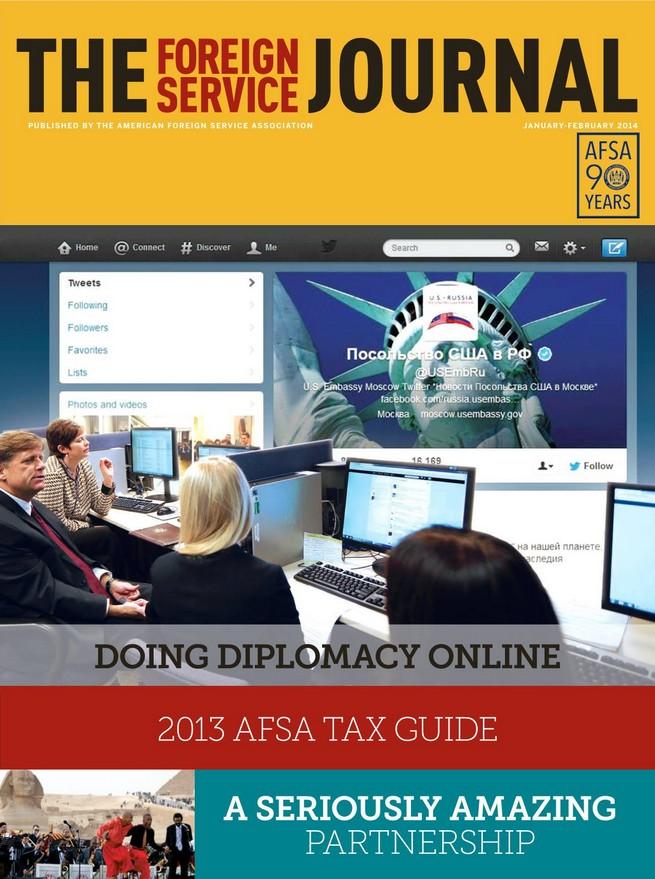
January-February 2014
The Foreign Service Journal covers foreign affairs from an insider's perspective, providing thought-provoking articles on international issues, the practice of diplomacy and the U.S. Foreign Service. Including the AFSA News section, The Journal is published monthly (January-February and July-August issues combined) by the American Foreign Service Association.
This month, FSJ takes a look at the ever-changing landscape of social media and the Foreign Service. Using Russia as a case study, Robert Koenig, a Foreign Service Officer at the U.S. Embassy in Moscow shows us how the embassy staff -- especially the U.S. ambassador -- reach out to Russians through Twitter, Facebook and other social media vehicles. In Success and Growing Pains: Official Use of Social Media at State, University of Pittsburgh graduate student Jesse Smith looks at the profound effect digital technology is having on diplomacy. AFSA’s Director of New Media Ásgeir Sigfússon reports on the association’s experience in the growing world of social media, and FSO Ben East offers a light look at what happens when Twitter meets the State Department bureaucracy in This Is How We Tweet.
Elsewhere in the issue, AFSA President Robert Silverman kicks off the 90th anniversary of AFSA and the Foreign Service with his column, The Foreign Service at 90: Future-Oriented, with Traditional Strengths. Senior FSO Beatrice Camp explores the great potential for cultural and scientific diplomacy through the State Department-Smithsonian partnership, and this issue’s Foreign Service Heritage department features FSO Gerald Loftus writing about the enigmatic J. Rives Childs. And in Jasmine and Lilacs Ray Peppers reflects on the charged atmosphere of Dhaka in 1967.
We always welcome short, focused letters about FSJ content; please send them to journal@afsa.org.
FOCUS ON SOCIAL MEDIA AND THE FOREIGN SERVICE
Using ‘Social Diplomacy’ to Reach Russians
Utilizing new media in public diplomacy is vital in countries like Russia, where government control of most broadcast media often distorts the message from Washington.
Success and Growing Pains: Official Use of Social Media at State
Digital technology, incorporating the most recent developments in social media and mobile applications, is having a profound effect on diplomacy.
AFSA's Social Media Roundup
Changing times call for changing attitudes toward member engagement. Here is a report on AFSA’s first four years of experience in the growing world of social media.
FEATURE
Side by Side by the Smithsonian
The potential for cultural and scientific diplomacy via the State-Smithsonian partnership is, as the Smithsonian brand states, “Seriously Amazing.”
FS HERITAGE
J. Rives Childs in Wartime Tangier
Despite the wealth of material generated by and about U.S. diplomat J. Rives Childs, he remains an enigma a quarter-century after his death.