Linda Thomas-Greenfield is the 2025 recipient of the AFSA Award for Lifetime Contributions to American Diplomacy
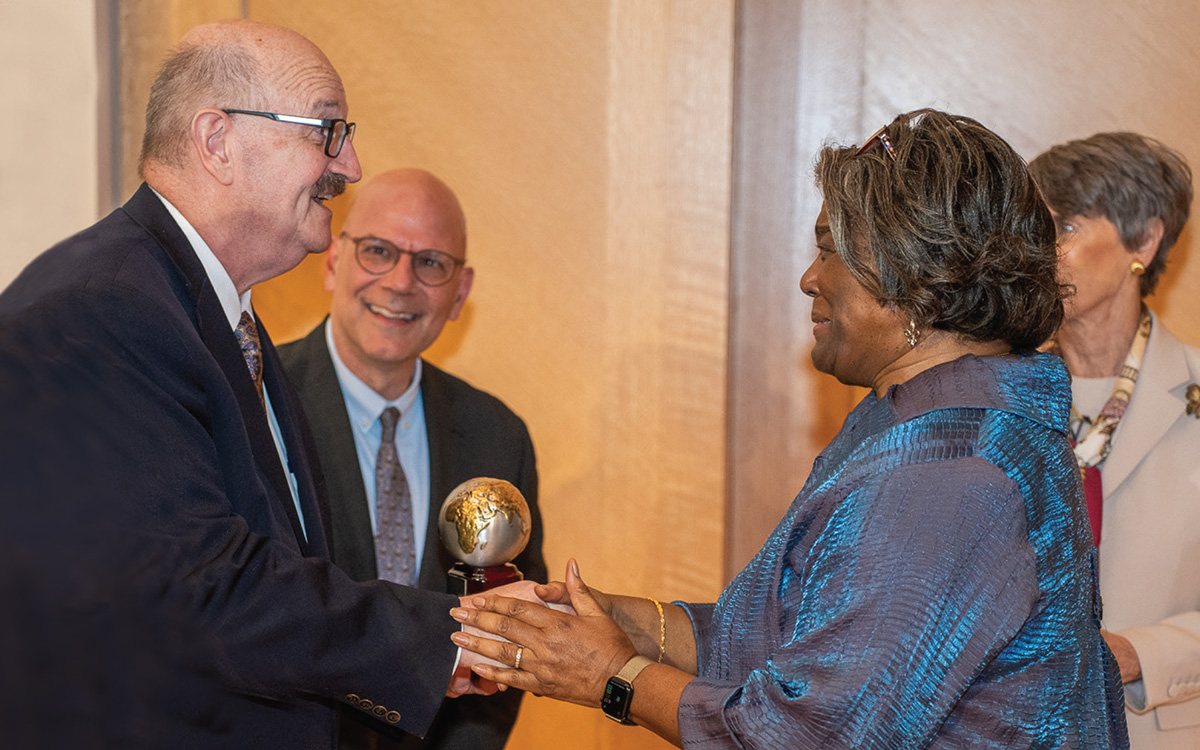
Ambassador Linda Thomas-Greenfield receives AFSA’s 2025 Award for Lifetime Contributions to American Diplomacy from AFSA President John Dinkelman on October 1, 2025, at Georgetown University. From left: Dinkelman, Dean of the Edmund A. Walsh School of Foreign Service Joel Hellman, Thomas-Greenfield, and Director of the Institute for the Study of Diplomacy Ambassador Barbara Bodine.
AFSA / Joaquin Sosa
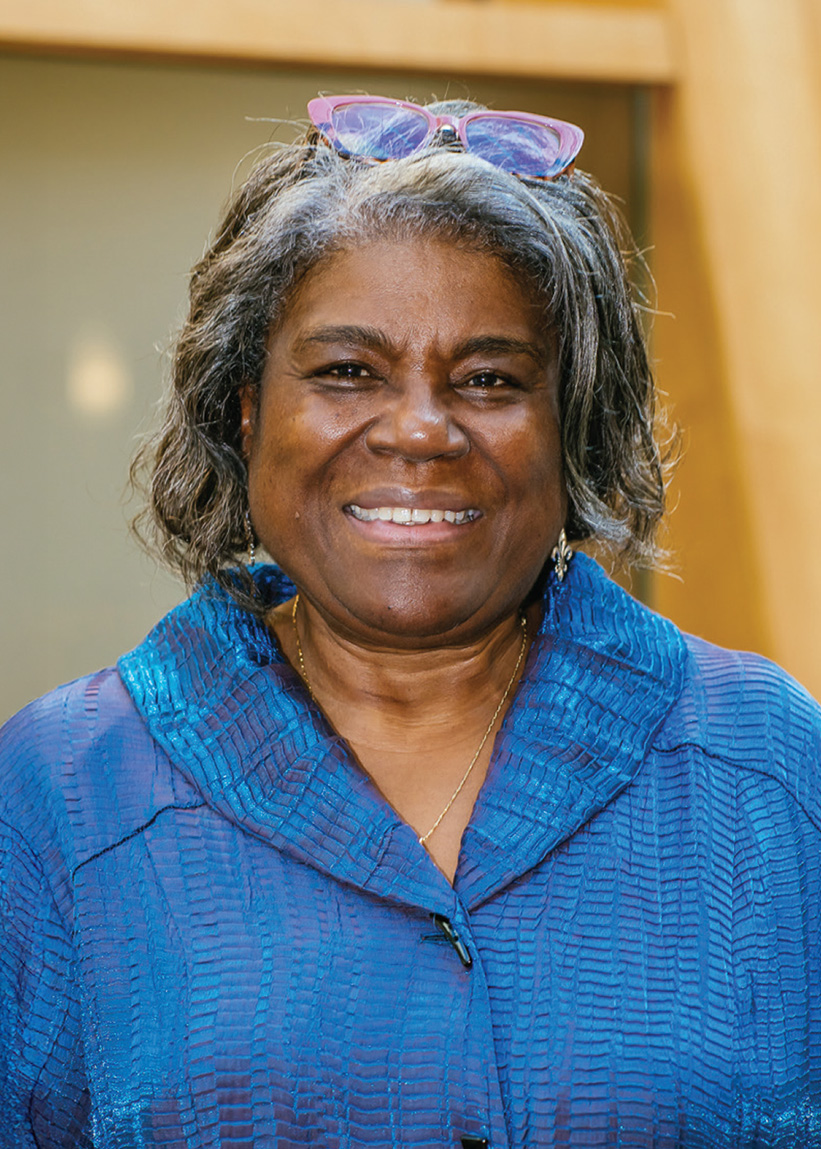
Ambassador Linda Thomas-Greenfield
AFSA / Joaquin Sosa
Ambassador Linda Thomas-Greenfield became the 31st winner of AFSA’s Lifetime Contributions to American Diplomacy Award in an October 1, 2025, ceremony at Georgetown University. She was honored for her deep commitment to the Foreign Service, mentorship, and leadership throughout an eminent diplomatic career, and for her continuing work to promote American global leadership, a strong Foreign Service, and State Department improvement.
AFSA’s highest tribute, the Lifetime Contributions to American Diplomacy Award is given annually to recognize an individual’s lifetime devotion to the work of diplomacy and to its practitioners. Past recipients include such luminaries as George H.W. Bush, Thomas Pickering, Ruth A. Davis, George Shultz, Richard Lugar, Joan Clark, Ronald Neumann, Nancy Powell, William C. Harrop, Thomas Boyatt, Edward Perkins, John D. Negroponte, Anne Patterson, and Marc Grossman.
As a career diplomat from 1982 to 2017, Linda Thomas-Greenfield had a wide range of important assignments for six presidents, both Republican and Democrat. She served as Assistant Secretary of State for African Affairs (2013-2017), where she led U.S. policy development for sub-Saharan Africa and played a critical role in the U.S. response to Ebola. And she served as Director General of the Foreign Service and Director of Human Resources (2012-2013), overseeing the department’s 70,000-strong workforce.
In 2008 Thomas-Greenfield was named U.S. ambassador to Liberia, where she served until 2012, supporting programs that rebuilt the country’s social and physical infrastructure and restored the rule of law. Other notable overseas roles include postings in Switzerland, Pakistan, Kenya, The Gambia, Nigeria, and Jamaica. In Washington, D.C., she also served as Principal Deputy Assistant Secretary in the Bureau of African Affairs (2006-2008) and as Deputy Assistant Secretary in the Bureau of Population, Refugees, and Migration (2004-2006).
Most recently, Thomas-Greenfield served as the U.S. ambassador to the United Nations (UN) and U.S. representative at the UN Security Council (2021-2025), called out of retirement to do so. She also served as a member of the president’s Cabinet and the National Security Council during that time.
At the United Nations, Amb. Thomas-Greenfield undertook a robust agenda to help restore and strengthen American global leadership and mobilize the international community to address global challenges. As part of her work, she rallied bipartisan and worldwide support for Ukrainian sovereignty and held Russia to account for violating international laws and norms.
She secured establishment of the Multinational Security Support Mission in Haiti (now the Gang Suppression Force) to address gang violence and restore long-term stability. She highlighted the need for increased humanitarian aid to Gaza while emphasizing Israel’s right to self-defense after the October 7, 2023, events. Additionally, she highlighted the urgency of the crisis in Sudan, mobilizing aid and personally assessing the humanitarian response during a trip to Chad.
Amb. Thomas-Greenfield is widely regarded as a trailblazer in the foreign affairs community. When she joined the U.S. Foreign Service in 1982, few Black women were in its ranks. She grew up in segregated Louisiana, the eldest of eight children to hardworking but poor parents, and became a first-generation high school graduate in 1970. She graduated from Louisiana State University in 1974, one of the few Black students in her class. She went on to earn a master’s degree in public administration in 1975 at the University of Wisconsin (UW), where she also pursued doctoral studies, and then taught political science at Bucknell before joining the Foreign Service.
Thomas-Greenfield is known for her relationship-building and problem-solving acumen and her leadership skills. In the course of overcoming challenges in her life and career, she developed what she calls “adversity muscles,” namely the ability to grow stronger in the face of hardship. She also learned to lead with kindness and compassion, and in her remarks at the AFSA ceremony, she called her unique approach “gumbo diplomacy,” which emphasizes building relationships through shared experiences—much like the process of creating the classic Louisiana dish. “Treating people well matters,” she says. “It will outlive the work we do.”
Over the years, her strong community outreach and ability to connect with locals earned her the accolade “The People’s Ambassador” by local media in Liberia. “She has never met someone she cannot turn into a friend,” Senator Chris Coons (D-Del.) observed during Thomas-Greenfield’s January 2021 confirmation for the post of ambassador to the United Nations, adding: “She is also battle tested and tough as nails, having overseen our responses in nations to some of the most complex and grinding crises in the world.”
In retirement, Amb. Thomas-Greenfield joined the Albright Stonebridge Group as head of the Africa Practice and served as Distinguished Resident Fellow in African Studies at Georgetown University’s Institute for the Study of Diplomacy (2017-2019). She also co-chaired an advisory committee for the Council on Foreign Relations special report, “Revitalizing the State Department and American Diplomacy” (2020). Based on her own experience, she believes the U.S. Foreign Service should better reflect America and find strength in diversity.
Throughout her Foreign Service career, as well as in retirement, Amb. Thomas-Greenfield has also been a devoted mentor, sharing her passion for diplomacy, her appreciation for the support of her own mentors, and her insight into overcoming challenges with young colleagues, students, and potential future diplomats. She credits her experience at UW for preparing her to succeed on the world stage, citing the school’s academic rigor, its international reach, and the ways it pushed her beyond her comfort zone—and she remained connected to the campus and its students throughout her career, returning often to speak and participate in various programs.
Amb. Thomas-Greenfield is the recipient of the Secretary’s Distinguished Service Award and other State Department honors. She is married to Lafayette Greenfield, a retired Foreign Service specialist, and the couple has two grown children, daughter Lindsay (a former Foreign Service specialist) and son Lafayette, known as “Deuce” (an attorney), and three grandchildren, Lydia, Luca, and Lola.
Following are the ambassador’s responses to our questions.
—Editor in Chief Shawn Dorman
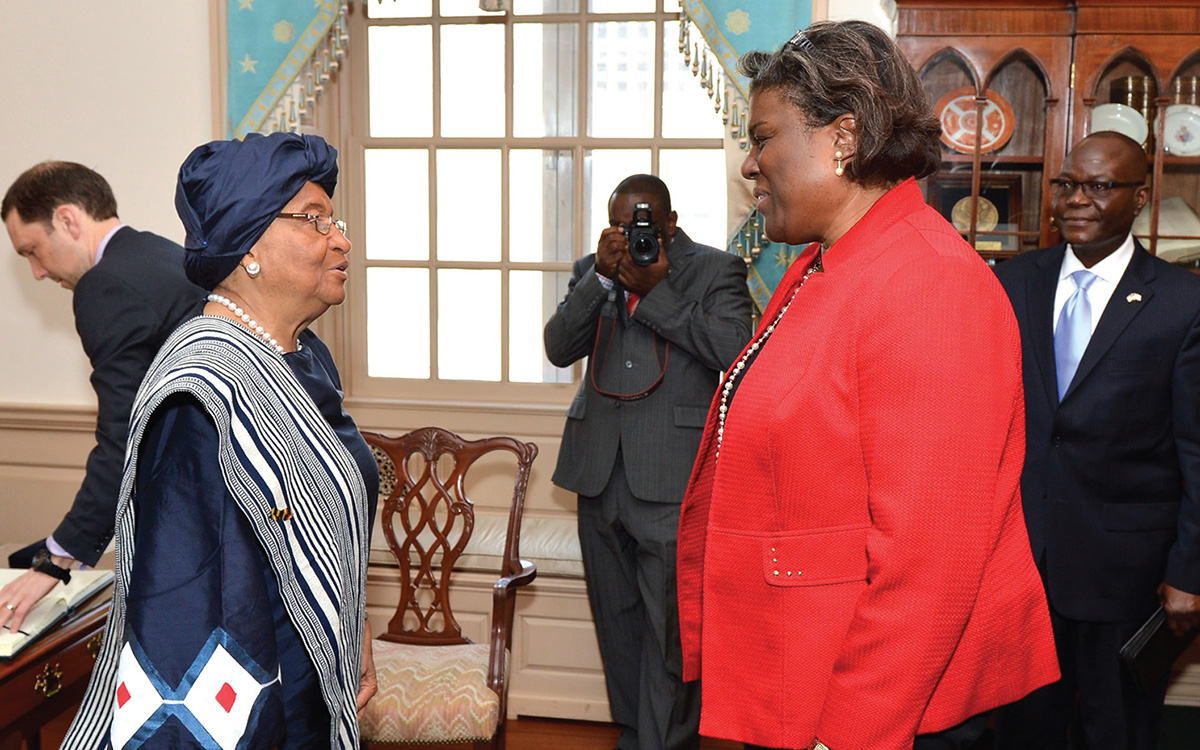
Assistant Secretary of State for African Affairs Linda Thomas-Greenfield greets Liberian President Ellen Johnson Sirleaf before her meeting with U.S. Secretary of State John Kerry at the U.S. Department of State in Washington, D.C., on February 27, 2015.
U.S. Department of State
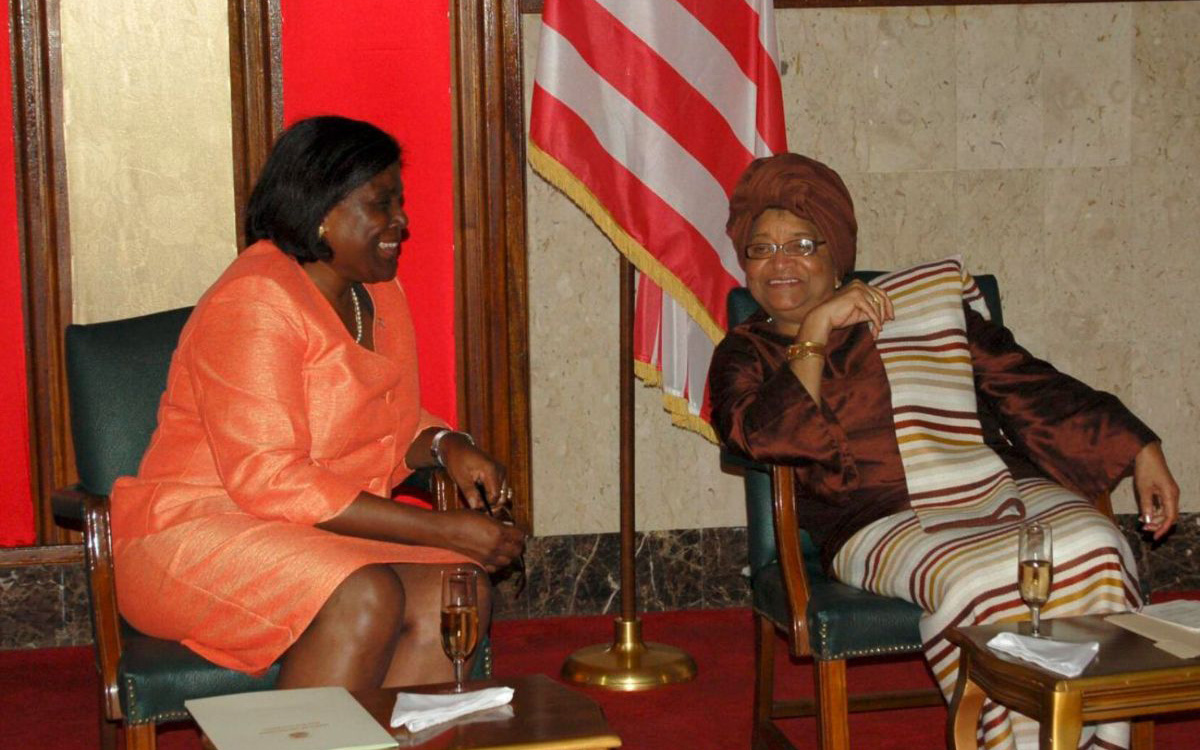
Ambassador Linda Thomas-Greenfield and President Ellen Sirleaf enjoy a private chat in Monrovia. Thomas-Greenfield served as U.S. ambassador to Liberia from 2008 to 2012.
U.S. Department of State
Foreign Service Journal: Congratulations on being the 2025 recipient of AFSA’s Award for Lifetime Contributions to American Diplomacy. This is so well deserved. Your remarks at the ceremony on October 1 were inspiring. Could you start us off here by saying a bit about what this award means to you personally and professionally?
Ambassador Linda Thomas-Greenfield: Thank you so much. I was so honored to receive this award. For me, it was an affirmation of all the work that I have done over my entire 40-year career in the Foreign Service. It was also a recognition that to succeed in the Foreign Service, you don’t have to have a “normal” career, one that checks all the boxes to get to the top, because I did not check the boxes: I did work that was very people-centric. I did work that supported refugees. I did humanitarian work. I was told over and over and over again, every single time I took a position working on refugees, that I would not get promoted and that my career would be finished. Receiving this award affirms for me that the directions I took were the right directions for me.
FSJ: What was it like joining the Foreign Service in the early 1980s as a Black woman in a still largely white male institution like the State Department? Did you feel supported or isolated, and were there peers or mentors who helped you navigate in those early years?
LTG: When I came in in 1982, the State Department was being sued by women Foreign Service officers in Palmer v. U.S. Department of State and by Black Foreign Service members in Thomas v. U.S. Department of State. That Thomas was not me; it was Walter Thomas. But I felt a bit intimidated to come into service where the two identities that I represented were suing the organization I was joining. And I didn’t quite understand it.
You asked if I felt supported or isolated: I truly felt isolated. I felt that I was out of my depth seeing the backgrounds of many of the people who were at State with me. There were a lot who were Yale, pale, and male; but there were also a lot of women who were pale and Yale, and there were not a lot of people of color.
I came from Louisiana State University, a state college that didn’t really have a big name except for in athletics and football, so I was out of place and I was isolated. I eventually found my place. I found people I could relate to, and I had mentors who certainly helped me get through the first couple of years, which were extraordinarily difficult for me.
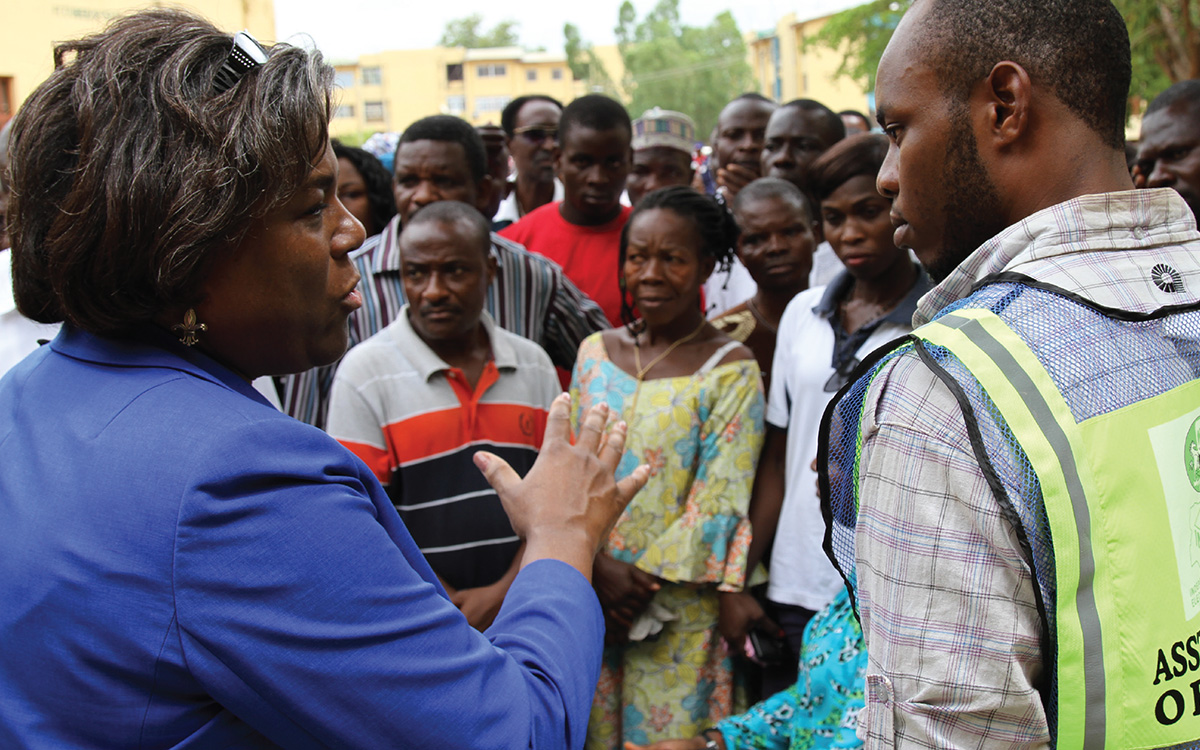
Assistant Secretary of State for African Affairs Linda Thomas-Greenfield speaks with an official from the Independent National Electoral Commission as voters wait to be registered at the Abuja Federal Capital Territory Area 1 polling center in Nigeria on March 28, 2015.
U.S. Department of State / Idika Onyukwu
Lessons in Leadership
FSJ: You subsequently held important roles at the department. Given your leadership in the Bureau of Population, Refugees, and Migration from 2004 to 2006, how do you view current efforts to shrink and restructure the bureau, and what advice would you offer to the administration on maintaining U.S. leadership on refugee issues?
LTG: You know, one of the things I was so proud of throughout my career—in particular during the period when I worked on refugee affairs, and that leadership role was my fifth refugee job—was the U.S. leadership in this area. I was committed to our programs and to the bipartisan promise that the U.S. made to refugees. So what is happening today is extraordinarily disappointing, and it’s almost alarming to me that we’ve gone from the country that was the most committed to refugees, with numbers up to 120,000 per year, to the country least committed to refugees, with plans to bring in only 7,500 in Fiscal Year 2026, prioritizing white Afrikaners from South Africa.
These numbers show the lack of caring and the real lack of commitment to supporting the people who are the most vulnerable, the most needy, in the world. That sends a message to the world that the United States is no longer there, that we no longer care about refugee issues.
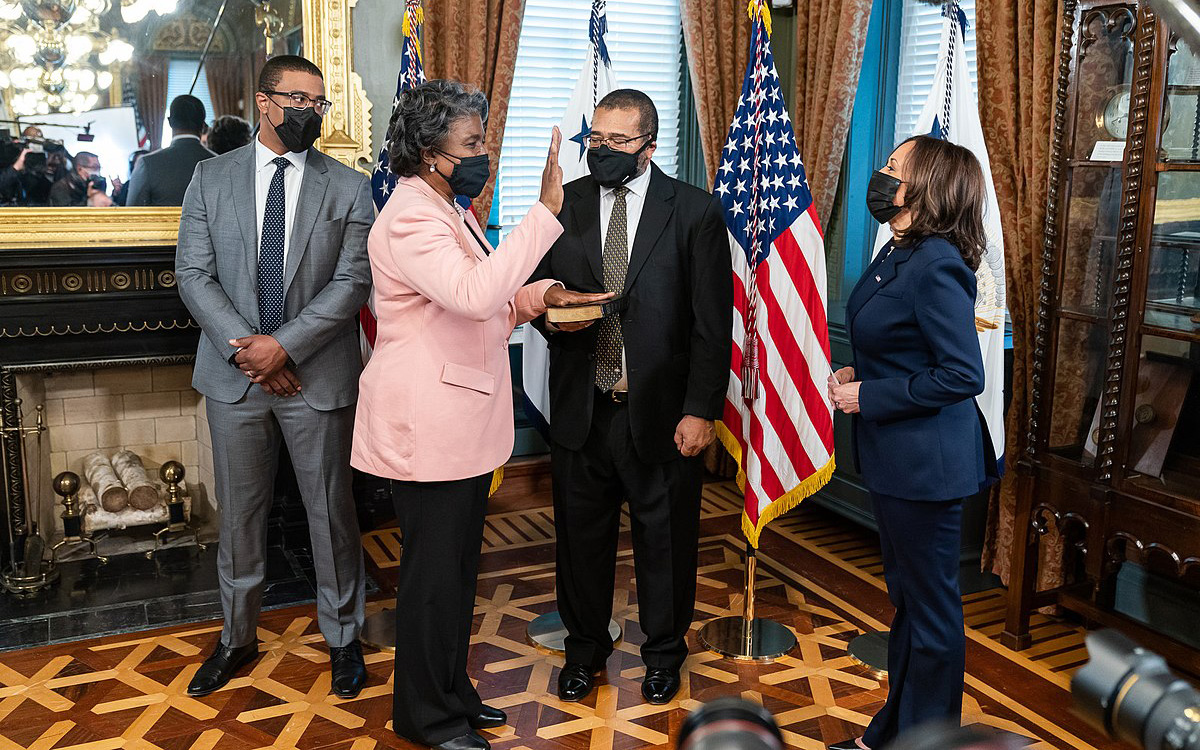
Vice President Kamala Harris swears-in Linda Thomas-Greenfield as U.S. ambassador to the United Nations, February 24, 2021, in the Vice President’s Ceremonial Office in the Eisenhower Executive Office Building at the White House.
White House / Lawrence Jackson
FSJ: You arrived back in Liberia in 2008 at a critical time in its postwar recovery. What are you proud of from that period, and what lessons did it offer for U.S. diplomacy in fragile states?
LTG: Well, let me just start by saying being ambassador to Liberia was a big deal for me. Most people don’t know that I lived and studied in Liberia in the 1970s. I met my husband in Liberia. He was already in the Foreign Service and was working at the embassy in Monrovia. And so going to Liberia as the ambassador 30 years after I had been there as a student doing research was the ultimate gift. I can’t even give you the words to describe my feelings when I received that appointment, and it came at a time when Liberia was still coming out of the ashes of a horrific civil war and people were still traumatized.
But Liberia had done something that no other country in Africa had ever done: They elected a woman as president, and I happened to know her, so I was really welcomed to Liberia with open arms. I went with a mandate from Secretary of State Condoleezza Rice, and that was to help the president and the people of Liberia succeed. With that mandate in my hand, I felt that I had to commit to doing a great job, and I tried my best to get to know all the people.
During my first year there, one of the local newspapers dubbed me “The People’s Ambassador.” It was a title I carried very proudly. “She doesn’t just sit in offices talking to government leaders,” they said. “She goes to the marketplace to meet with the market women, she goes to tea shops and talks to unemployed teachers. She goes to schools and talks to students. She’s the people’s ambassador.” So if there were any accomplishments, and there were many, I think for me, the most important was to be recognized as someone who cared about the people of Liberia. To have a job that allowed me to work with the extraordinary “Iron Lady,” President Ellen Johnson Sirleaf, and help her to help Liberia succeed, was the accomplishment of a lifetime.
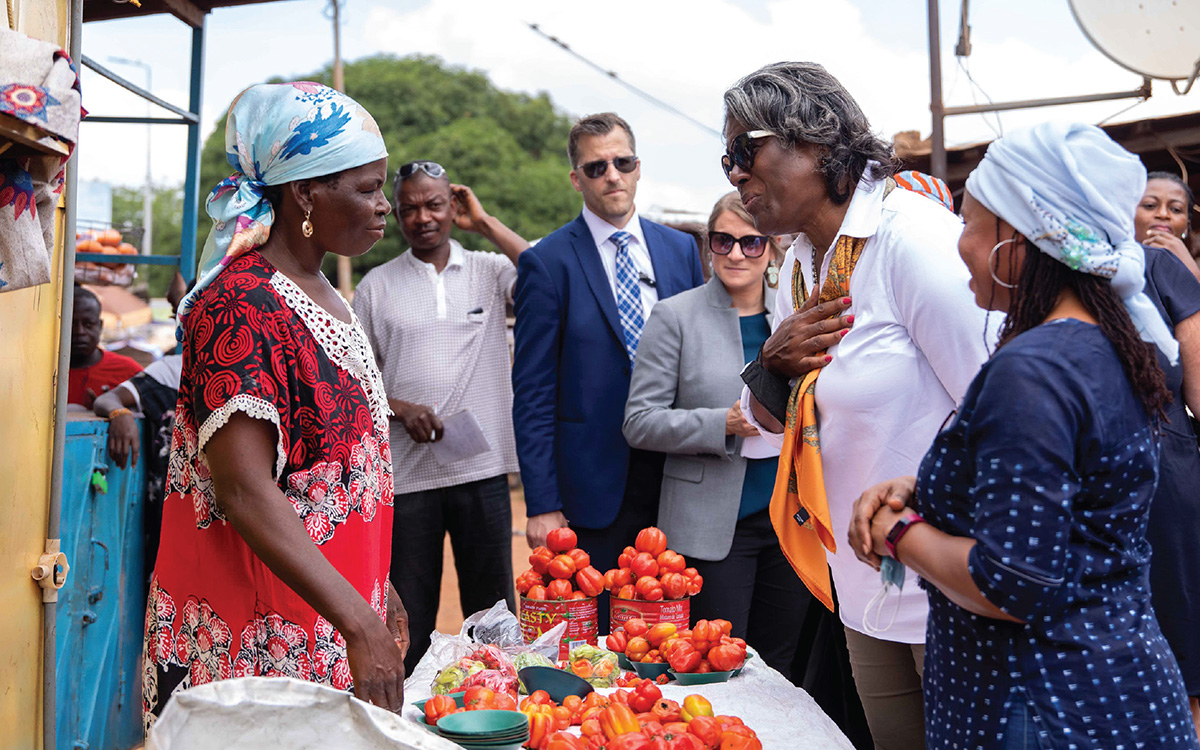
U.S. Ambassador to the UN Linda Thomas-Greenfield visited Ghana August 5-6, 2022, to discuss U.S.-Africa partnership, continued bilateral cooperation, and food security with government and civil society leaders.
U.S. Embassy Ghana / Archibald Sackey
Addressing a Crisis of Confidence
FSJ: Shifting now from your time in Liberia to your tenure as the 31st United States ambassador to the United Nations and as a member of President Joe Biden’s Cabinet [2021-2025]. What, in your view, should the new U.S. ambassador to the United Nations be focused on?
LTG: When I arrived in New York in 2021, I found a UN that was very uncomfortable about where the United States was as a member state. During the first Trump administration, the U.S. had pulled out of the World Health Organization. We had pulled out of the United Nations Educational, Scientific, and Cultural Organization. We had pulled out of the Paris Agreement. And we had pulled out of the Human Rights Commission. I was charged with rebuilding confidence in the United States’ commitment to the UN, and over the course of four years I think I was able to achieve that.
The new U.S. ambassador to the UN is walking a very, very tight rope of keeping U.S. leadership at the table and ensuring that our priorities are addressed—all while having a president who does not have confidence in the United Nations and has indicated in many conversations that the UN does not serve a purpose. I always advocated for a UN that is fit for purpose to deal with the crises of the world including Sudan, Gaza, and Ukraine. To do this, the United States must be at the forefront and in a leadership role, so the ambassador is going to have to figure out how to thread this needle that he has been given, to keep the U.S. in the forefront and also be loyal to the priorities of the president.
FSJ: Switching gears a bit, how can AFSA best serve the Foreign Service community at a time when its union status is under challenge?
LTG: AFSA is our representative. It is the organization that we look to in good times and bad times. We’re facing some very difficult times now, and it is more important than ever that AFSA be there for its members. We need AFSA. We need AFSA today, and we will need AFSA tomorrow.
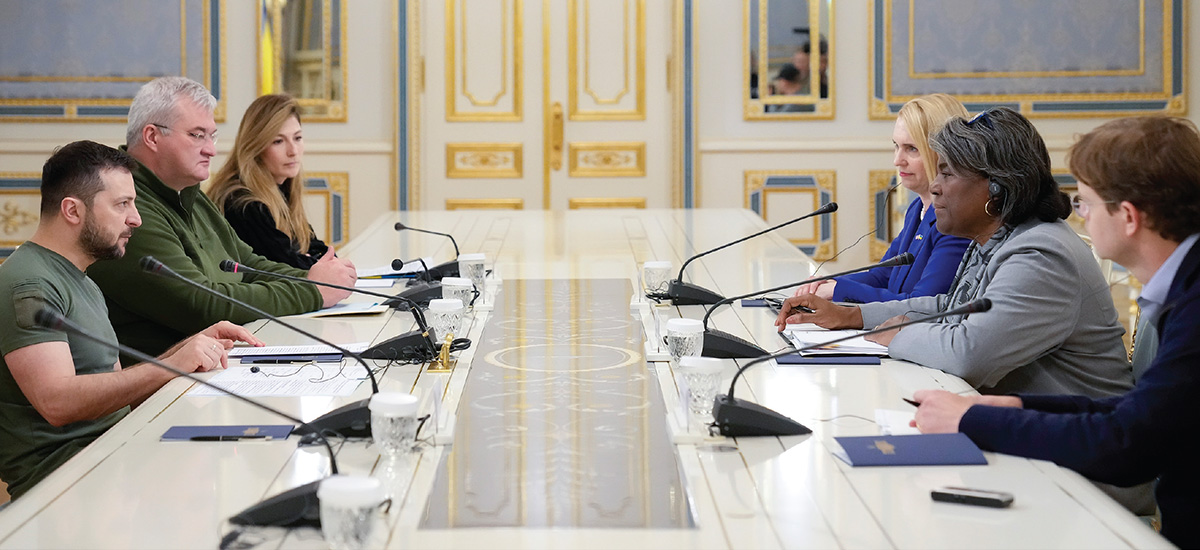
U.S. Ambassador to the UN Linda Thomas-Greenfield in talks with President Volodymyr Zelensky during her visit to Ukraine in November 2022.
U.S. Embassy Kyiv
The Role of Diplomacy and Diplomats
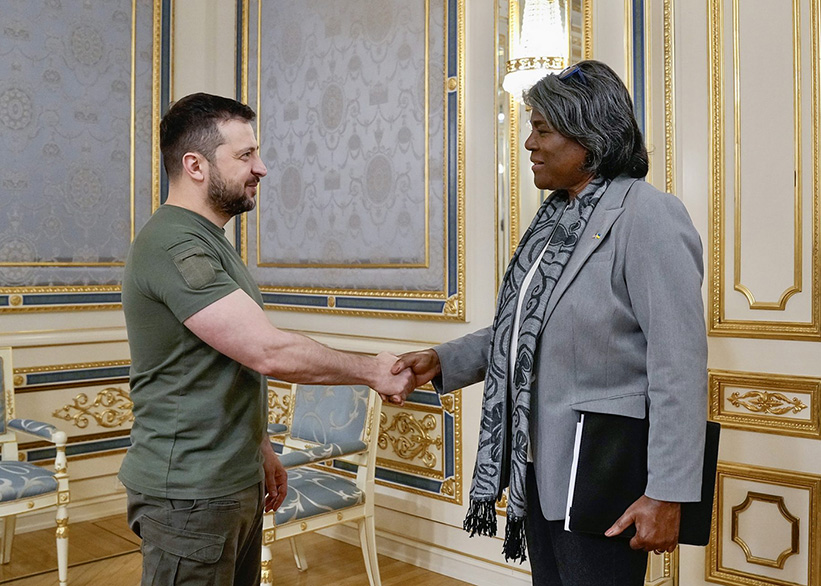
Ambassador Thomas-Greenfield greets President Zelensky.
U.S. Embassy Kyiv
FSJ: What do you wish more Americans understood about the role of diplomacy and the U.S. Foreign Service?
LTG: The truth is that most Americans don’t understand the role of the U.S. Foreign Service and most Americans don’t know what Foreign Service officers [FSOs] do to represent the United States overseas. They may find out if they’re traveling, but the vast majority of Americans are not traveling.
We are there to protect American citizens who are overseas. We’re also there to represent the interest of our government and our people. Many American farmers, for example, are dealing with issues of their products not being bought. It is diplomats, working with the leadership of the White House, who will address those issues with foreign countries.
Americans who travel overseas and get arrested know that they can depend on a U.S. diplomat. Earlier in my career as an FSO, I visited many American citizens who had been arrested and ensured that their rights were preserved. I assisted American citizens who had relatives pass away overseas and needed to start the process of transporting the remains of their loved ones back to the United States. If we’re not there, no one will take care of those issues for them; they are left to their own devices.
Finally, American companies, I think, do appreciate the role of U.S. diplomats overseas in terms of representing them and their interest with governments. I think it’s important that diplomats get out to their communities and talk about what they’re doing. We used to have a hometown diplomat program that the State Department sponsored. I don’t know if it’s still in existence, but that allowed for members of the Foreign Service to go home and tell people what they were doing.
I can tell you that nobody in Louisiana in my community would have a clue what diplomacy was—I don’t think most people I grew up with even had a passport—so I think I contributed a great deal in my home state and in my community in sharing the important role that U.S. diplomats overseas play for American citizens. And I think more can be done in that area. I think our Congress needs to be brought into the picture; we diplomats should be meeting with members of our state delegations to let them know what we’re doing and make sure they support the work of the Foreign Service in the future.
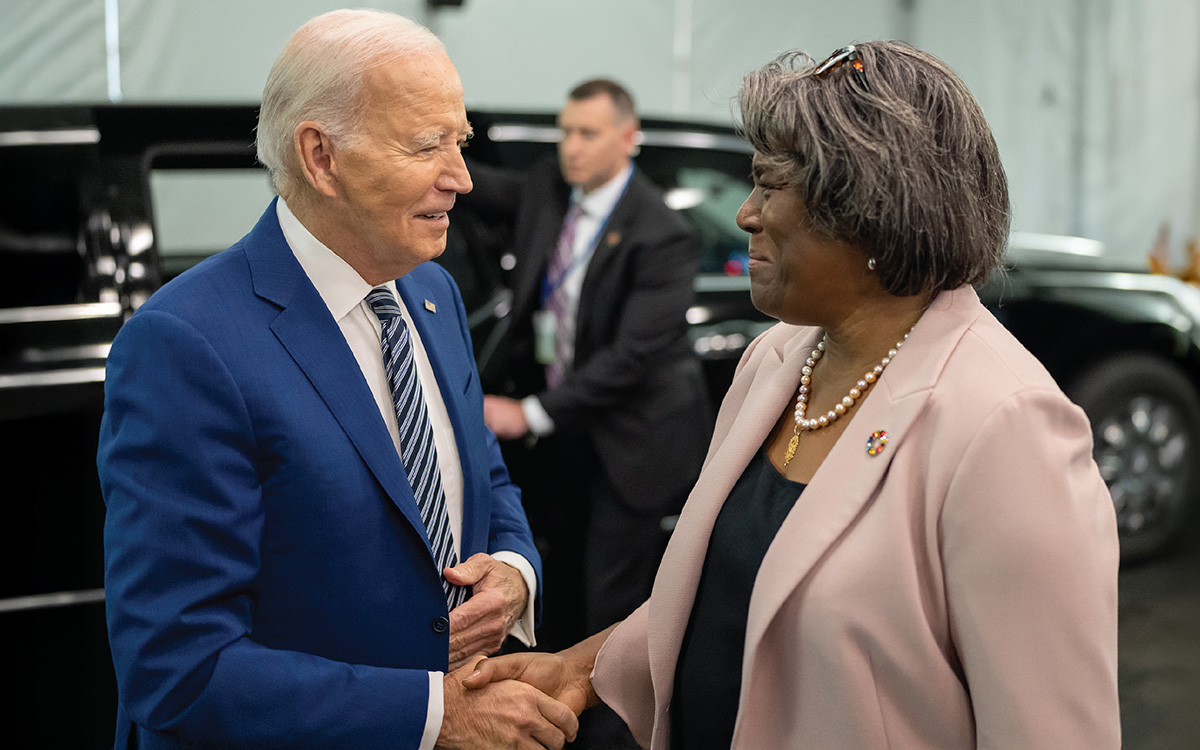
U.S. Ambassador to the UN Linda Thomas-Greenfield greets President Joe Biden at United Nations Headquarters for the UN General Assembly on September 19, 2023, in New York City.
White House / Adam Schultz
FSJ: I’m going to end by asking you to elaborate a bit on what qualities you believe the most effective diplomats possess?
LTG: That is an extraordinarily interesting question. I think in the old days, when you asked someone that question, they would want someone who was absolutely brilliant. They would want amazing writers. They didn’t necessarily look for people who understood people; they didn’t want managers.
Over my 40-year career, I’ve determined that people are the greatest tool in our diplomatic toolbox. When I served as the Director General of the Foreign Service and the director of personnel during the Obama administration, I got to really get out and see people doing their jobs in the field, whether it was the locally engaged staff [also known as Foreign Service Nationals] who work for us in the various countries we work in or whether it was our spouses and our children—because the Foreign Service is not just about the FSOs, it is about their families and the important role that they play as representatives of the American people to the countries that we are in.
So when I’m asked what the most important qualities of an effective diplomat are, I think it’s being able to communicate to the people you are working with and being able to share with them the important values that are a part of us as Americans. Those same diplomats are great writers, those diplomats are extraordinary intellectuals; but with all of that, they must be kind and compassionate and communicative to everyday people.
FSJ: Ambassador Thomas-Greenfield, thank you for sharing your candid responses, and congratulations again on being the 2025 recipient of AFSA’s Lifetime Contributions to American Diplomacy Award.
LTG: Thank you very much. I will always cherish this award.
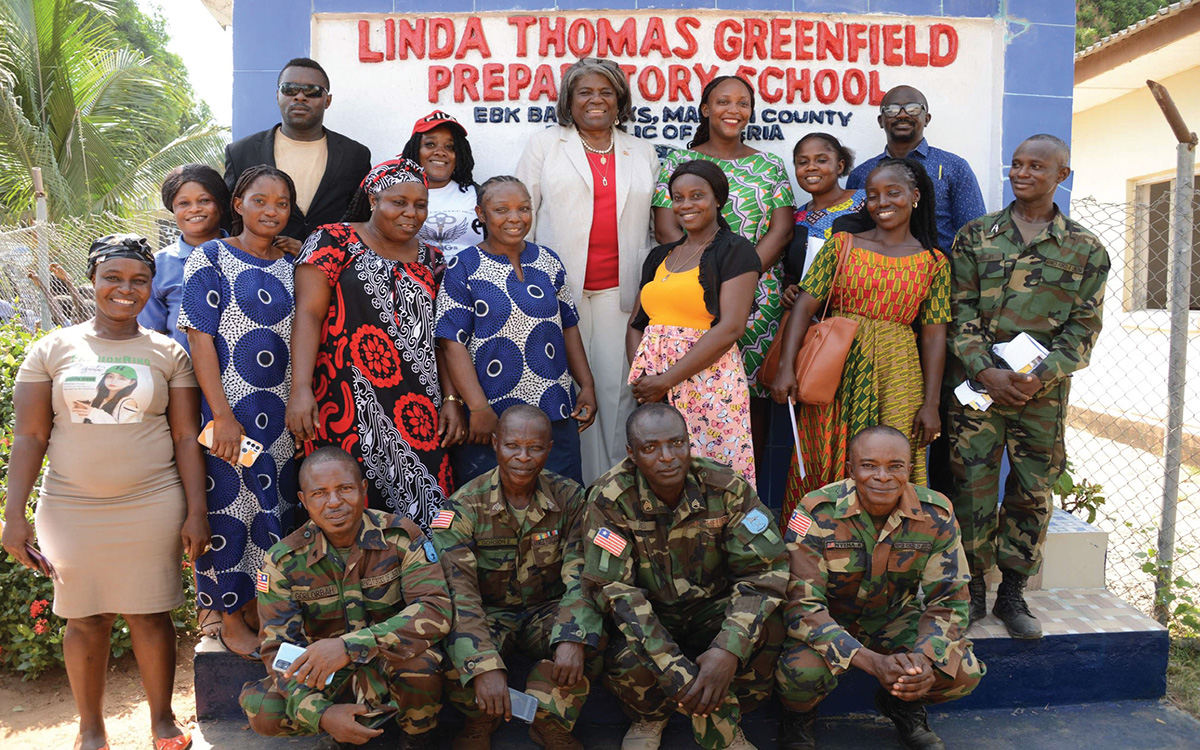
Ambassador Linda Thomas-Greenfield visits her eponymous school in Margibi County in Liberia, January 2024.
U.S. Embassy Monrovia
When sharing or linking to FSJ articles online, which we welcome and encourage, please be sure to cite the magazine (The Foreign Service Journal) and the month and year of publication. Please check the permissions page for further details.